
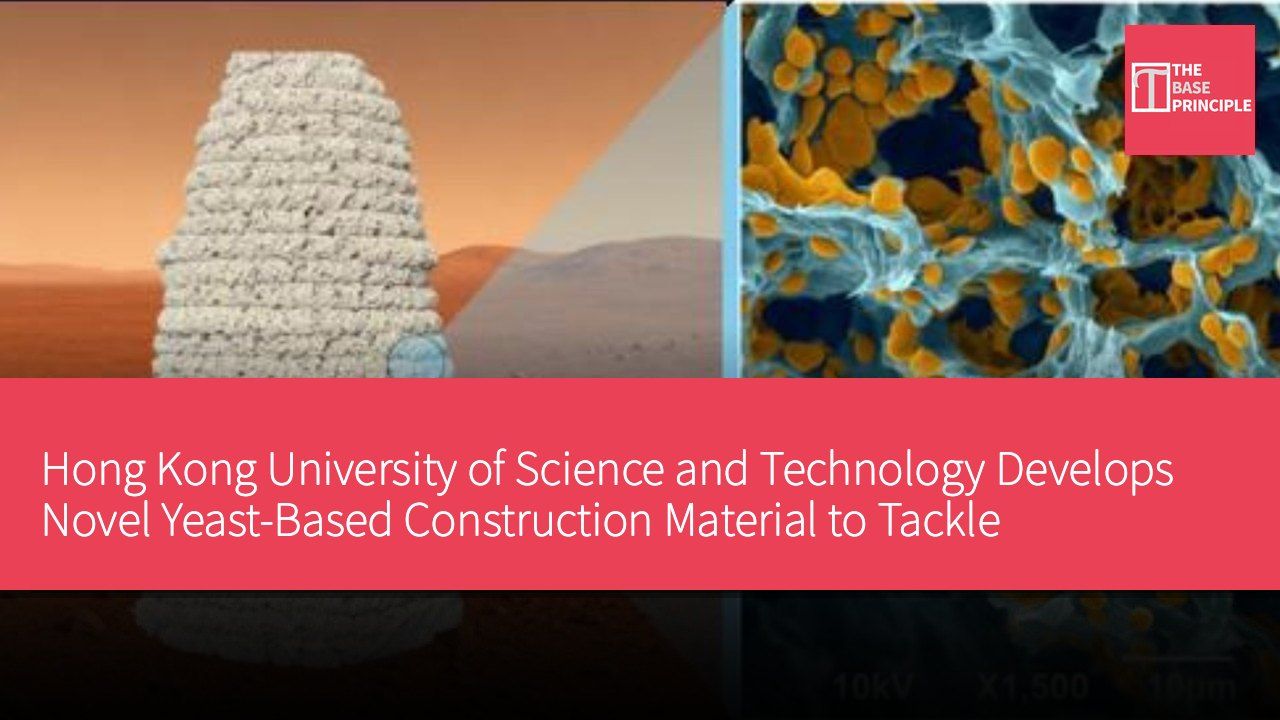
- Hong Kong University of Science and Technology develops a novel yeast-based construction material for Mars.
- The new material leverages Mars' extreme environment to reduce transportation costs.
- Tests show the material achieves strength comparable to low-grade concrete.
- The biological approach could create an eco-friendly system with reusable yeast cells.
If humans ever establish homes on Mars, yeast might become the most crucial item on the packing list. This is the conclusion of a new study from the Hong Kong University of Science and Technology, where researchers have unveiled a new biological formula for 3D printing living spaces on the Red Planet. This printable, bio-based construction material is designed for construction on Mars.
The challenges of building homes on Mars are well known. The atmosphere is nearly a vacuum, the radiation is lethal, and temperatures plummet to despairingly low levels. Transporting heavy construction materials like steel or concrete millions of miles into deep space is economically unfeasible. Most previous proposals suggested using extreme heat to melt Martian soil into bricks, but this requires vast amounts of energy, which early settlers would lack. Now, civil engineer Professor Kaimin Shih and his team wondered if engineers could harness Mars' harsh climate instead of fighting the planet's extremely low temperatures.
Inspiration and Creation of the New Material
Professor Shih explained, "My inspiration came from freeze-dried fruits becoming harder." Mars' environment acts like a "natural freeze-dryer." Sub-zero temperatures and negligible atmospheric pressure cause ice to sublimate directly into water vapor without melting. Shih used sand and a bio-glue (gelatin and engineered yeast) to create a printable material. The team coated the yeast with adhesive proteins inspired by marine mussels. The gelatin binds the mixture together and provides nutrients for growing cells, while the sand offers structural mass.
When printed under simulated Martian conditions, the cold vacuum instantly freeze-dried the wet compound. The ice transformed directly into water vapor, forming a lightweight, porous foam. The test domes currently produced by the team are about the size of a wine cork. Despite their small size, these structures achieved a strength comparable to low-grade concrete. Tests showed the bio-material's compressive strength could reach 10 to 12 megapascals. "So, this is actually enough to build a one- or two-story building on Earth because the gravity on Mars is one-third of that on Earth," Shih said.
"So, you could probably easily build multi-story buildings on Mars with this material."
The Potential for an Eco-Friendly System
However, further research is needed. Most space construction concepts use melting local rocks to make bricks, which consumes enormous amounts of energy. This biological method overcomes the high-heat processing requirement and creates an eco-friendly system. When buildings are no longer needed, settlers could dismantle them, harvest the live yeast cells, and recultivate them in bioreactors. Of course, challenges remain. Scientists still need to prove that yeast can survive real Martian radiation and atmospheric pressure. Early projects would also need to transport hundreds of tons of raw materials from Earth before full local production could begin.
Yet, the basic science is feasible. Shih stated, "I always ask myself: Is there any physical law or fundamental mechanism preventing us from doing this?" He noted, "Currently, I don't see any limitations. We are confident in scaling up production. If future Martian engineering materials are not as diverse as those on Earth, it will surprise me, and biology will certainly contribute."
It seems biology may be the blueprint for surviving on other planets. While yeast is a single-celled fungus, its filamentous fungal relatives (mushrooms) play a central role in NASA's Ames Research Center Mycotecture Off-Planet project. Scientists cultivate fungal mycelium (roots) around Martian soil simulants and organic waste. After baking and sealing, these growing structures form lightweight, fire-resistant, and radiation-shielding construction materials. The research findings were published in the journal Chem Circularity on September 10.
The Future Outlook for Yeast-Based Construction Materials
This study demonstrates the potential of bio-materials in extreme environments, particularly in Martian construction. The high transportation costs of traditional construction materials could be mitigated by the new yeast-based construction material, which can utilize local resources and reduce energy consumption. This aligns with the principles of sustainability and offers a more flexible construction solution for future space exploration. While challenges remain in ensuring yeast's survival in the Martian environment, this innovation provides new possibilities for humans to establish homes on other planets.