
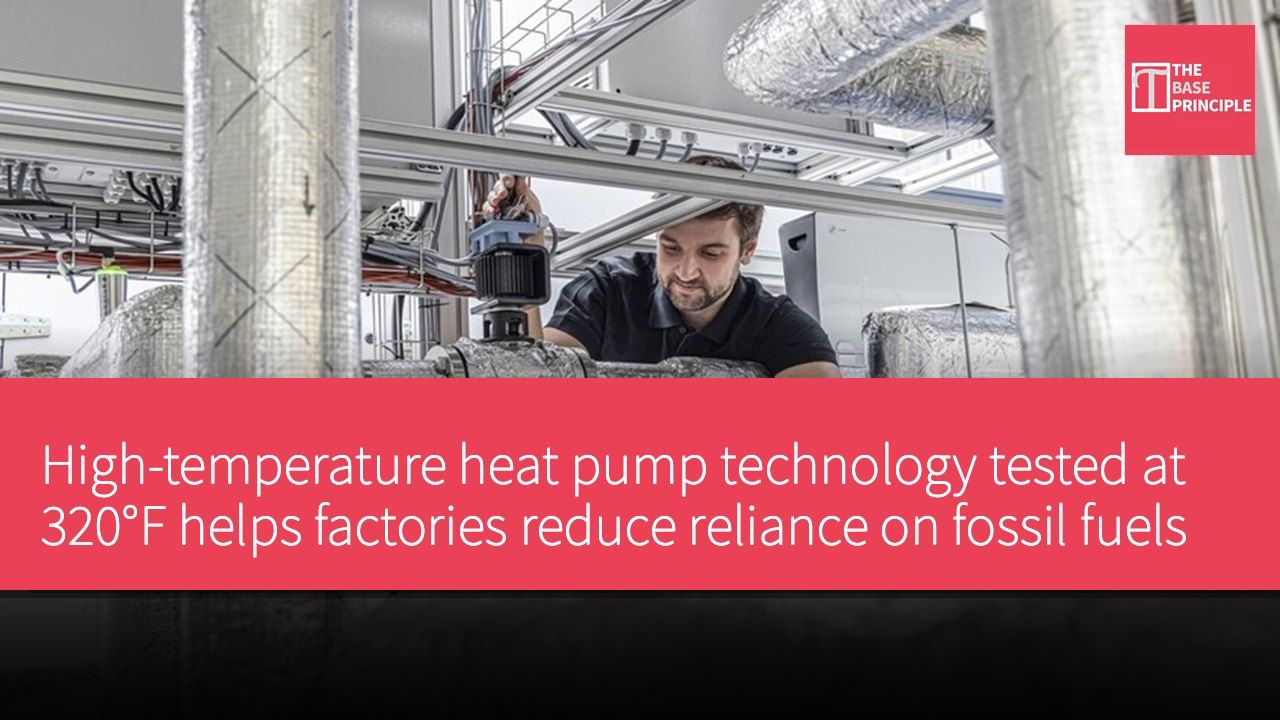
- High-temperature heat pump technology can deliver industrial steam and hot water at 320°F.
- The technology helps factories reduce reliance on fossil fuels.
- The research team emphasizes the importance of reliability and efficiency of high-temperature heat pumps for industrial applications.
- Monitoring results show large-scale heat pumps perform well under real-world conditions.
Researchers tested a high-temperature heat pump at 320°F (approximately 160°C), demonstrating the technology can supply industrial steam and hot water while reducing reliance on fossil fuels. The research was conducted by scientists at Germany's Fraunhofer Institute for Solar Energy Systems ISE. The team developed a new laboratory test rig to evaluate heat pumps capable of supplying process steam and pressurized hot water at high temperatures.
Addressing Industrial Decarbonization Challenges
This work aims to tackle industrial decarbonization, a major challenge for factories that still depend on fossil fuels for large-scale heat supply. Dr. Ursula Wittstadt, senior engineer and FernWP project manager at the institute, noted that high-temperature heat pumps can offer an alternative. She highlighted the technology's potential: "With our test rig, we can measure these interactions, laying the foundation for further development of components and complete systems."
The new test rig was designed under the FernWP research project to explore how heat pumps can replace coal for district and industrial heating. Researchers can use the facility to measure heat pump performance at up to 320°F (approximately 160°C) and examine how the system responds to varying heat sources, loads, and operating modes. Wittstadt further explained, "For industrial applications, the maximum achievable temperature alone is not the decisive factor." The institute's test site focuses on investigating heat pumps that can generate steam at 320°F.
According to Wittstadt, high-temperature heat pumps must reliably and efficiently produce process steam or pressurized hot water even when operating conditions change.
In the project, the team tested a heat pump using butane as a refrigerant. Because butane is flammable, they also studied safety and installation requirements. Data collected from the test rig can enable manufacturers to design heat pumps and heat exchangers suited for high temperatures, heavy loads, and variable conditions. Meanwhile, Fraunhofer ISE plans to further develop its safety testing facilities to establish safety concepts for refrigerants in large-scale and high-temperature heat pumps.
Operational Monitoring of Large-Scale Heat Pumps
Beyond laboratory testing, Fraunhofer ISE has also monitored the operation of five large-scale heat pumps in district heating networks since 2023. Researchers found that when these heat pumps' components, control systems, hydraulic integration, and operating strategies are properly designed, they can run reliably and achieve their target performance. Axel Oliva, project manager of Fraunhofer ISE's Reallabor GroßWP, revealed that monitoring results show large-scale heat pumps perform well under real-world conditions and can meet their target performance.
However, this performance largely depends on ambient conditions. He stated that when water temperatures drop or during part-load operation, systems extracting heat from flowing water produce less heat, and output also decreases when source temperatures fall below approximately 43°F (approximately 6°C).
The power plant in Mannheim is part of the large-scale heat pump living lab research. Oliva emphasized in a press release, "We also see that operating a heat pump in an integrated power plant system requires a good understanding of existing power plant infrastructure, district heating networks, and customer installations." According to the research team, operators are increasingly running heat pumps based on daily heat demand and energy prices. This means these systems must start and stop more frequently while remaining reliable. The team will use this data to model the interaction of large-scale heat pumps with electricity and heating systems, which could show how to operate heat pumps more efficiently and reduce fossil fuel use.
Item Specification Maximum Operating Temperature 320°F (160°C) Refrigerant Used Butane
Future Potential of High-Temperature Heat Pump Technology
The development of high-temperature heat pump technology holds significant importance for industrial decarbonization. As global demand to reduce fossil fuel dependence grows, this technology offers a viable alternative. Research shows that the performance stability and safety of these heat pumps at high temperatures are key factors, especially under changing operating conditions. With the accumulation of laboratory test data and real-world operational data, future heat pump designs will be more targeted, able to meet the needs of different factories, and further drive sustainable industrial development.