
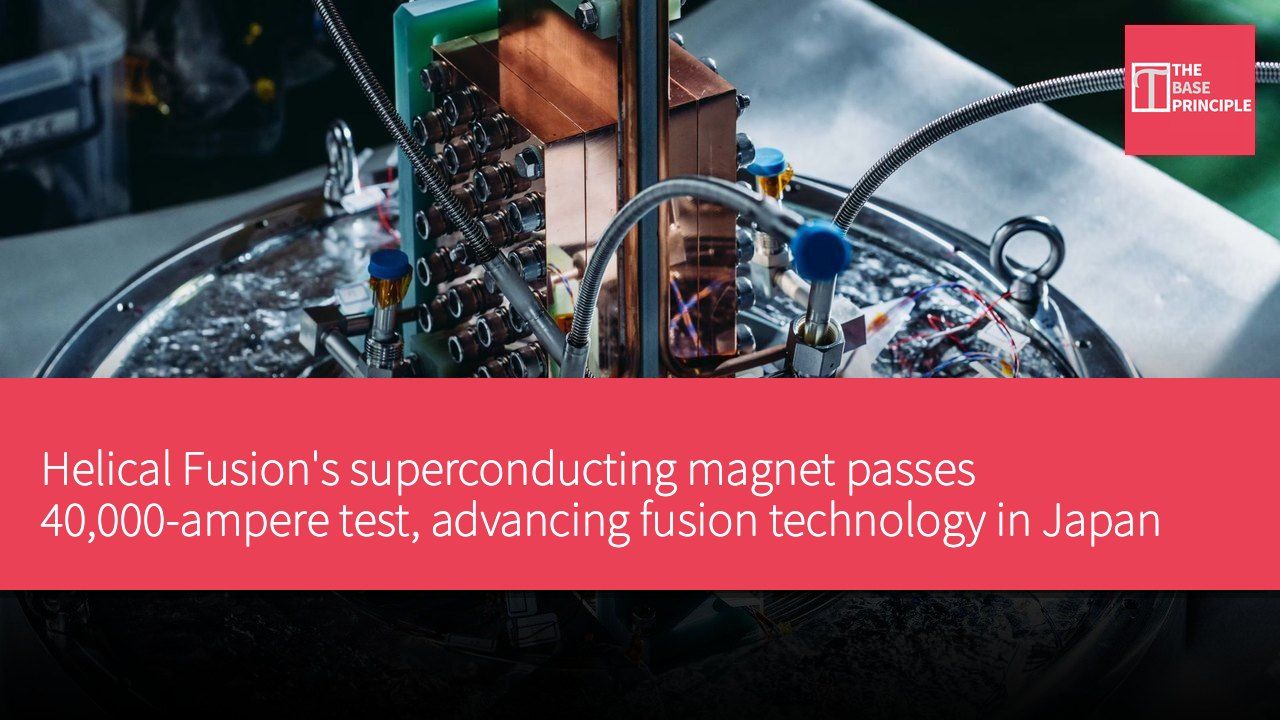
- Helical Fusion's superconducting magnet design has been formally validated.
- The UROCOIC structural design prevents internal material damage under load.
- The test coil operated at high current without experiencing a quench.
- Successful testing could pave the way for commercial fusion power plant construction.
Helical Fusion's high-temperature superconducting magnet design has been formally validated by peer-reviewed research, with the findings published in the IOP Publishing journal Journal of Physics: Conference Series. The paper discloses laboratory data for the company's UROCOIC conductor, which was initially presented at the 38th International Symposium on Superconductivity.
The publication of the paper coincides with the project's official review by Japan's Ministry of Education, Culture, Sports, Science and Technology (MEXT) under the SBIR program's third phase. The research focuses on a major technical hurdle in fusion energy. Stellarator reactors use magnetic fields to confine extremely hot plasma, and helical stellarators require three-dimensional, geometrically complex superconducting coils that must balance high current capacity with mechanical stability under electromagnetic loads.
Introduction to the UROCOIC Structure Design
To address this challenge, the engineering team developed the UROCOIC structure, which stands for "Unitized Reinforcing Outer Cover On Internal Components." The design encases the internal superconducting tapes with an outer metal sheath that directly absorbs physical stress, preventing the internal delicate materials from bending or breaking under load. During experiments, Japanese manufacturing partners used UROCOIC conductors to fabricate a test magnet called a "double-pancake coil," with no traditional electrical insulation between the layers.
In conventional superconducting magnets, insulation layers can accumulate heat during localized heating, potentially triggering a sudden failure known as a "quench." Eliminating the insulation allows heat and excess current to bypass hot spots, preventing damage and maintaining system stability.
Test Results Demonstrate Stability
Researchers from Helical Fusion and Japan's National Institute for Fusion Science placed the test coil in a specialized cryostat, cooling the system to 10 K (-263°C) and operating it at temperatures up to 30 K (-243°C or -405°F). The team then applied an external background magnetic field of 7 Tesla, causing the test magnet to experience a maximum magnetic field strength of 8.9 Tesla. The test coil operated continuously at 40 kiloamperes without experiencing a quench or losing superconductivity, while also withstanding a physical force of 356 kilonewtons per meter generated by the interaction of current and magnetic field.
When the external magnetic field changed suddenly, the uninsulated coil remained stable and provided crucial data on the current adjustment speed within the coil windings. This test provided direct experimental evidence of the conductor's ability to withstand the forces generated in an operating fusion device.
Future Fusion Plans Outlook
Helical Fusion plans to apply this magnet technology to its next experimental device, Helix HARUKA. If successful, the company will scale up the conductor for use in the full-scale commercial fusion power plant Helix KANATA, which is expected to be completed in the 2030s. Junichi Miyazawa, co-founder and deputy chief technology officer of Helical Fusion, stated that the team will continue to advance the Helix program and integrate the technology into Helix HARUKA, with the goal of achieving the world's first commercially viable fusion power plant based on the helical stellarator concept.
Parameter Specification Minimum operating temperature 10 K (-263°C) Maximum operating temperature 30 K (-243°C / -405°F) External background magnetic field 7 Tesla Maximum magnetic field on test magnet 8.9 Tesla Continuous operating current 40 kiloamperes Withstand electromagnetic force 356 kilonewtons per meter
The Impact of Superconducting Magnet Technology on Fusion
Helical Fusion's breakthrough in superconducting magnet technology opens new possibilities for the development of fusion energy. The UROCOIC structure design effectively addresses the issue of material stability during high-current operation, which is crucial for the commercialization of fusion reactors. The successful test results not only demonstrate the reliability of the technology but also pave the way for future fusion power plants. As Helix HARUKA continues to develop, this technology could become the core of the world's first commercially viable fusion power plant, with profound implications for energy transition and sustainable development.