
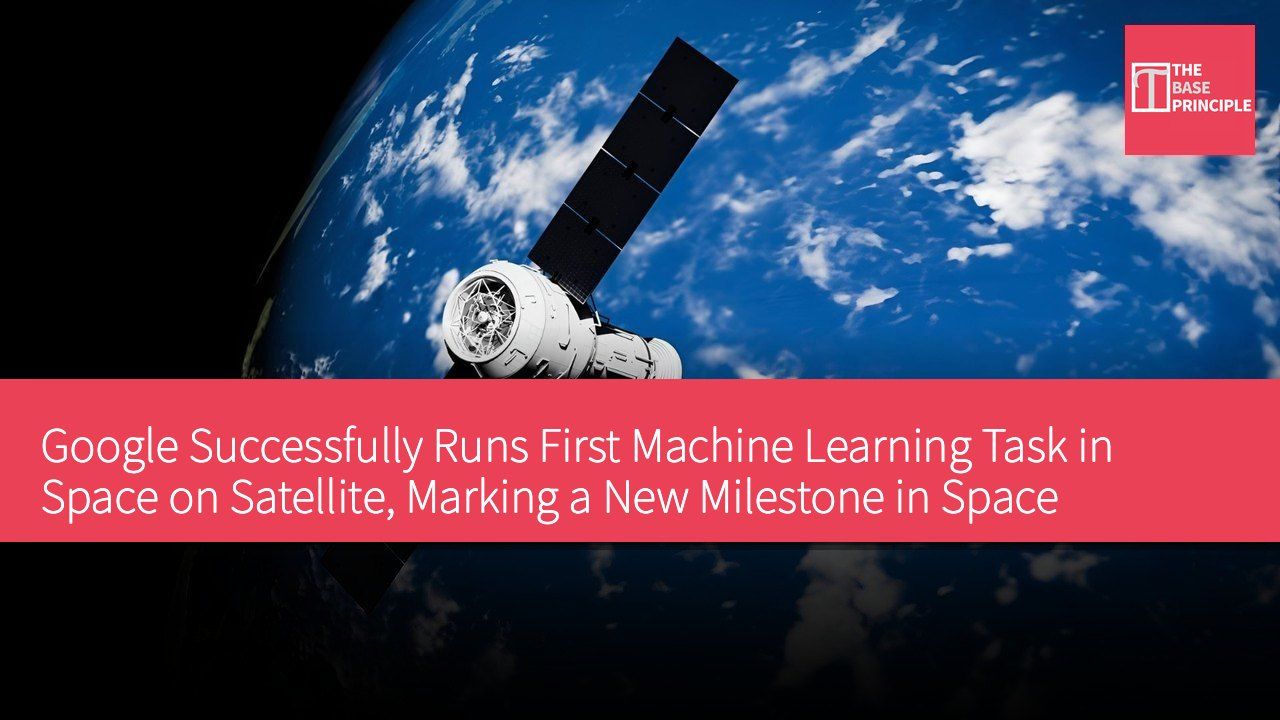
- Google has successfully run its first machine learning task on a satellite, advancing space computing experiments.
- The satellite is capable of receiving commands and generating poetry related to its space environment.
- Project Suncatcher will connect multiple spacecraft to form an orbital computing network.
- Google plans to launch more satellites in 2027 to enhance computing capabilities.
Google has successfully executed its first machine learning prompt on a processor installed on a satellite, bringing its space computing experiment to fruition. This prototype spacecraft uses Google’s Tensor Processing Units (TPUs) to generate AI responses from orbit. This achievement marks an early milestone for Project Suncatcher, which is Google’s research initiative exploring large-scale computing infrastructure in space. Engineers launched the satellite on October 1 aboard SpaceX’s Falcon 9 rocket, alongside more than 100 other spacecraft.
Google confirmed that its onboard system completed initial checks after approximately three weeks of debugging. The team has demonstrated that the orbital TPUs can handle basic machine learning workloads.
During a communication window with a ground station, engineers sent a prompt to Google’s Gemma 4 open model, requesting the onboard system to create a haiku related to its space environment. The satellite received the prompt and generated three lines of poetry. The subsequent transmission back to Earth confirmed that the system successfully processed the request. The response was: “Blue marble below / Data streams silent and graceful / Starlight nourishes my core.” Google also conducted model testing with a space-themed five-line poem, using additional prompts to retrieve remote sensing information about the spacecraft's operational conditions.
Onboard System Successfully Generates Poetry
This demonstration represents a significant technical step, confirming that the satellite can receive commands from Earth, perform onboard processing, and return generated information.
The spacecraft carries four Google TPUs, although its power system only allows engineers to run one processor at a time. Its power generation capacity is approximately 1 kilowatt. Power consumption also limits the duration of each operation. Engineers can run the TPUs for about 20 minutes, after which available energy becomes a limiting factor. Google’s next tests will examine the resilience of these processors in the harsh environment of low Earth orbit, which includes temperature fluctuations and exposure to space radiation. Radiation poses a major challenge to traditional computing hardware, as high-energy particles can cause bit flips, altering stored values in computer memory.
Such errors can disrupt computations without activating standard monitoring systems. Google has previously studied the effects of radiation on Earth using particle accelerators, and these experiments indicated that inference workloads can better withstand radiation than model training. However, actual orbital testing will help researchers determine how hardware behaves under continuous exposure.
Future Plans for Project Suncatcher
Project Suncatcher ultimately aims to connect multiple spacecraft into an orbital computing network. Google plans to launch two additional satellites in 2027, which will demonstrate higher power generation capabilities and optical communication links between spacecraft. These connections will enable multiple processors to coordinate workloads across the orbital network. Google’s approach differs from other proposed space computing systems, focusing on closely coordinated satellites capable of sharing processing tasks. Other companies, including Starcloud and Cowboy Space, are exploring orbital computing, with initial methods emphasizing running inference workloads on a single spacecraft.
Expanding these systems will also depend on launch economics. Google’s research suggests that SpaceX’s fully reusable Starship rocket may require approximately 1,800 flights to achieve significant cost reductions.
Item Specification Processor Google TPU Power Generation Capacity Approximately 1 kilowatt Runtime Approximately 20 minutes
The Future and Challenges of Space Computing
Google’s Project Suncatcher represents a significant technological advancement, showcasing the potential for running machine learning in space environments. As spacecraft are launched and subsequent tests are conducted, this technology can not only process data but also operate continuously in extreme conditions, which is crucial for future space exploration. Despite challenges such as power and radiation, Google’s plans demonstrate strategic thinking in the field of space computing, potentially transforming the design and operation of future spacecraft.