
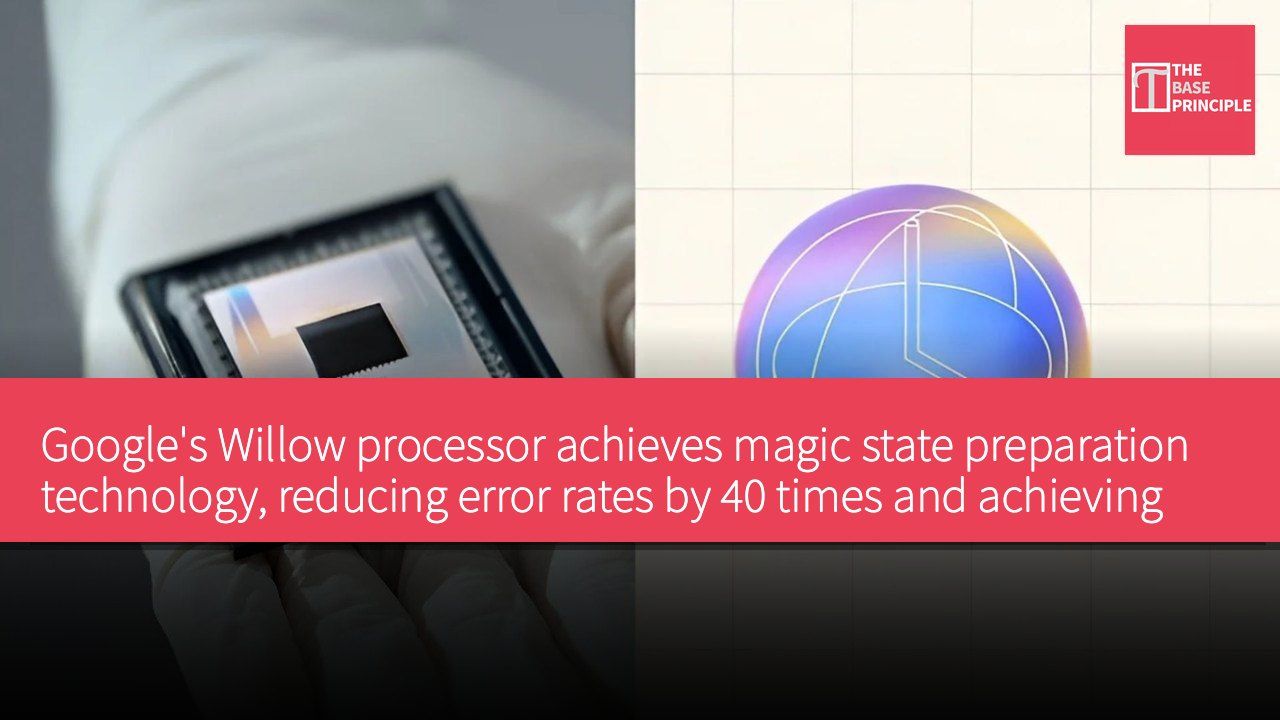
- Google's Willow processor has achieved a 40-fold reduction in error rates, with logical fidelity reaching 99.99%.
- Magic state preparation technology can generate high-precision quantum states, which are crucial for quantum computing.
- Researchers demonstrated that quantum states can be transferred between different error correction methods.
- Google acknowledges that the effectiveness of the preparation technology still needs to be proven on a larger scale.
Google recently announced that its Willow processor has demonstrated a 40-fold reduction in error rates while preparing specialized quantum states, a breakthrough that helps address a major bottleneck in practical quantum computing. This technology, known as "magic state preparation," achieves a logical fidelity of 99.99% and can generate the high-precision quantum states necessary for complex calculations. These states are essential for building powerful error-corrected quantum computers. However, generating these magic states has long been a significant challenge. These states are indispensable for performing complex quantum computations, but generating them with a sufficiently low error rate requires enormous computational resources.
Some estimates suggest that up to 95% of a quantum computer's capacity may be used to generate these states, leaving relatively limited space for actual computations. The issue is further compounded by the fact that each magic state can only be used once, meaning quantum computers must continuously generate new states to perform operations. Google’s latest experiments showcase a method that can reduce this resource burden.
Magic State Preparation Technology
In 2024, Google quantum AI researchers Craig Gidney, Noah Shutty, and Cody Jones developed the magic state preparation technology and improved upon earlier theoretical approaches. The method resembles a filter, where researchers introduce quantum states containing errors into a small region of the processor and conduct a series of carefully coordinated measurements to identify issues. Attempts that fail the checks are discarded, while those that pass yield purer quantum states. These states can then be scaled up into larger forms suitable for more complex quantum operations.
While the method shows promise in theory, demonstrating it on practical quantum hardware required several engineering improvements. In early experiments, Google researcher Emma Rosenfeld encountered unexpected measurement results. After months of testing and simulations, the team traced the problem to noise caused by electrical equipment drift and laboratory temperature variations, which affected the accuracy of their existing measurement methods. Researchers addressed this by improving the control of the processor and developing a new benchmarking technique that utilizes the preparation process itself to evaluate results.
These changes helped the Willow processor achieve a 40-fold reduction in error rates, and the experiment also produced logical T states with a reported fidelity of 99.99% compared to unprepared quantum states.
Transfer of Quantum States
In addition to reducing error rates, Google researchers also demonstrated that purified quantum states can be transferred between two different error correction methods. The team transferred states from a distance-3 color code to a distance-5 surface code. These are two methods of organizing quantum information to detect and correct errors, with distance indicating the level of protection the code offers against certain errors. This process, known as "grafting," shows that carefully prepared states can successfully transition between these two methods on actual hardware. This result is significant because future quantum computers may need to combine different error correction techniques to reliably perform computations while limiting hardware demands.
However, this demonstration does not mean that Google has eliminated the magic state bottleneck or established a practical fault-tolerant quantum computer. The company acknowledges that the preparation technology still needs to be proven on a larger scale to support useful quantum applications. The research is published in the journal Science.
How Google is Addressing Quantum Computing Bottlenecks
Google's latest breakthrough in quantum computing shows that magic state preparation technology can significantly reduce error rates, which is crucial for the practicality of quantum computers. One of the challenges in quantum computing is generating high-precision quantum states, and the successful implementation of this technology could make quantum computers more efficient at solving complex computational problems. Additionally, the ability to transfer quantum states between different error correction techniques provides greater flexibility and reliability for future quantum computers. Nevertheless, Google still needs to further validate the application of this technology on a larger scale to truly achieve fault-tolerant quantum computing.