
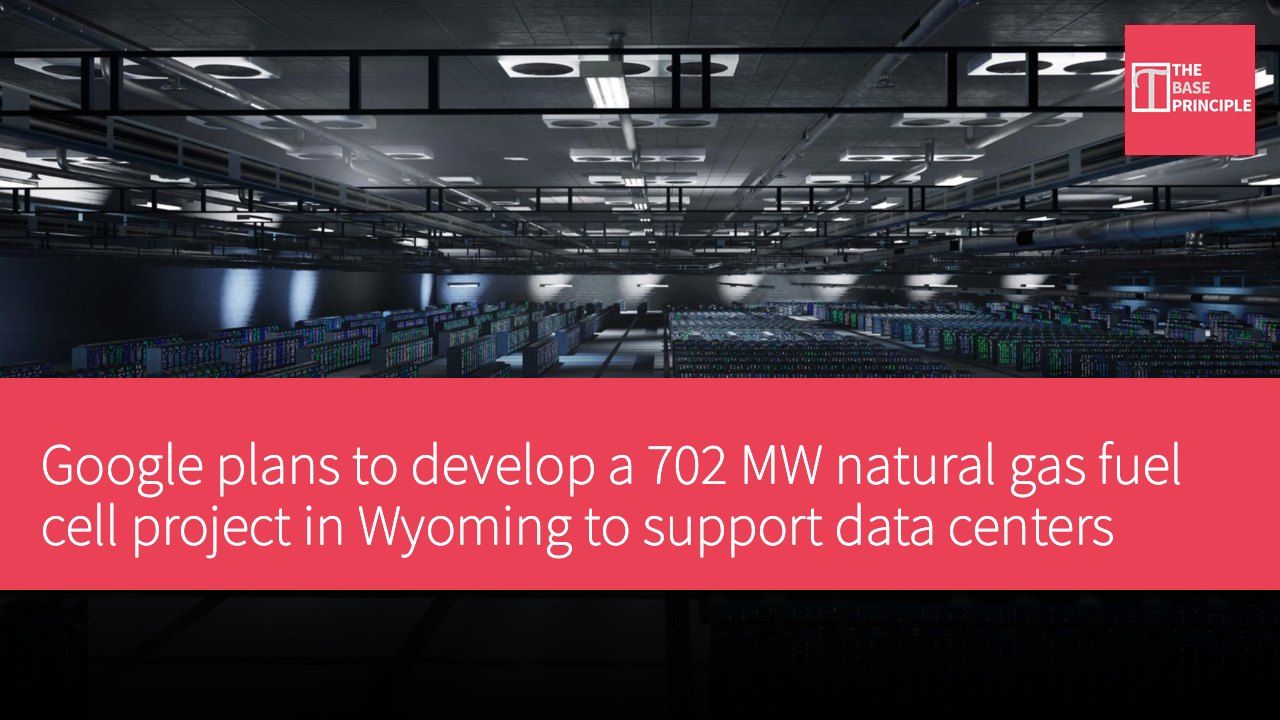
- Google plans to develop a 702 MW natural gas fuel cell project in Wyoming.
- The project will utilize carbon capture and storage technology to reduce emissions.
- Google will use an air cooling system to alleviate pressure on water resources.
- The project is expected to generate hundreds of millions of dollars in property tax revenue for the local area.
Google plans to develop a 702 megawatt (MW) natural gas fuel cell project in Wyoming, incorporating carbon capture and storage (CCS) technology to support its first data center, as part of the company's long-term $17 billion investment in the state. The project was announced in collaboration with American Electric Power (AEP), Tallgrass Energy, Black Hills Energy, and Related Digital, and is expected to become the largest commercial fuel cell development initiative.
The fuel cells will be manufactured by Bloom Energy in the United States and will convert natural gas into electricity through an electrochemical process. Google stated that this development will help reduce emissions and water usage associated with powering its data infrastructure.
Application of Carbon Capture Technology
The project will employ CCS technology to capture most carbon emissions, transporting the captured carbon dioxide to a carbon storage hub in eastern Wyoming, developed by Tallgrass Energy, for permanent geological storage. This hub is under development to support commercial-scale carbon dioxide storage in the state. Google noted that the Wyoming project extends its first carbon capture and storage agreement in the U.S., bringing its total contracted CCS capacity close to 1 gigawatt. Google will also source electricity from Tallgrass Energy and Black Hills Energy gas-fired power plants.
Additionally, Google is conducting front-end engineering design studies to assess the feasibility of installing CCS technology on Tallgrass's combined cycle gas turbines.
Community Investment Plans
These arrangements are part of Google's broader efforts to secure power for its expanding data center infrastructure while reducing carbon emissions associated with natural gas generation. However, the fuel cell development will still utilize natural gas, and the carbon capture system aims to capture a significant portion of emissions rather than eliminate them entirely. Google stated that this $17 billion investment aims to provide long-term economic benefits for Laramie County and the broader state. The company anticipates that the project will generate hundreds of millions of dollars in local property tax revenue for the county and school districts.
Its community investment plans will also support K-12 education, workforce development, STEM programs, and technical training. Following a community meeting attended by over 200 Laramie County residents, Google and its partners are establishing a community committee to address the impact of data center expansion on Cheyenne and surrounding communities. Water usage is another consideration for the project. Google stated that the Wyoming facility will utilize air cooling to reduce pressure on local water resources, rather than relying on water-intensive cooling systems.
This announcement comes as technology companies expand data center capacity to meet growing demands for computing and digital infrastructure. Ensuring reliable power has become a significant challenge for these developments, prompting companies to explore new generation projects and partnerships with energy suppliers. Google stated that it will pay for all the electricity consumed by its data centers and will directly bear the infrastructure demands arising from its growth.
Project Specifications Battery Capacity 702 megawatts (MW) Investment Amount $17 billion
How Google is Addressing Data Center Expansion Challenges
As demand for data centers continues to rise, Google's fuel cell project in Wyoming demonstrates its commitment to sustainability. Through carbon capture and storage technology, Google aims to reduce carbon emissions while ensuring the reliability of power supply. This investment not only meets the needs of its data infrastructure but also brings long-term benefits to the local economy, showcasing the balance technology companies seek between environmental responsibility and economic development.