
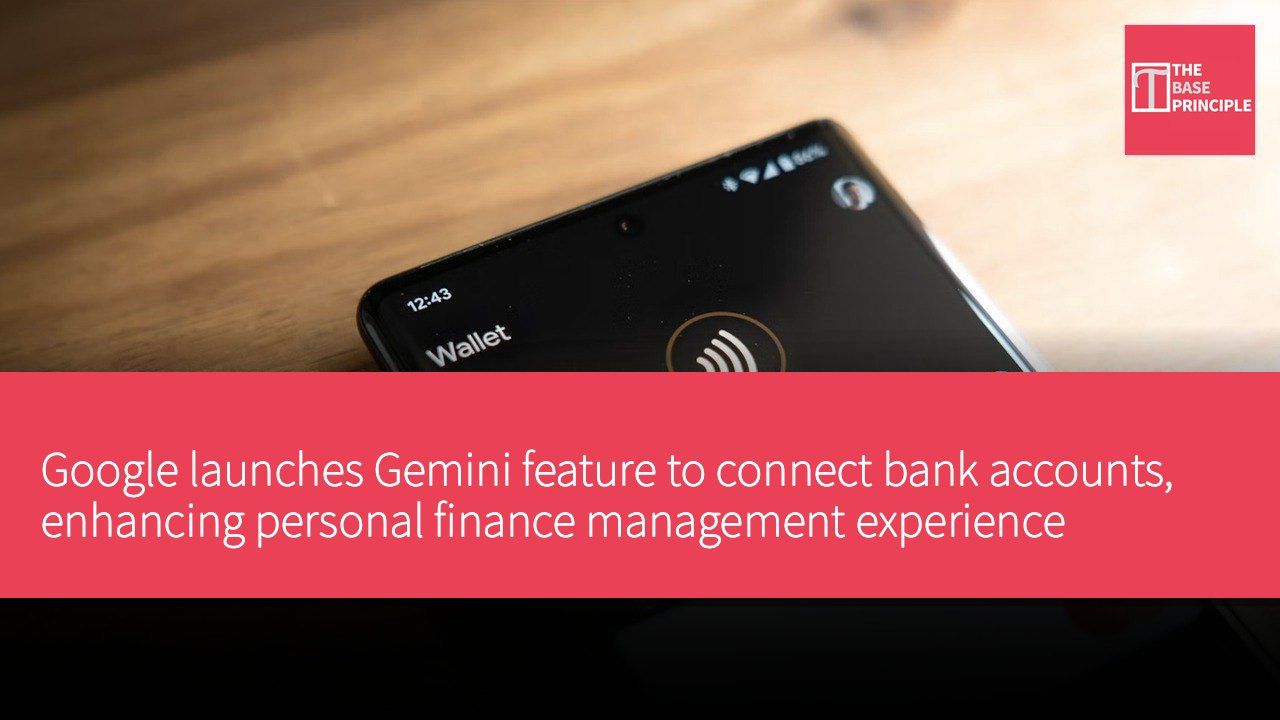
Google has officially announced that Gemini users can now connect the chatbot to their bank accounts through the Google Wallet feature. This function is not a shopping chatbot platform like Meta Muse, but is positioned as "providing more personalized responses for personal finance." Once connected, users can directly ask Gemini questions related to their accounts, and the chatbot can offer suggestions based on bills, transactions, and spending patterns, even helping to identify unnecessary subscriptions or other ongoing expenses. This direction certainly helps users regain more space from daily expenditures, but it also involves handling sensitive financial data, requiring a high level of trust and strict security mechanisms. Google emphasizes that this tool is designed to "only read account information," without performing transfers, management, or investment operations, and it is completely optional to enable or disable, launching simultaneously on both web and mobile platforms.
Functionally, Gemini claims to generate specific financial budgets based on user-defined time frames and provides "dynamic charts" to track cash flow, asset allocation, and other indicators, even assisting in setting holiday budgets. Such features typically require users to manually review multiple account details, but through language interaction, automated visual analysis can be obtained, theoretically improving the efficiency of self-managing finances. Broadly speaking, these tools are no longer limited to retrospective data viewing but transform complex financial situations into easy-to-understand strategic suggestions, which can be appealing to users who are busy yet concerned about their financial health.
Security has always been a core challenge for such features. Google states that the new toolset only allows Gemini to "read" account information, without the ability to move, manage, or invest funds, and it is a completely voluntary and easily toggled experience. This design also responds to industry concerns about the integration of AI and financial data, aiming to minimize risks associated with automated operations. Users can quickly toggle this feature on or off, ensuring it is used only when needed, while returning to a higher level of privacy during regular use. Google points out that the connection process will involve deep data unlocking and integration through Plaid, but specific details have not yet been disclosed, and the company has not provided a comprehensive list of specific security reviews or regulatory compliance.
Regarding the scope of implementation, Google has announced that this integration is being promoted simultaneously on both web and mobile platforms, with a "gradual rollout" strategy, meaning the speed of deployment may vary across different regions and user groups. Plaid, as a partner, is responsible for assisting with data connection and technical integration, helping users unlock deeper insights more smoothly. In terms of the competitive landscape, such tools are not uncommon; for example, OpenAI recently launched a feature allowing Dots to act on behalf of users for purchases, while other players in the industry continue to test similar capabilities on commercial platforms. However, most commercial platforms impose strict limitations or outright bans on automated shopping capabilities within their financial environments. These actions indicate that the integration of AI with financial data is at a careful balancing stage between innovation and risk.
Long-term impacts of Gemini's integration with financial insights and user experience trade-offs
The new feature of Gemini centers on balancing "visibility" and "control." Bringing account information into conversations in a controlled manner means users can receive immediate and personalized financial responses, achieving higher precision in subscription management and spending optimization, but it also carries the risk of errors in interpretation. For instance, AI might misclassify certain transaction attributes or misunderstand account groupings, potentially affecting users' financial decisions. In the long term, if this service can operate reliably and provide a clear error feedback mechanism, it may encourage more people to adopt "conversational financial assistants" as everyday tools. On the other hand, competitors in the market, such as Meta Muse, have previously attempted to intervene in users' financial domains through conversational shopping experiences, raising strong concerns in the industry about data privacy and security. Google's choice to "only read" data and allow users to control toggles is an important step in addressing these concerns.
In terms of user interface and experience, Gemini's integration must align with the security processes of existing banking and financial applications to avoid creating lengthy authorization processes or content display confusion across platforms. While the features provide more detailed financial insights, if the interface leads to excessive user monitoring or privacy anxiety, it could weaken adoption willingness. The data authorization, review, and withdrawal mechanisms implemented by Google and Plaid are crucial for enhancing trust. If users encounter system-generated corrections or suggestions, there needs to be clear traceability and explanations to facilitate quick backtracking in case of errors. Currently, this feature is still in a gradual rollout phase, and the stability and usability of the final user experience will need to be validated through more user testing and official updates.
From a long-term perspective, whether Gemini can shape a new market for "conversational financial advisors" depends on the synergy of multiple factors: first, ensuring that the security of data connections is robust enough; second, providing transparent risk alerts and controllable mechanisms; and third, ensuring that the interpretations of analytical models are clear enough to avoid misleading users. Additionally, claims of high-level features such as "dynamic charts and asset allocation" may attract financially literate users, but for the general public, ease of use, understandability, and a low learning curve are more important. Google and Plaid need to continuously optimize these elements while maintaining an open user feedback mechanism to ensure that the new features genuinely enhance users' financial management capabilities without infringing on privacy. For the latest developments, users can visit the official Google Wallet webpage and Plaid's official website to track relevant announcements.
While technological innovation brings new conveniences, transparency and controllability are always the two most important indicators when it comes to financial data. Gemini's connection design emphasizes "only reading" and "enable/disable" options, providing users with agency and setting a new benchmark for the industry on how to achieve the best balance between enhancing user experience and protecting privacy. This will be a core topic in the coming quarters. Users who wish to gain a deeper understanding are advised to pay attention to the latest integration details between Google Wallet and Plaid, as well as Gemini's promotional strategies in different markets.
For more information, please refer to the official announcements at https://wallet.google and https://plaid.com to learn about the latest developments in data authorization, privacy protection, and security mechanisms. In today's highly competitive environment, these details often determine whether new features can be successfully implemented in the long term.