
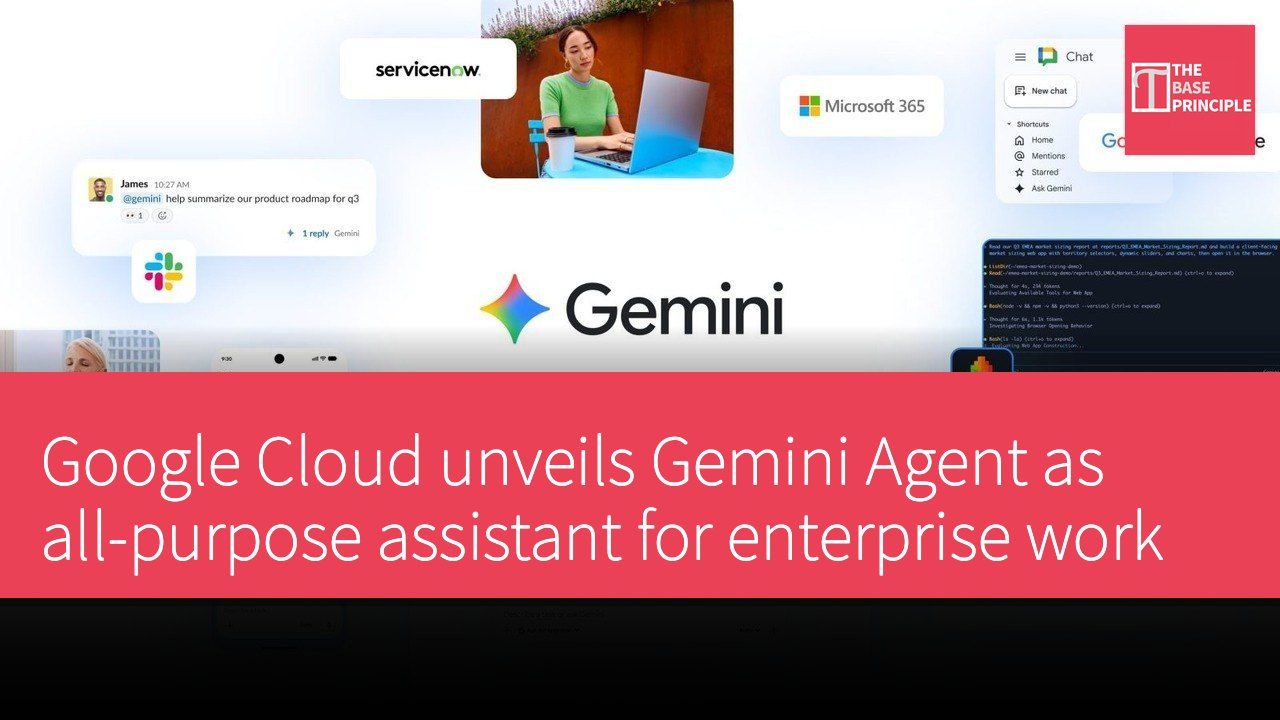
At the 2026 Gemini at Work conference, Google Cloud today announced the launch of the Gemini Agent for enterprise customers. The Gemini Agent is a new unified work agent usable across Gemini enterprise apps, Workspace, and third-party services. Google says users can give it goals rather than instructions. It can answer questions, handle knowledge work, create media, and write/run code. "For example, if your manager emails asking for an update on the latest project and requests it in presentation form, Workspace Intelligence will treat it as a delegable task and provide a one-click option to hand it off to
Gemini's options." Users can ask Gemini to schedule a meeting next week with the usual regional event team without providing any names or email addresses. Gemini identifies those people from your chat space members and clues from the last event, checks their calendars, and starts an email thread to coordinate a suitable time, even with external participants.
Gemini Agent to become integral part of enterprise workflows
Beyond serving as a personal assistant, the Gemini Agent can also function as a team member, working on behalf of a group — for example, as a project manager within a team — or representing a specific role in an organization, such as an analyst in the finance department. On the technical side, the Gemini Agent runs each task on the model best suited for it. This includes the current Gemini and Claude model families, with future support for other proprietary and open models. This aims to deliver the best quality while reducing costs. It uses sub-agents to handle multi-step tasks and connects with a variety of third-party tools.
Gemini can communicate with these sub-agents to coordinate workflows, including parallel and serial steps that can run for hours or days. The agent operates in the cloud with a single, unified memory, context, and personalized graph. Memory is divided into four types: working memory: for the current task, even if it runs for days; semantic memory: a structured knowledge base built from reading documents, talking with people, and collaborating with other agents; procedural memory: methods for getting work done, including skills it writes for itself; episodic memory: everything it has done before.
In Gmail, Google Docs, Sheets, Slides, and Chat, users can invoke the agent by mentioning @Gemini. The Gemini Agent is accessible from any device and channel — command line, Google Workspace, Slack, and Microsoft 365 are examples. An API enables integration into third-party applications to run as a headless agent, meaning it does not require a dedicated user interface. The Gemini Agent will soon be broadly available to Workspace customers on select Business and Enterprise plans, and is currently in private preview.