
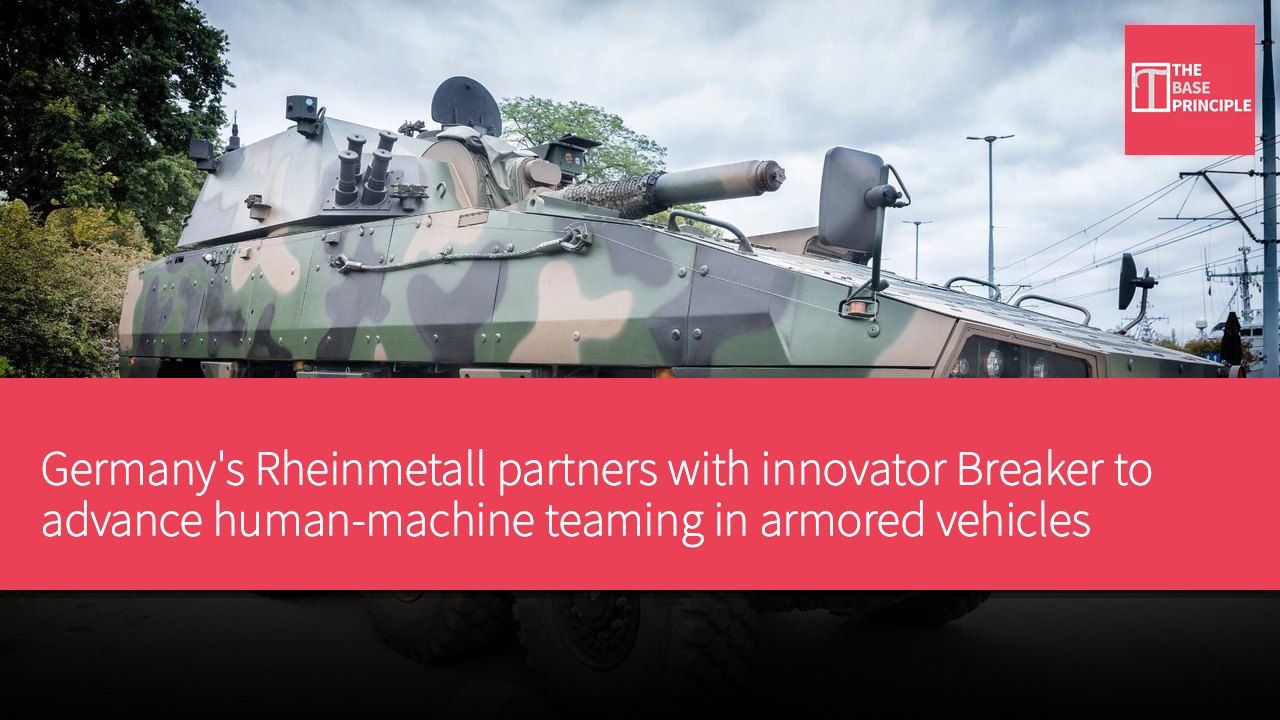
- Rheinmetall and Breaker sign agreement to advance human-machine teaming technology.
- Boxer Combat Reconnaissance Vehicle demonstrates potential of human-machine teaming.
- Collaboration integrates software in short timeframe, boosting operational efficiency.
- Future cooperation has potential to expand to multiple vehicle types.
A new agreement signed by two defense companies will drive the application of human-machine teaming in armored vehicles. The new agreement between Rheinmetall and defense tech startup Breaker marks a significant shift in armored vehicle operations. The two sides have successfully demonstrated human-machine teaming in Australia using the Boxer Combat Reconnaissance Vehicle. Breaker's tactical coordination agent will be integrated into Australia's Boxer Combat Reconnaissance Vehicles via the platform's open architecture, enabling crews to control teams of autonomous systems by voice.
Partnership to enhance combat capability
The move aims to enhance combat capability by combining manned and unmanned platforms, thereby extending the Boxer's reach and situational awareness without adding personnel. This will improve survivability and lethality on the battlefield by enhancing collaboration between Boxer crews and robotic teams, allowing them to focus fully on the mission. "The Boxer Combat Reconnaissance Vehicle, delivered under LAND 400 Phase 2, is the most advanced land platform currently in service with the Australian Army. Its open architecture makes integration of new force multipliers, such as Breaker's software, nearly plug-and-play," said Nathan Poyner, Managing Director of Rheinmetall Defence Australia.
The two companies collaborated at remarkable speed, integrating Breaker's software into Rheinmetall Defence Australia's simulator within weeks and demonstrating the Boxer's operational capability within six months of their first conversation. The demonstration clearly proved that seamless manned-unmanned teaming can protect human operators on the front lines.
Results of rapid software integration
According to the press release, "The purpose of integrating with the automated solutions platform is to increase crew survivability and mission efficiency," Poyner said. "We demonstrated within just six months of working with Breaker that Boxer operators can control autonomous systems by voice as naturally as speaking to a crew member. This achievement validates Rheinmetall's open architecture approach and Breaker's platform-agnostic software."
Under the LAND 400 Phase 2 project awarded in 2018, Rheinmetall will deliver 211 Boxer Combat Reconnaissance Vehicles, which are expected to serve for the next 30 years. According to the press release, this partnership with Breaker has the potential to expand to various capabilities and vehicle types, both in Australia and globally. "We are thrilled to partner with Rheinmetall to advance next-generation armored vehicle operations," said Michael Irwin, co-founder and co-CEO of Breaker.
Potential for future expansion
"The Boxer is a tested, verified, and integrated capability, while Breaker's tactical coordination layer allows crews to collaborate with robotic teams in an entirely new way. This integration makes the Boxer more lethal and survivable in future combat, while reducing crew requirements. It makes every vehicle the core of its own autonomous formation."
Strategic significance of human-machine teaming technology
As defense technology advances, the application of human-machine teaming in armored vehicles is becoming increasingly important. This technology not only enhances combat capability but also extends mission scope without increasing personnel. The collaboration between Rheinmetall and Breaker demonstrates how technology integration can be achieved in a short timeframe, which is critical for future battlefield environments. As the technology matures, this partnership model may extend to other types of military platforms, further enhancing military operational efficiency and survivability.