
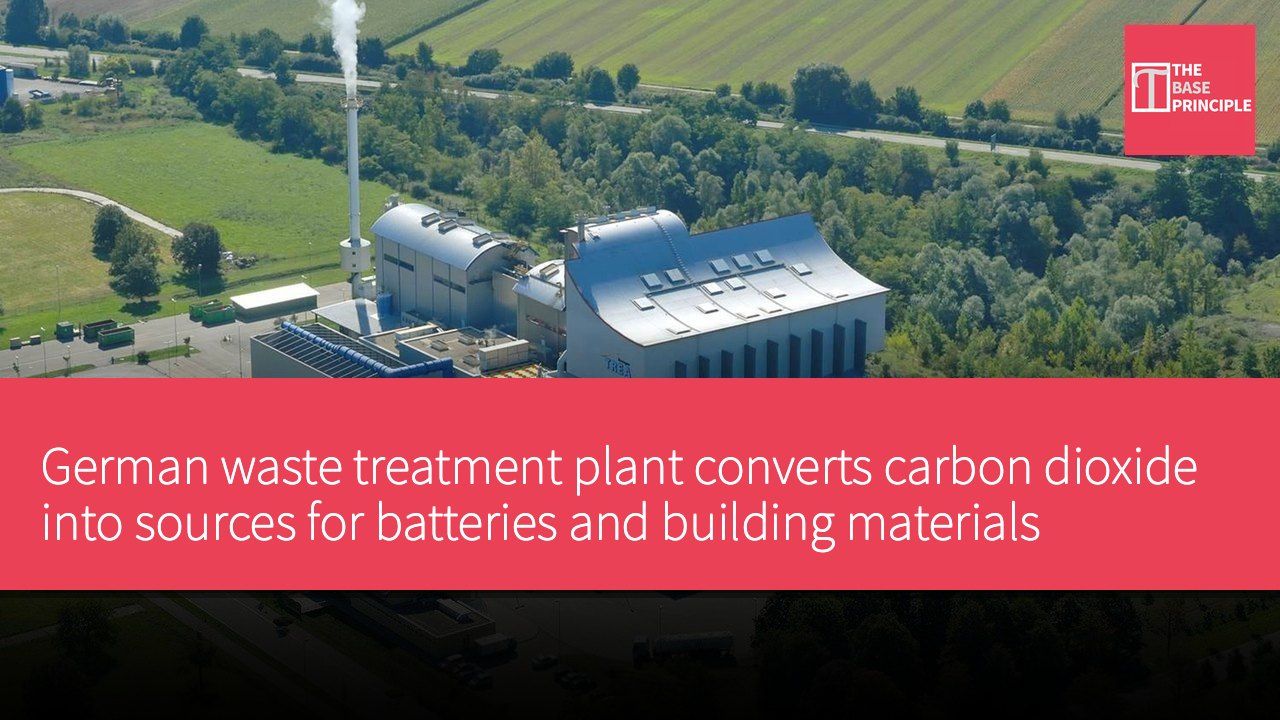
- The Eshbach waste treatment plant in Germany will become a source of carbon for batteries and building materials.
- The team uses liquid metal to extract carbon from carbon dioxide to reduce emissions.
- The NECOC 2.0 project aims to advance the practical application of carbon capture technology.
- Researchers will investigate the potential applications of recycled carbon in batteries and building materials.
A waste treatment plant in Eshbach, Germany, processes nearly 200,000 tons (175,000 metric tons) of residual waste each year and is expected to become a source of carbon for batteries and building materials in the future. The facility captures carbon dioxide generated during the incineration process and converts it into solid carbon for industrial use. This work is part of a project called NECOC 2.0, which brings together researchers from the Karlsruhe Institute of Technology (KIT), EEW Energy from Waste, and other partners.
The team will use liquid metal to extract carbon from carbon dioxide. They believe this technology can significantly reduce emissions and produce carbon powder, while also providing an alternative to fossil-sourced carbon for industrial applications. The project has received over $5.8 million (approximately €5 million) in funding from the German Federal Ministry for Economic Affairs and Energy.
Goals of the NECOC 2.0 Project
Thomas Hirth, Vice President for Transfer and International Affairs at the Karlsruhe Institute of Technology, stated, "Through NECOC 2.0, we are taking a crucial step in advancing solutions developed at KIT to practical applications." The incineration of waste generates carbon dioxide, as residual waste is burned for electricity generation, with emissions including carbon from fossil materials and biological sources. To address this issue, KIT's NECOC process aims to capture carbon dioxide directly from clean exhaust gases, preventing it from entering the atmosphere.
The captured carbon dioxide first reacts with hydrogen to produce methane, which then passes through a reactor containing liquid tin, where it is decomposed into solid carbon and hydrogen. The hydrogen is recycled back to the first stage, while the carbon is collected in fine powder form.
Benjamin Dietrich, a researcher at the Institute of Thermal Process Engineering at the Karlsruhe Institute of Technology who helped develop this technology, explained, "We aim to capture carbon dioxide and directly convert it into usable raw materials." According to the team, the recycled carbon could replace fossil-sourced carbon in various industrial applications. Researchers will also investigate whether this carbon is suitable for use in battery electrodes and building materials. Timo Poppe, CEO of EEW Energy from Waste, remarked, "Carbon capture is an important component of future thermal waste treatment."
Preliminary Results of Technical Experiments
This technology has shown potential in early experiments. In 2020, KIT built an integrated experimental facility at its Karlsruhe Liquid Metal Laboratory (KALLA) that combines methane production and decomposition into a single process. The system successfully converted carbon dioxide into micro-particle carbon, a form of fine solid carbon. The results confirmed the feasibility of the process. However, the team noted that carbon dioxide has not yet been captured from real industrial emission streams to demonstrate the operation of the entire system. EEW will evaluate and test the carbon capture technology at its Eshbach site, while KIT will focus on methane production and decomposition.
The Fraunhofer Institute for Ceramic Technologies and Systems will also investigate how to combine carbon dioxide with calcium and magnesium carbonates.
Poppe emphasized the importance of investment in research and development. In a press statement, he summarized, "As the coordinator of the alliance, we contribute our industry experience to the NECOC 2.0 project and work with partners to explore how to capture carbon dioxide from flue gases and use it as a raw material."
Future Potential of Carbon Capture Technology
As climate change issues become increasingly severe, the development of carbon capture technology has become crucial. Germany's NECOC 2.0 project not only aims to reduce carbon emissions during the waste incineration process but also to convert captured carbon dioxide into usable industrial raw materials, which is essential for finding sustainable sources of carbon. The successful implementation of this technology could transform the waste treatment industry and encourage other sectors to move towards more environmentally friendly practices, thereby promoting overall environmental protection.