
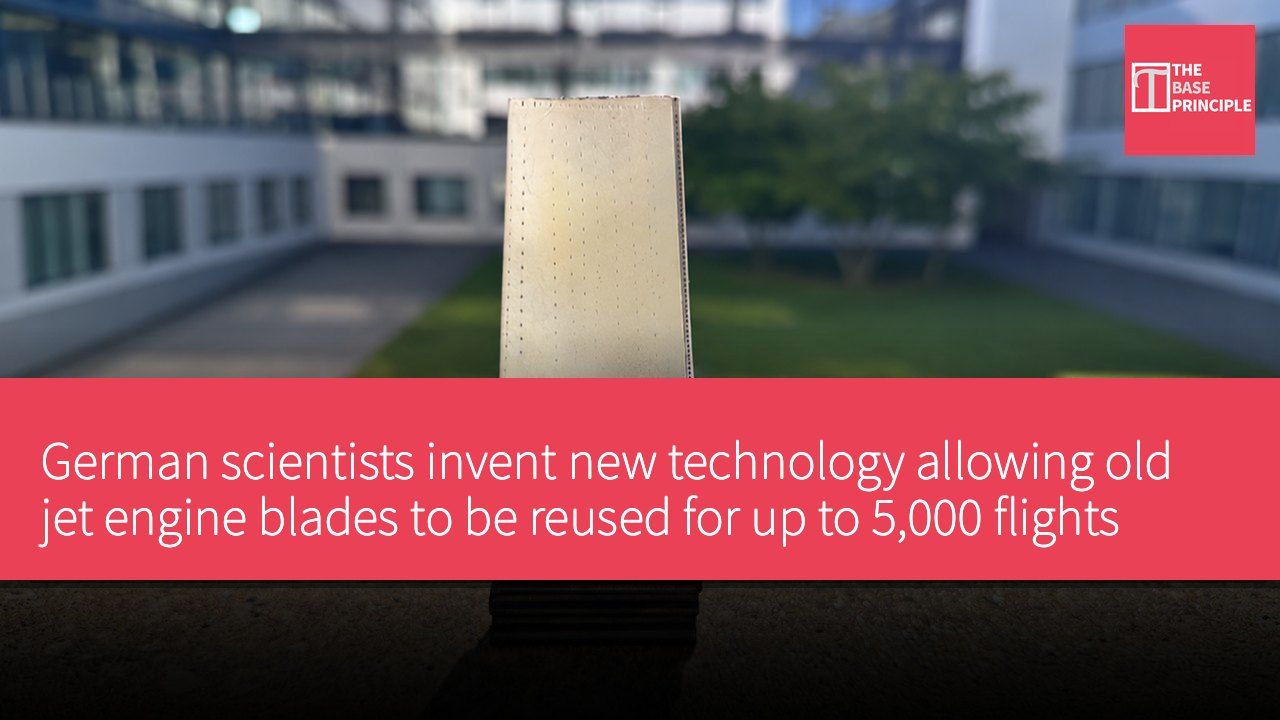
- The new heat treatment technology allows old jet engine blades to be reused for up to 5,000 flights.
- The technology repairs tiny internal damages in the blades using high-pressure gas and heat.
- The research team aims to extend the lifespan of the blades and reduce the need for new manufacturing.
- The project, named Second_Life, involves collaboration among several German aerospace organizations.
A new heat treatment technology developed by German scientists promises to give aging jet engine blades a second life, reducing the costly need for replacements and conserving critical raw materials. The method, proposed by scientists at Ruhr University, uses high-pressure gas and heat to repair tiny internal damages in jet turbine blades. Reports indicate that this technology can restore blades to their original state after 5,000 flight missions. According to the research team, this innovative technology allows blades to remain reusable even after experiencing mechanical stress and extreme temperatures exceeding 1,000 degrees Celsius.
This initiative is part of a three-year project called Second_Life, which will launch in August 2026 and involves collaboration with the German Aerospace Center (DLR), aircraft engine repair specialist Lufthansa Technik, heat treatment and surface processing company Aalberts Surface Technologies, and metal processing company Otto Fuchs.
Extreme Challenges for Jet Engine Blades
Jet engine blades are designed to withstand extreme temperatures, which can sometimes exceed 1,500 degrees Celsius, even surpassing the melting point of the materials themselves. These blades can endure rotational speeds of up to 16,000 RPM and immense centrifugal forces, typically made from single-crystal nickel-based superalloys. Their atomic structure forms a continuous crystalline structure without grain boundaries, which can weaken the material at high temperatures. However, even these materials degrade over time. Extreme conditions alter the internal structure of the blades and weaken their strength by creating tiny voids within them.
First-stage turbine blades are typically replaced after about 5,000 flight missions, equivalent to approximately three to six years of service. "During turbine operation, the blades experience tensile stresses due to centrifugal forces at high temperatures, and they are subject to damage from what is known as creep fatigue," said Dr. Sebastian Weber, a researcher at the university and co-author of the paper.
Application of Hot Isostatic Pressing Technology
To address this challenge, scientists have adopted a method known as Hot Isostatic Pressing (HIP). This process involves heating damaged components under uniform gas pressure and then rapidly cooling them. This has the potential to close tiny voids and restore the original structure of the material without compromising its single-crystal characteristics. "The restoration of the microstructure and mechanical properties will be achieved through Hot Isostatic Pressing, abbreviated as HIP," added Dr. Louis Beck, another scientist involved in the research.
To test this technology, the research team will first replicate real-world turbine blade damage at the German Aerospace Center. They will expose samples to high temperatures and mechanical stress to induce controlled creep fatigue damage. These samples will then undergo Hot Isostatic Pressing treatment at Ruhr University, where researchers will determine the optimal processing conditions and examine changes in the material's microstructure. Subsequent mechanical tests will assess whether this treatment can restore the original performance of the blades. The ultimate goal of the research team is to demonstrate that damaged turbine blades can be safely reused after treatment and recoating.
This technology has the potential to reduce the demand for newly manufactured turbine blades. "By extending the lifespan of turbine blades, we can decrease the need for new manufactured components and their associated energy and raw material consumption," Weber summarized in a press release.
Item Specification Maximum Temperature 1,500 degrees Celsius Turbine Blade Speed 16,000 RPM Lifespan 5,000 flight missions
Potential Impact of the New Technology on the Aviation Industry
This new technology not only extends the lifespan of jet engine blades but also helps reduce the aviation industry's demand for new materials. As environmental awareness grows, minimizing raw material consumption and energy use becomes increasingly important. Through this technology, airlines can lower maintenance costs and environmental impact without compromising safety. Additionally, this innovative approach may encourage other industries to explore similar repair technologies, promoting sustainable resource utilization.