
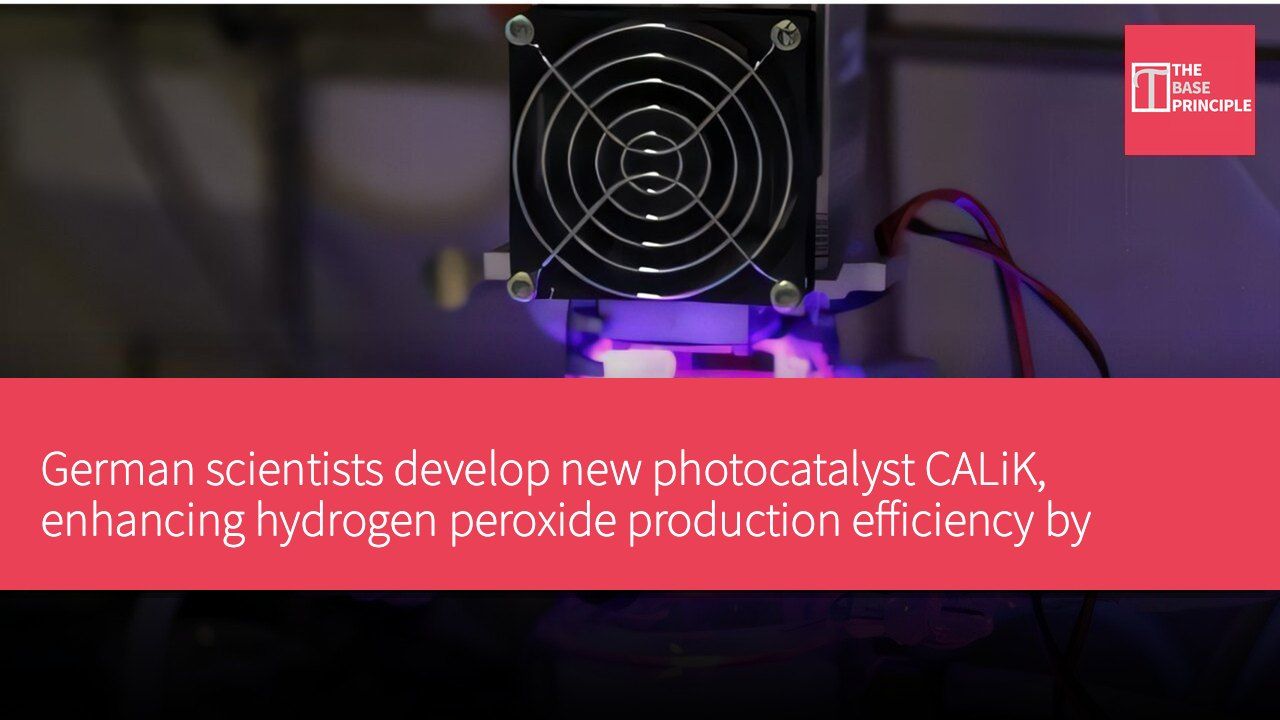
- The new photocatalyst CALiK increases hydrogen peroxide production by 200%.
- The arrangement of lithium and potassium atoms is crucial to the catalytic effect.
- Photocatalysis uses light to trigger chemical reactions to produce hydrogen peroxide.
- CALiK's yield is three times that of traditional catalysts.
German scientists have developed a new photocatalyst, CALiK, which increases hydrogen peroxide production by 200% through a clever arrangement of lithium and potassium atoms. This photocatalyst is based on carbon nitride, whose unique structure allows it to utilize light more effectively to produce hydrogen peroxide. Laboratory tests show that CALiK's hydrogen peroxide yield is three times that of standard materials, representing a 200% increase in production. Furthermore, the catalyst's performance exceeds that of the best-tested lithium single catalyst by about 40%. Anna Lo Presti, a PhD student at the Max Planck Institute, noted that the enhancement in catalyst performance comes from the arrangement of lithium and potassium atoms.
She emphasized that the spatial positioning of the ions has a significant impact on the catalytic effect. Presti added, "We have demonstrated for the first time that not only the type or quantity of ions matters, but their position in the lattice is equally critical."
Key to Enhanced Catalyst Performance
Hydrogen peroxide is a colorless, odorless, and slightly viscous liquid widely used as a disinfectant, bleach, and industrial chemical. Its production process typically relies on the anthraquinone method (also known as the Riedl-Pfleiderer process), which is energy-intensive and involves multiple chemical processing steps. In contrast, photocatalysis utilizes light to trigger chemical reactions to produce hydrogen peroxide. Carbon nitride has emerged as a promising option for this process due to its ability to absorb light and harness its energy to drive chemical reactions. Anna Lo Presti and Christian M. Pellicano from the Max Planck Institute are researching the photocatalyst CALiK.
Image/ Neubauer.
Production Process of CALiK
However, the charges generated when carbon nitride absorbs light quickly recombine, which reduces its catalytic efficiency. To address this issue, the scientists introduced lithium and potassium into the carbon nitride structure and controlled the positioning of these atoms. They created a specific atomic arrangement to improve the charge separation generated by light. Christian M. Pellicano, a PhD at the Max Planck Institute, stated, "We are not increasing the efficiency of the photocatalyst by changing its chemical composition, but rather by attempting to change the arrangement of its building blocks."
During the production process of the catalyst, the research team used special crystals containing carbon and nitrogen compounds along with lithium chloride as starting materials, which were arranged in a regular three-dimensional structure. They then heated these crystals with potassium chloride to create CALiK. Pellicano emphasized that these crystals are not a new discovery, but their application in the production of carbon nitride is novel. He added, "What interests us is that the chemical components they contain are consistent with the precursors we typically use."
The research team compared CALiK with traditionally prepared carbon nitride and a lithium single version known as CALi. They were surprised to find that CALiK's hydrogen peroxide yield is three times that of traditional catalysts and produces 40% more hydrogen peroxide than the best lithium single catalyst. These findings indicate that the precise placement of atoms is as important as the chemical composition of the catalyst. Pellicano summarized in a press release, "The key distinction is that these ions are arranged in a specific way, and we want to know whether this arrangement can be transferred to carbon nitride materials."
The study has been published in the journal Advanced Materials.
Innovation and Application Prospects of the New Catalyst
The development of CALiK highlights the importance of atomic arrangement in catalyst design, a discovery that could guide future research directions in catalysis. Traditional catalyst design has often focused on changes in chemical composition, while CALiK enhances efficiency by adjusting atomic positions, providing new insights for catalyst innovation. Additionally, advancements in photocatalytic technology contribute to reducing the energy consumption of hydrogen peroxide production, aligning with sustainability needs and holding significant implications for environmental protection and industrial applications.