
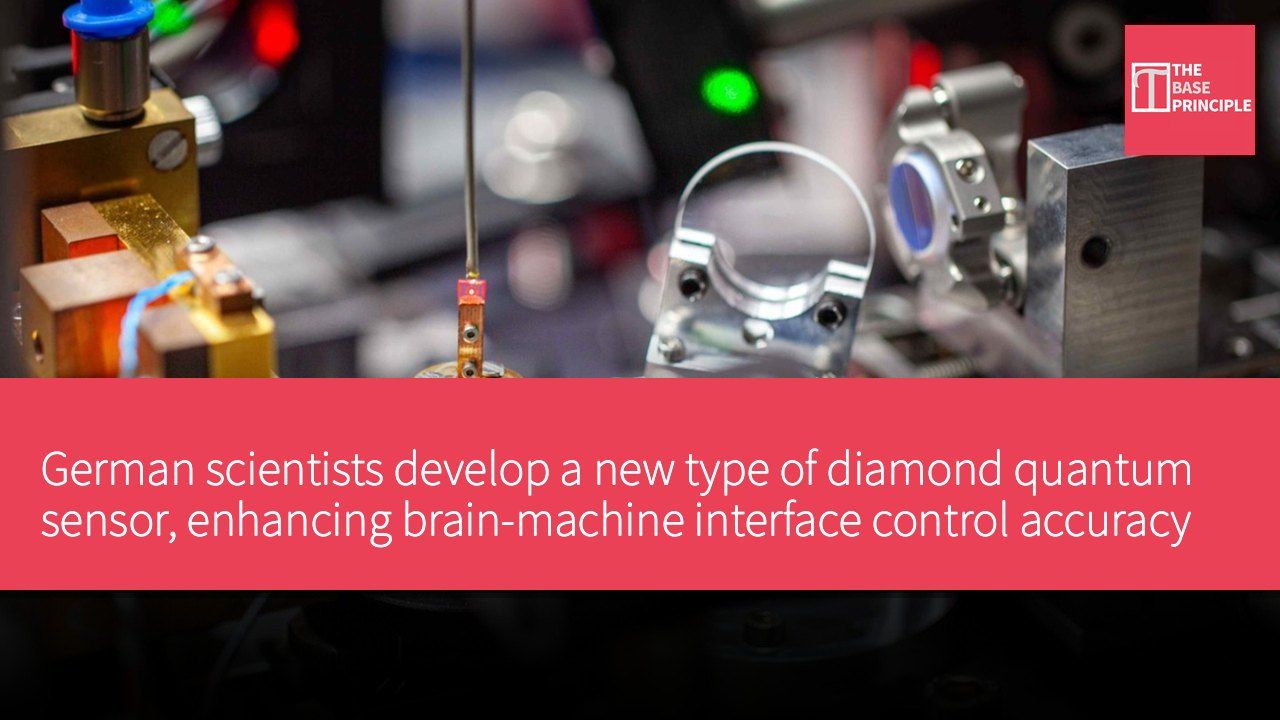
- The new diamond quantum sensor can enhance brain-machine interface control accuracy by 590 times.
- The technology utilizes NV centers to detect weak magnetic fields with high sensitivity.
- Research indicates that the sensor can be used in various applications, including medical testing and navigation.
- The technology is still under development and has not yet undergone practical testing.
German scientists recently demonstrated a new quantum sensor based on diamond, which has the potential to allow paralyzed individuals to control robotic exoskeletons using only their thoughts. This research was developed by a team at the Fraunhofer Institute for Applied Solid State Physics IAF, and the sensor utilizes a laser system to detect weak magnetic fields with high sensitivity. Compared to existing technologies, the device achieves 100% optical contrast and improves the balance between sensitivity and measurement range by up to 590 times.
The project is led by Dr. Jan Jeske, a researcher at the institute, who heads the quantum sensing group. Jeske proposed the theoretical model for using a nitrogen-vacancy (NV) center diamond laser system a decade ago. Jeske explained, "I am very pleased that we have now experimentally demonstrated the magnetic field dependence of the laser threshold." The applications of this sensor could include brain-computer interfaces, medical testing, navigation, and resource exploration.
Principles and Applications of the New Technology
Sensors for detecting magnetic fields have limited measurement ranges for very weak magnetic fields, while sensors with broader ranges typically have lower sensitivity. Therefore, the research team created a technique called laser threshold magnetometry. This technique relies on NV centers, which are essentially tiny defects in the diamond crystal that respond to magnetic fields. An NV center is formed when a nitrogen atom replaces a carbon atom in the diamond, leaving an adjacent position vacant. Traditional diamond quantum sensors measure the fluorescence emitted by these defects. The new technology places the diamond directly inside a laser cavity.
The NV centers interact with the laser's optical field, causing changes in the magnetic field to affect the laser output. Under certain conditions, these changes can even turn the laser off, achieving 100% optical contrast. In contrast, most NV-based magnetic sensors typically achieve only a few percent contrast.
The system can generate laser signals with power up to 50 milliwatts (mW), which is significantly stronger than signals from traditional sensors. Calculations indicate that under ideal photon shot noise limits, the technology can detect extremely weak magnetic fields with a sensitivity of less than 400 femtoTesla (fT) per square root Hertz (Hz) for every three magnetic field components. According to the research team, in addition to improving magnetic field measurements, this finding could also assist paralyzed individuals. These signals may ultimately be transmitted through brain-computer interfaces to control robotic exoskeletons. Other potential uses include detecting weak magnetic signals from the heart and muscles, improving navigation accuracy, and detecting underground magnetic anomalies.
Challenges and Prospects for Technological Development
However, the technology is still under development and has not yet been tested. Florian Schall, a doctoral researcher at Fraunhofer IAF and the lead author of the study, stated at a press conference, "Our approach may resolve the trade-offs that have long limited the development and application of magnetic field sensors." He added, "This will pave the way for a new generation of mobile, high-sensitivity magnetic field sensors." The research has been published in the journal Nature Communications.
Potential Impact of the New Quantum Sensor
The development of this new diamond quantum sensor marks a significant advancement in brain-machine interface technology, enabling paralyzed individuals to control robotic exoskeletons with greater precision, demonstrating its potential in the medical field. Furthermore, the technology's high sensitivity and enhanced optical contrast could alter existing standards for magnetic field measurement, expanding its applications in navigation and resource exploration. However, as the technology is still in the development phase, further testing and validation are needed for future practical applications.