
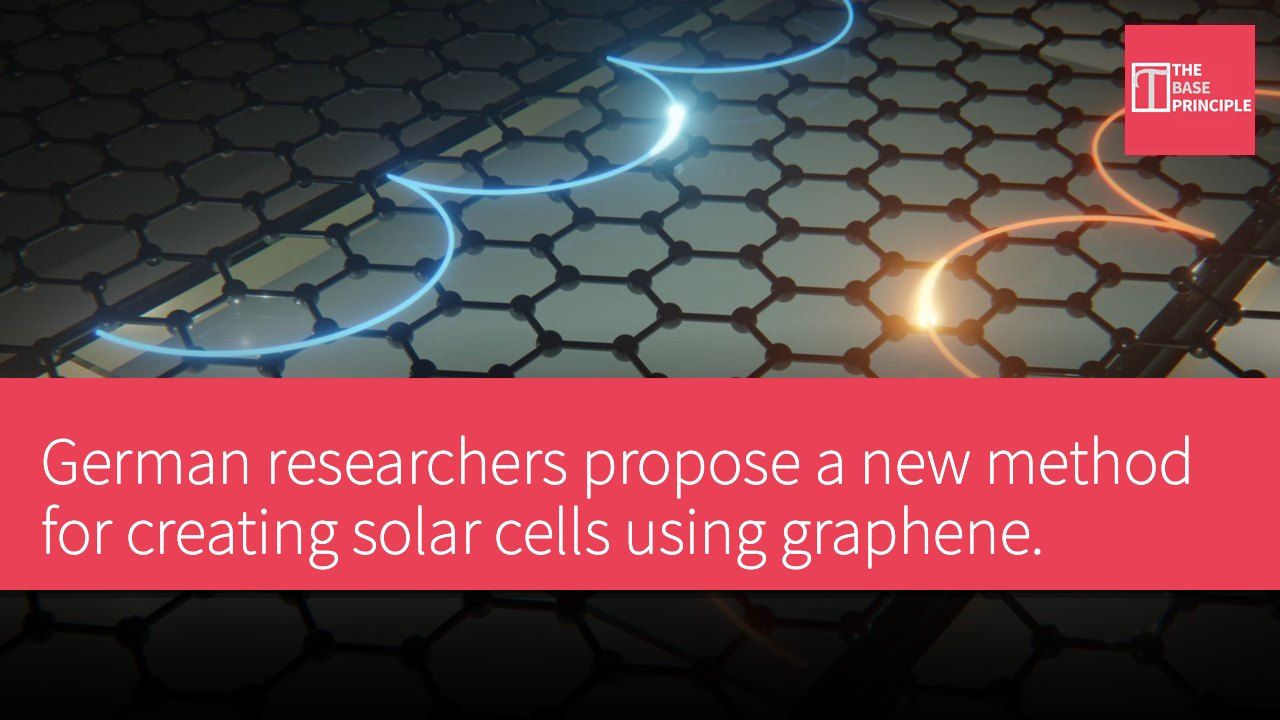
- Researchers propose a new method for manufacturing solar cells using graphene.
- Challenges exist in the light energy conversion efficiency of graphene, necessitating the creation of a bandgap.
- Application of voltage and magnetic fields can guide the flow of electrons and holes.
- Graphene-based batteries can interact with infrared photons, expanding their range of applications.
Researchers at the Helmholtz Center Dresden-Rossendorf (HZDR) in Germany have introduced a new approach to manufacturing solar cells, photodetectors, and optoelectronic devices using graphene as the core material, replacing traditional silicon materials. This could open a new realm for future electronic products, allowing light energy to serve as a direct power source. Graphene is a two-dimensional material made up of carbon atoms arranged in a hexagonal lattice, with a thickness of just one atom. It is a fundamental component of carbon nanotubes and graphite, with applications ranging from flexible displays to lithium batteries.
Graphene exhibits excellent conductivity, but its efficiency in converting light into electrical energy is not high. While light energy can indeed excite electrons in graphene, these electrons cannot be used for power because the "holes" they leave behind are not separated and cannot be effectively guided to the electrodes, which is a strength of silicon materials.
Challenges and Solutions for Graphene
The reason semiconductors like silicon can be used in solar cells is that they possess a bandgap. The bandgap is the energy required to excite electrons from a low-energy state to a high-energy conduction band, allowing electrons to move freely and conduct electricity. In contrast, graphene does not have a similar bandgap. Ralf Schützhold, a theoretical physicist at HZDR, therefore suggests creating a bandgap through other methods, such as shearing and folding graphene to form tiny edges. When incident light generates electrons and holes in the modified graphene, a magnetic field can be applied to cause the charge carriers to move in circular paths.
The purpose of these edge configurations is to act as barriers, guiding the charge carriers in opposite directions. This facilitates the separation of electrons and holes, enabling them to carry current.
Experimental Setup and Advantages of the New Method
Although this method is feasible, it lacks scalability and cannot be deployed in real-world scenarios. HZDR researchers then considered using voltage as a barrier, as its deployment in graphene is relatively simple. By placing narrow metal electrodes on an insulating layer, voltage can be applied to the graphene sheet, creating potential barriers for the flow of electrons and holes. When a magnetic field is applied to the graphene, electrons and holes will move in circular paths, and this movement can be converted into directed motion through the barriers created by the voltage. Negative charge barriers reflect electrons, while positive charge barriers attract them; these barriers are used to guide their flow.
Researchers have determined the height and width of the barriers to ensure that electrons can flow smoothly.
The experimental setup resembles a sandwich, with a layer of graphene in the middle. The advantage of this method is that by changing the voltage or turning off the electrodes, charge transport can be adjusted to different light energies. While silicon can interact with visible light, graphene-based solar cells can also interact with infrared photons, which are considered to have too low energy to generate electron-hole pairs in silicon. According to the researchers, a magnetic field of 0.1 Tesla and a spacing of a few micrometers are sufficient to convert infrared light into electrical energy. To enhance light absorption, multiple layers of graphene can also be added, separated by insulating layers.
This research has been published in the journal Physical Review Applied.
Potential and Limitations of Graphene Solar Cells
Graphene shows potential as a new material in the application of solar cells, particularly in its interaction with infrared photons. Although challenges remain in light energy conversion efficiency, the researchers' innovative approach using voltage and magnetic fields holds promise for overcoming these limitations. This not only provides new insights for the design of solar cells but may also drive the development of future electronic products, especially in the field of efficient energy conversion.