
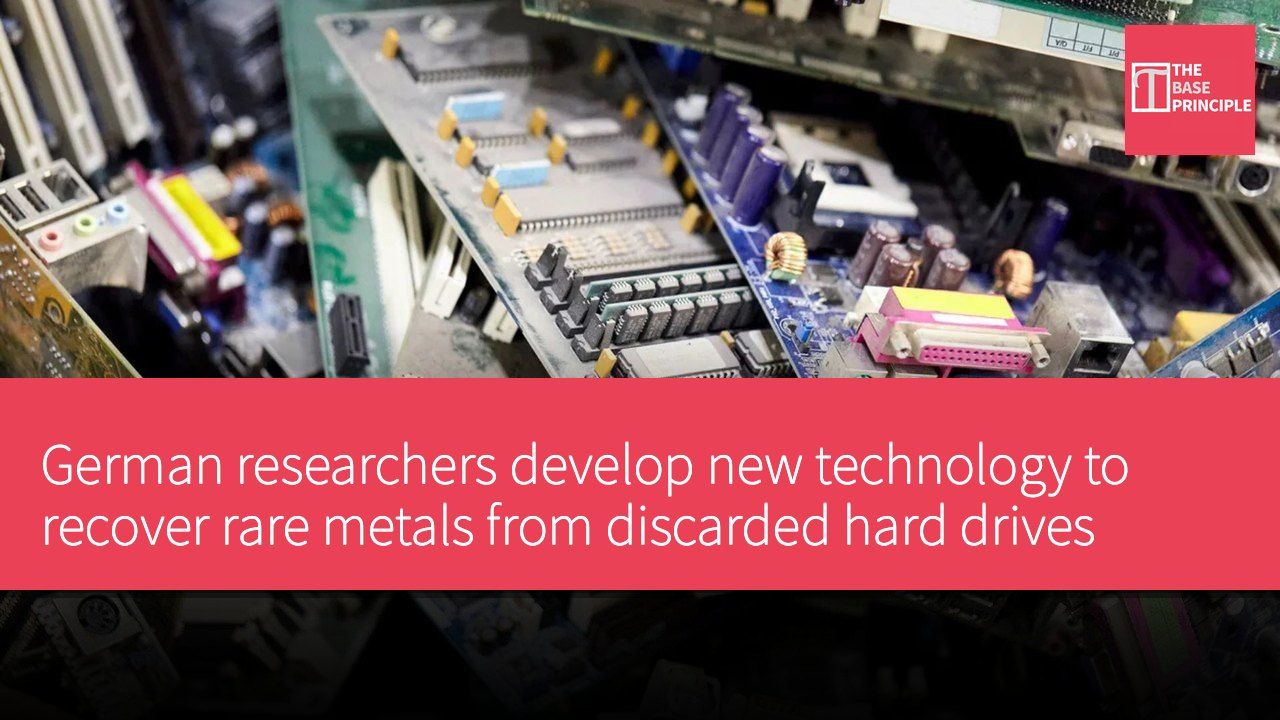
- German researchers are testing new processes to recover rare metals from discarded hard drives.
- Neodymium-iron-boron magnets are widely used in electric vehicles and electronics, but recycling challenges remain.
- The NEO-CYCLE project explores two new methods to improve metal recovery efficiency.
- If successful, it could reduce dependence on imported critical raw materials and promote a circular supply chain.
Discarded computer hard drives could become an important source of raw materials for electric vehicles, wind turbines, and other technologies. Researchers in Germany are testing two processes for recovering precious metals from old magnets, one of which uses ammonium chloride instead of traditional hydrochloric acid. This work is part of the EU-funded NEO-CYCLE project, in which researchers from the Fraunhofer Institute for Ceramic Technologies and Systems (IKTS) collaborate with TU Bergakademie Freiberg to recover neodymium, iron, and boron from discarded hard drives.
Neodymium-iron-boron magnets are among the strongest permanent magnets currently available and are widely used in electric vehicle motors, wind turbines, and electronic products such as speakers, smartphones, and hard drives. However, recovering and reusing their constituent materials at the required purity remains technically challenging. According to Fraunhofer, neodymium is particularly important because about 90% of the material is imported from China. Additionally, most of the magnet waste collected in Europe is sent to China for processing before the recycled materials are imported back.
New Methods to Improve Metal Recovery Efficiency
Researchers in the NEO-CYCLE project are evaluating two methods to separate valuable materials from discarded computers and laptops. The first method is solid-state chlorination, developed by project partner TU Bergakademie Freiberg. This method does not use traditional hydrochloric acid but instead employs a mixture with added ammonium chloride, which contains neodymium, iron, and boron recovered from magnet waste. During the heating process, this mixture transforms into metal chlorides and a high-purity ammonia solution. This method builds on a patented process currently used for recycling fluorescent lamps, and researchers are testing its application in magnet recycling.
Preliminary results indicate that this method can more effectively separate metal chlorides from magnet materials, allowing for the extraction of nearly all metals while using relatively few chemicals.
The second method employs electrochemical treatment. Researchers place powdered magnet waste in an electrochemical cell, where diluted sulfuric acid and other electrolytes provide the medium for chemical reactions. This process initially extracts boron into the solution, which can then be concentrated for use in the chemical and pharmaceutical industries. After initial processing, researchers at Fraunhofer IKTS use hydrometallurgical techniques to separate the obtained materials. The team employs selective treatment to recover neodymium and iron, obtaining the metals in pure salt form. The recovered materials can subsequently be further processed by project partners for applications in various industries, including chemicals, pharmaceuticals, hydrogen production, and fertilizers.
Potential for Establishing a Circular Supply Chain
Researchers are also exploring how to transform the recovered materials into higher-value products, rather than merely extracting them from waste. This helps establish a circular supply chain, turning discarded electronic components into raw materials for new industrial applications. The four-year NEO-CYCLE project is funded by the EU's Horizon Europe program. Researchers have completed laboratory-scale tests of the recycling methods and are currently planning a pilot plant. The goal is to develop an economically and environmentally viable process for recovering high-quality materials from discarded magnets while reducing the consumption of chemicals and water.
If successful, this method will help Europe better utilize electronic waste and reduce dependence on imported critical raw materials.
Impact of New Technologies on Electronic Waste Recycling
As the rapid growth of electronic products continues, the recycling of electronic waste has become a global focus. Germany's NEO-CYCLE project demonstrates progress in environmental protection and resource management through innovative technologies for recovering rare metals. These new methods not only improve recycling efficiency but also help reduce dependence on external resources, promoting the development of local supply chains. If successfully implemented, this could set an example for Europe in sustainable development and resource circularity, potentially having a profound impact on global electronic waste management.