
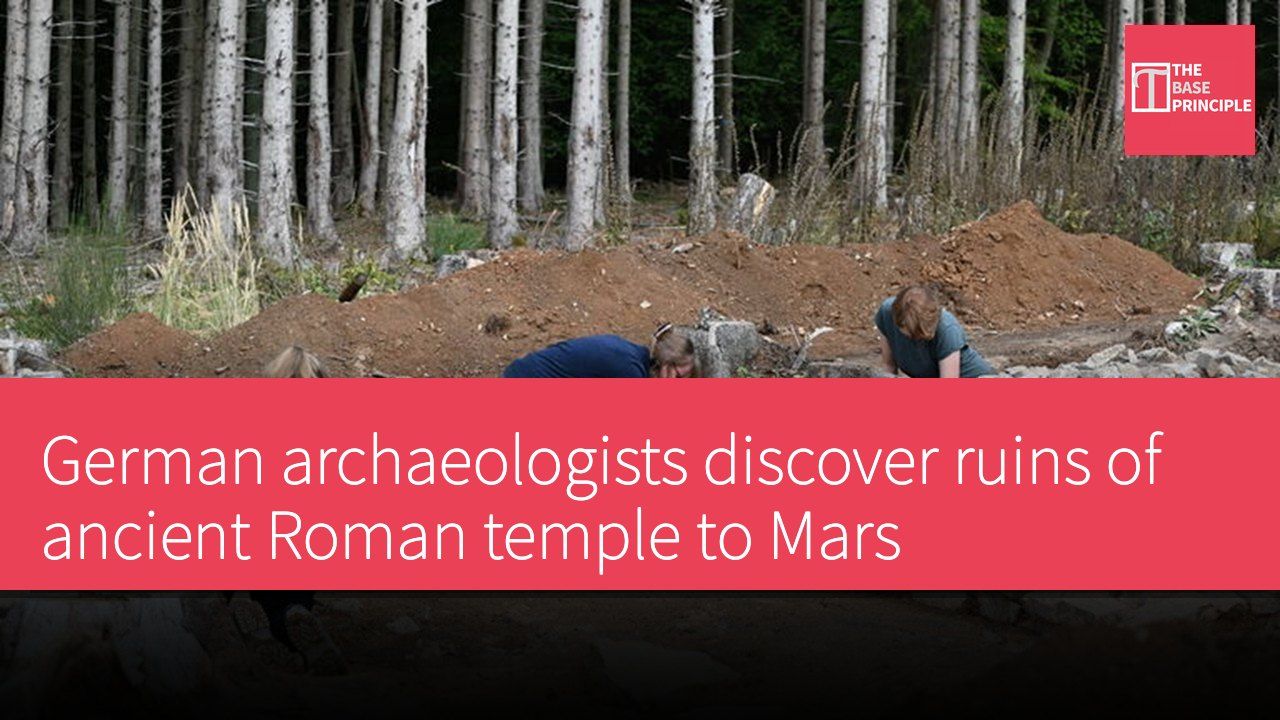
- Archaeologists discover ruins of ancient Roman temple to Mars near Frankfurt.
- Temple interior features a square room with three walls.
- Artifacts found include fragments of a Mars statue and votive stones.
- Site's preservation remains good due to forest cover.
German archaeologists have uncovered what appears to be a Roman temple dedicated to the war god Mars beneath the forest floor near Frankfurt. According to a Sept. 25 announcement from the Hesse State Office for Heritage Management, the structure lies at the foot of the Taunus Mountains, near Frankfurt's northern edge, adjacent to the Kapersburg fort.
Temple structure and artifacts
The rectangular temple measures roughly 16 feet long and, according to the Smithsonian, appears to contain a smaller square room with three walls, each about 20 inches thick. Archaeologists suspect it may be an ambulatory temple with a three-walled prayer chamber accessed through a wooden door or gate and surrounded by a covered walkway. An inscription indicates the temple was dedicated to Mars. The team also found a statue fragment that may depict the war god, along with two votive stones and a broken statuette of Victoria, the goddess of victory, who often appears alongside Mars.
The statuette still retains her wings, a palm branch, and a laurel wreath.
Historical context of the archaeological find
A Latin inscription inside the temple chamber is being deciphered and may reveal the name of the nearby village. The temple was discovered during excavations at the Kapersburg fort, which is thought to have been built in the second century and stood adjacent to a village, or vicus. Researchers estimate about 160 soldiers were garrisoned at the fort, while up to 700 people lived in the settlement. Since 2024, the state office and Goethe University Frankfurt have been investigating this vicus. Early excavation work focused on the fort, but drought, pests, and storms that cleared parts of the surrounding forest prompted archaeologists to turn their attention to the settlement.
Regional archaeologist Kai Mückenberg said the forest's presence explains the site's condition. "The preservation layers we have here are unparalleled in Hesse because no agricultural activity has ever affected these layers," he said. He added: "The forest has preserved everything for the past several centuries."
The team also uncovered traces of craft activity, including a smithy area and a possible drying oven for grain. Leveled layers suggest the Romans dismantled these workshops during a reorganization and later built housing atop them. Remnants of roads and terraces help illustrate the settlement's layout. Near the temple, archaeologists also found a late-antique fibula and fragments of handmade pottery. If confirmed, these would be the first archaeological evidence in the region from after the Romans left, attributed to the Alemanni tribe that lived in Wetterau, the state office said.
A Roman auxiliary unit known as the "Nidensium" garrisoned the fort for about 150 years until it was abandoned in the mid-third century. The fort sits on the Upper Germanic-Rhaetian Limes, a 342-mile-long UNESCO World Heritage Site marking the Roman frontier between the Rhine and Danube rivers. Mückenberg hopes to continue excavations next year with students from Goethe University Frankfurt. Even 125 years after the fort was first surveyed, the dig shows the story of the Roman presence in Hesse is far from over, the state office said.
Discovery and significance of ancient Roman remains
The discovery by German archaeologists near Frankfurt demonstrates the influence of ancient Roman culture in the region, particularly military-related religious activity. This temple dedicated to the war god Mars and its surrounding artifacts provide valuable material for understanding the social structure and religious beliefs of the time. Archaeologists note the site's good preservation, which is crucial for further research into Roman lifeways and their interaction with neighboring communities.