
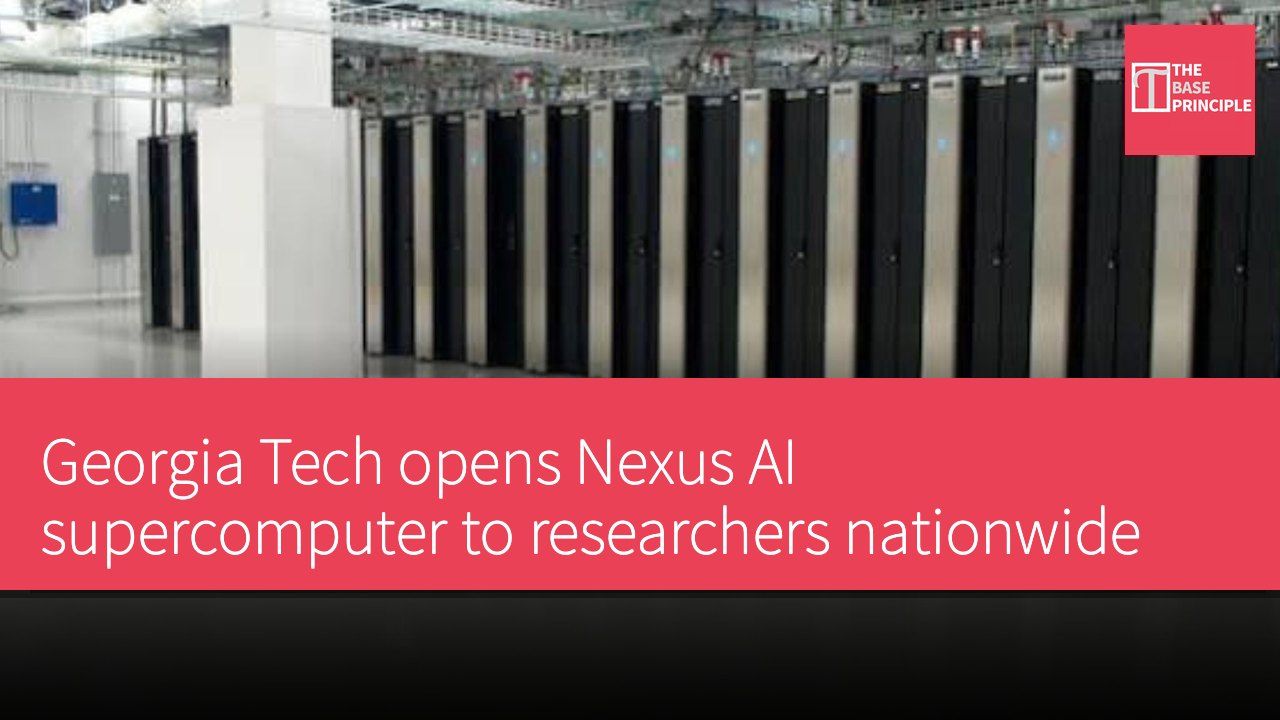
- Nexus is a newly installed AI supercomputer open to researchers nationwide.
- Nexus can break down large computational problems and compute them simultaneously to accelerate solutions.
- The computer's construction was funded by NSF investment and in collaboration with the University of Illinois.
- 90% of computing capacity will be made available to researchers through a peer-reviewed allocation process.
Nexus, the latest artificial intelligence supercomputer installed at the Coda Data Center in Atlanta, is now open to researchers across the United States. Georgia Tech has provided nationwide access to this resource. Nexus's cloud services will enable researchers to access massive computing power from anywhere in the country. Computers can help scientists perform massive calculations; however, when problems are too large to solve individually, computers require a long time to complete the calculations. Supercomputers, by contrast, possess vast computational resources that can break problems into parts and distribute them across different resources for simultaneous computation, yielding solutions more quickly.
This is particularly important when solving problems such as hurricane modeling.
Building and Collaboration Behind Nexus
Rather than using a single processor to obtain a complete model, a supercomputer can divide a problem into small three-dimensional boxes and assign the activity within each box to a processor. Each processor simulates only the information within its assigned box, then shares that information with neighboring processors to create a larger picture of the hurricane. How was Nexus built? Nexus's construction received a $20 million investment from the National Science Foundation (NSF) and was carried out in collaboration with the University of Illinois Urbana-Champaign. Although the computing world's fervor has largely centered on artificial intelligence (AI) and data centers, Nexus's availability offers researchers a new way to combine AI with supercomputing.
Nexus integrates both, allowing research teams to run simulations, process large datasets, and build AI models on a single platform.
Nexus's Impact on Research
Georgia Tech President Ángel Cabrera said in a press release: "This new resource will help researchers nationwide accelerate discovery and strengthen collaboration in fields requiring advanced computing." He noted, "Expanding the nation's computational capacity for scientific discovery reflects Georgia Tech's commitment to advancing research and improving lives." Support for research on Nexus will extend the system's capabilities, enabling scientists across the United States to advance research in drug discovery, energy, neuroscience, robotics, and other fields. As a national resource, 90% of computing capacity will be made available through an open, peer-reviewed allocation process coordinated by the NSF.
Irina Dolinskaya, director of the NSF's Division of Computing and Communication Foundations, said: "By integrating advanced computational capabilities with expertise from the research community, Nexus will help expand the range of scientific problems researchers can solve and enhance the nation's capacity for AI-driven discovery." She added: "Nexus is part of a larger NSF effort to strengthen U.S. research infrastructure, enabling researchers nationwide to access the advanced computing capabilities they need to accelerate scientific discovery." University of Illinois Urbana-Champaign Chancellor Charles Isbell said in a press release: "Georgia Tech and the University of Illinois bring complementary expertise to Nexus, and we are pleased to contribute the National Center for Supercomputing Applications' decades of experience operating national computing resources and supporting users."
He noted: "Together we have built a partnership and infrastructure that foster discovery, ultimately improving the lives of those we serve."
Nexus's Role in Advancing Scientific Research
The opening of the Nexus supercomputer marks a new era of research resources, providing powerful computational capabilities to scientists across the United States. This will not only accelerate scientific discovery but also foster collaboration across multiple fields, particularly in areas requiring high computational power such as drug discovery and robotics. By combining artificial intelligence with supercomputing, Nexus can solve more complex scientific problems, which holds significant importance for driving technological progress and improving human lives.