
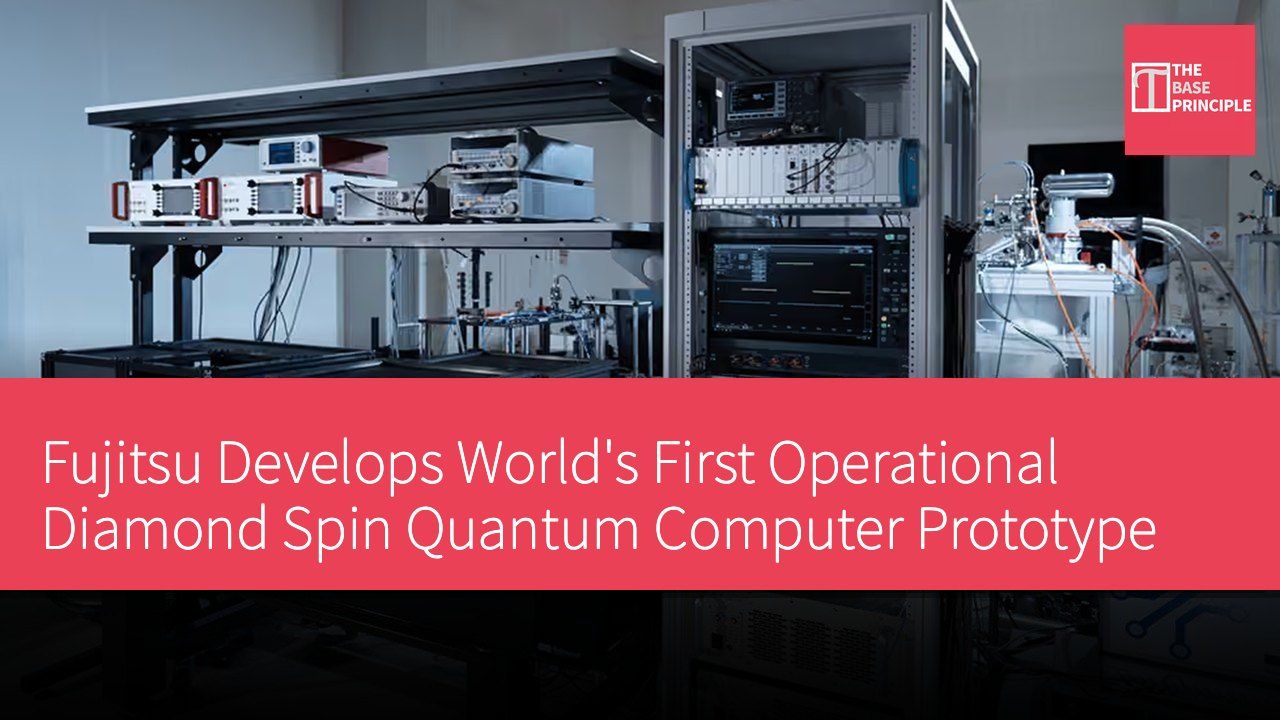
- Fujitsu has developed the world's first operational diamond spin quantum computer prototype.
- The new prototype can operate at -456.9 degrees Fahrenheit, which is about 2.8 degrees Fahrenheit higher than that required by superconducting quantum computers.
- The system uses tin-vacancy centers, offering higher optical emission brightness and stability.
- Fujitsu plans to achieve practical quantum computing by 2030.
Japanese tech giant Fujitsu has developed the world's first operational diamond spin quantum computer prototype, incorporating tin-vacancy (SnV) centers into a photonic integrated circuit. This new prototype can operate at -456.9 degrees Fahrenheit (-271.6 degrees Celsius), which is approximately 2.8 degrees Fahrenheit higher than the -459.6 degrees Fahrenheit (-273.13 degrees Celsius) required by superconducting quantum computers. Fujitsu stated that the technology can drive the development of more powerful quantum computers by using light to connect various computing modules. The company plans to build a multi-module diamond spin prototype by 2027 and aims to achieve practical quantum computing by 2030.
According to Fujitsu's quantum roadmap, the company plans to develop a 250-logical-qubit system by fiscal year 2030 and a 1000-logical-qubit system by fiscal year 2035. Dr. Kees Eijkel, Director of QuTech, said, "We are excited to announce this prototype diamond spin quantum computer, which is the result of collaborative research between Fujitsu, Delft University of Technology, and QuTech since 2020."
New Qubit Technology
The prototype relies on lattice defects in diamond crystals, more commonly known as color centers, to create qubits. Diamond spin systems typically rely on nitrogen-vacancy (NV) centers, which form when a nitrogen atom replaces a neighboring carbon atom in the diamond lattice. However, for the new system, engineers have turned to using tin-vacancy (SnV) centers. These defects have a tin atom positioned between two vacancies in the diamond structure. Fujitsu claims that their symmetrical structure makes SnV centers less susceptible to external noise compared to traditional NV centers.
Furthermore, the optical emission brightness of SnV centers is about 10 times that of NV centers, which could improve optical connections between quantum modules and help increase the efficiency of error correction.
The system's characteristics can maintain the stability of quantum states and allow for the formation of logical qubits (groups of physical qubits that perform quantum computations according to quantum algorithm specifications) using fewer physical qubits than competing methods. Fujitsu first created a process to implant high-quality tin into diamond substrates combined with aluminum oxide and silicon dioxide substrates. The diamond's thickness was reduced from several hundred micrometers to just a few hundred nanometers to integrate into quantum chips.
Future Plans for Quantum Computing
The company has also produced a photonic integrated circuit that combines nanoscale diamond crystals containing SnV centers with aluminum oxide optical waveguides. Ultimately, Fujitsu has created a mechanism to control diamond spin qubits through light, microwaves, and radio frequency waves. Fujitsu Chief Technology Officer Vivek Mahajan stated, "The diamond spin approach we have applied in this prototype not only has excellent scalability in itself but also has the potential to integrate with superconducting quantum computers to further expand its capabilities, making more complex large-scale computations possible."
The device has been run in a test environment through Fujitsu's hybrid quantum computing platform. According to the company, users do not need additional expertise to control this new hardware. Mahajan summarized in a statement, "Based on our roadmap, aiming to achieve a 250-logical-qubit system by fiscal year 2030 and a 1000-logical-qubit system by fiscal year 2035, Fujitsu will continue to advance practical quantum computing, developing across a wide range of areas from software to hardware, while leveraging the key advantages of the diamond spin approach, including high fidelity and optical connectivity."
Item Specification Operating Temperature -456.9 degrees Fahrenheit (-271.6 degrees Celsius) Tin-Vacancy Center Present in diamond structure Optical Emission Brightness About 10 times that of NV centers
The Potential and Challenges of Diamond Spin Quantum Computers
Fujitsu's diamond spin quantum computer prototype marks a significant advancement in quantum computing technology. By using tin-vacancy centers, the system outperforms traditional nitrogen-vacancy centers in terms of stability and optical emission brightness, which is crucial for improving the efficiency of quantum computing. Additionally, the higher operating temperature of the technology may make the practical application of quantum computers more feasible. However, Fujitsu still needs to overcome technical challenges to achieve its quantum computing goals by 2030 and ensure that its system can integrate with existing superconducting quantum computer technology.