
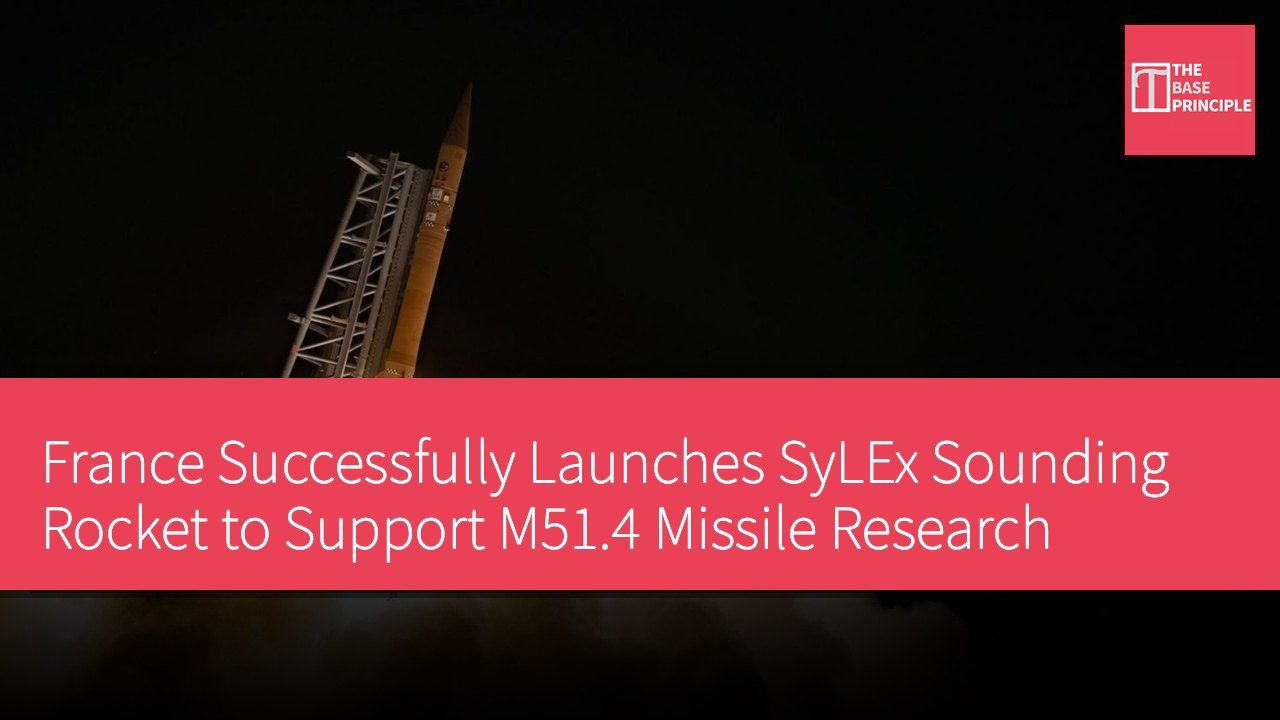
- France successfully launched the SyLEx sounding rocket to support M51.4 missile research.
- SyLEx can carry payloads of up to 600 kilograms, suitable for military and civilian applications.
- This launch marks the restoration of France's suborbital testing capabilities, which are crucial for national defense.
- ArianeGroup is developing a two-stage version of SyLEx to expand its mission scope.
France successfully launched its SyLEx sounding rocket, marking the second flight of the system and the first practical flight demonstrating the restoration of national sovereign suborbital testing capabilities. The launch occurred on November 4 at the missile test center in Biscarrosse, operated by the French Directorate General of Armaments (DGA), carrying an experimental payload designed for the French military to support research related to the development of its M51.4 strategic missile. SyLEx stands for Système de Lancement d’Expériences, built by ArianeGroup under the guidance of the DGA, aimed at delivering experimental equipment to altitudes between 200 and 400 kilometers.
This flight is the second successful launch of the system following the initial demonstration on November 28, 2025. Catherine Colonna, the French Minister for the Armed Forces and Veterans, stated that this mission enables critical experiments for the development of the M51.4 missile.
Design and Applications of the SyLEx Rocket
Unlike orbital launch vehicles, sounding rockets fly along a suborbital trajectory, delivering instruments and experimental payloads to high altitudes before returning to Earth. They provide researchers with opportunities to experience atmospheric conditions and brief microgravity, which are highly useful for testing materials, sensors, and other technologies. According to ArianeGroup, SyLEx can carry payloads of up to 600 kilograms, accommodating multiple experiments per flight depending on the mission configuration. The system is designed for both military and civilian applications, including atmospheric re-entry studies and microgravity experiments. SyLEx includes two rocket configurations: single-stage and two-stage versions, supported by dedicated launch pads.
The mission on November 4 utilized the single-stage configuration. ArianeGroup stated that it is now collaborating with the DGA to develop the next milestone: the two-stage version. Reports indicate that the single-stage setup can support research equipment weighing up to 300 kilograms.
The Importance of the Launch for France's Nuclear Deterrence
This launch is particularly significant for France's nuclear deterrent capabilities. The M51 series of submarine-launched ballistic missiles constitutes the sea-based component of the country's nuclear force. The M51.4 is a planned evolution of this missile system, although French officials have not disclosed the specific experiments conducted on SyLEx or how they contribute to the system's development. Colonna also emphasized the rocket's potential to support hypersonic demonstrators. High-altitude experimental flights help assess technologies under harsh flight conditions, including those related to atmospheric re-entry and high-speed flight. However, specific hypersonic research activities related to the SyLEx program have not been detailed.
ArianeGroup described this successful launch as a demonstration of its capability to provide a sovereign suborbital testing platform. The company stated that it developed the system for the DGA in less than three years, acting as the contracting agency for the program. Besides defense, SyLEx could also support civilian research and other European applications. Its payload capacity and ability to accommodate multiple experiments provide a platform for scientific investigations requiring high-altitude access. For France, this launch marks the return of domestic suborbital flight and high-altitude testing capabilities after decades without such capabilities.
With the single-stage version completing its first practical flight, the next step is to develop the two-stage configuration, which will expand the range of missions the system can undertake.
The Impact of SyLEx on France's Defense Capabilities
The successful launch of the SyLEx rocket marks a significant return for France in suborbital testing capabilities, which is crucial for enhancing defense technology and nuclear deterrent strength. The development of the M51.4 missile requires high-altitude experiments to test its technologies, and SyLEx provides such a platform. With the development of the two-stage version, it will be able to undertake more complex missions in the future, further enhancing France's military capabilities. Additionally, the design of SyLEx also considers civilian needs, demonstrating its multipurpose potential, which could have a positive impact on scientific research and technological development in Europe.