
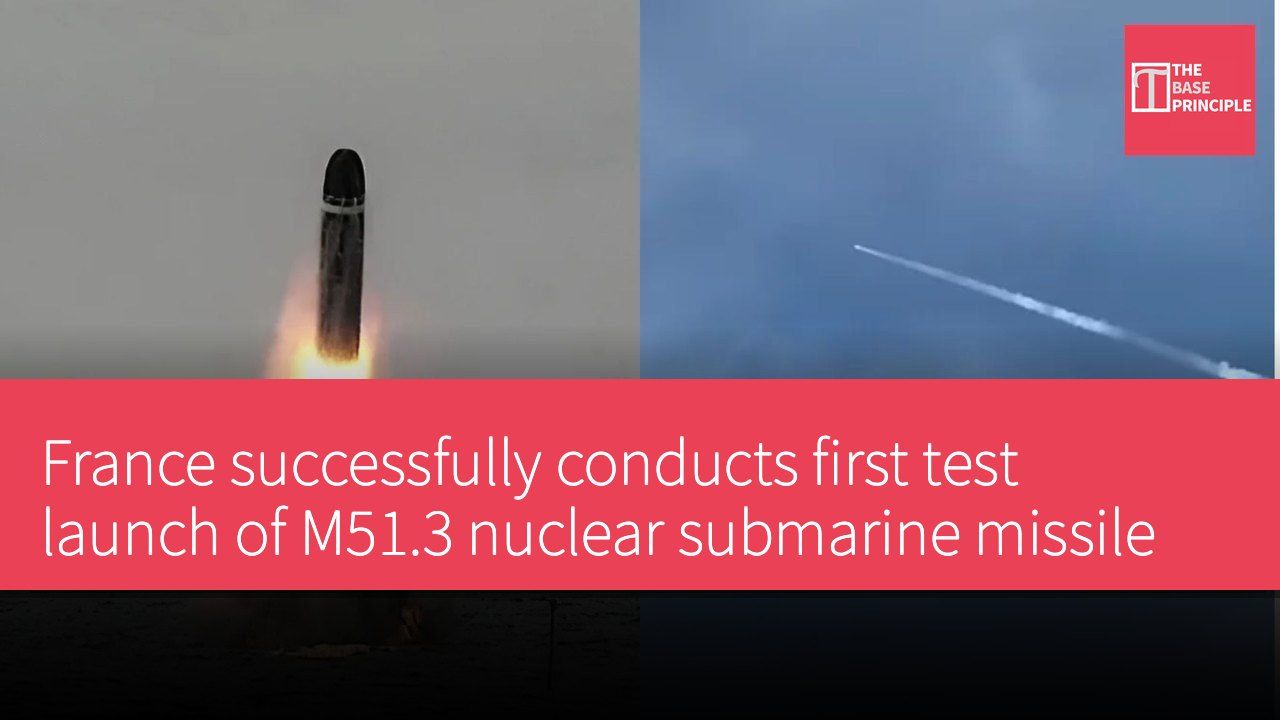
- France successfully conducts first test launch of M51.3 nuclear submarine missile.
- Launch test examines missile performance and submarine operational capability.
- M51.3 missile range exceeds earlier versions, features enhanced accuracy.
- Test marks M51 series transition from development to submarine operations.
France has completed the first submarine launch of its upgraded M51.3 strategic nuclear submarine-launched ballistic missile. The test examined the missile's performance aboard the nuclear submarine Le Vigilant. The missile was launched on Tuesday during an acceptance test off France's western coast, without a nuclear warhead, flying toward the North Atlantic. French officials said the missile reached a designated area several hundred miles from land. The test took place after Le Vigilant completed major maintenance work.
Multiple objectives of the launch test
The launch test was not only about the missile's flight performance; engineers also needed to verify the submarine's ability to operate the upgraded weapon. Le Vigilant launched the M51.3 after completing a major overhaul. France typically conducts acceptance launches after major maintenance on its ballistic missile submarines.
French President Emmanuel Macron posted on Twitter: "Aboard the multi-mission frigate Auvergne, I witnessed the first launch of the new M51.3 ballistic missile from the nuclear submarine Le Vigilant. Only a few nations possess such technological capability. Congratulations to all personnel involved in this success."
Technical features of the M51.3 missile
The process checks whether the submarine and missile can operate together as an integrated system, including the launch sequence and the missile's performance after leaving the submarine. The M51 is launched underwater from the submarine using a gas-propelled ejection system. Its solid-fuel rocket motor then propels the missile through the atmosphere. A successful submarine launch represents a significant step beyond ground test flights. The weapon must remain compatible with the submarine's launch systems and operational environment.
The M51.3 is the latest operational version of France's M51 submarine-launched ballistic missile. ArianeGroup and the French Defence Procurement Agency jointly developed the missile. The missile's official range remains classified; independent estimates place the M51.3's range at over 5,900 miles, giving it longer range than earlier versions. Previous M51 variants reportedly had a range exceeding 5,600 miles. ArianeGroup states that the M51 can climb to over 1,240 miles above Earth before re-entering the atmosphere at approximately Mach 20.
The M51 series also employs multiple independently targetable reentry vehicle (MIRV) technology, allowing multiple warheads to fly along different trajectories after the missile's boost phase. The M51.3 also introduces improvements aimed at enhancing accuracy and penetration capabilities, making the missile's guidance and reentry systems especially critical.
Engineering challenges of submarine launch
ArianeGroup and the French defence procurement agency conducted the first flight test of the M51.3 at a ground facility in 2023, which helped verify the upgraded missile's performance before submarine deployment. The new test adds another layer of verification, allowing engineers to assess the missile's full launch sequence from its intended operational platform. Launching a ballistic missile from a submarine presents additional engineering challenges: the weapon must be safely ejected from a moving platform before its rocket propulsion takes over. The submarine must also conduct the launch without impeding its own operations, requiring precise coordination between the submarine's launch systems and the missile.
France placed the M51.3 into operational service in 2025, and the country's next planned upgrade, the M51.4, is expected to further enhance the system's capabilities. Tuesday's test therefore marks an important checkpoint for the M51 series, demonstrating that the upgraded missile can transition from development testing to submarine-based operations.
Advances in French nuclear submarine missile technology
France's M51.3 nuclear submarine missile test demonstrates its continued progress in strategic weapons systems. This test not only underscores the missile's performance but also validates the submarine's operational capabilities, highlighting France's competitiveness in global nuclear weapons technology. With the successful launch of the M51.3, France further consolidates its position as one of the few nations possessing advanced submarine-launched missile technology. This series of tests and upgrades will lay the groundwork for the future M51.4 system, reflecting France's long-term planning and investment in defence and security.