
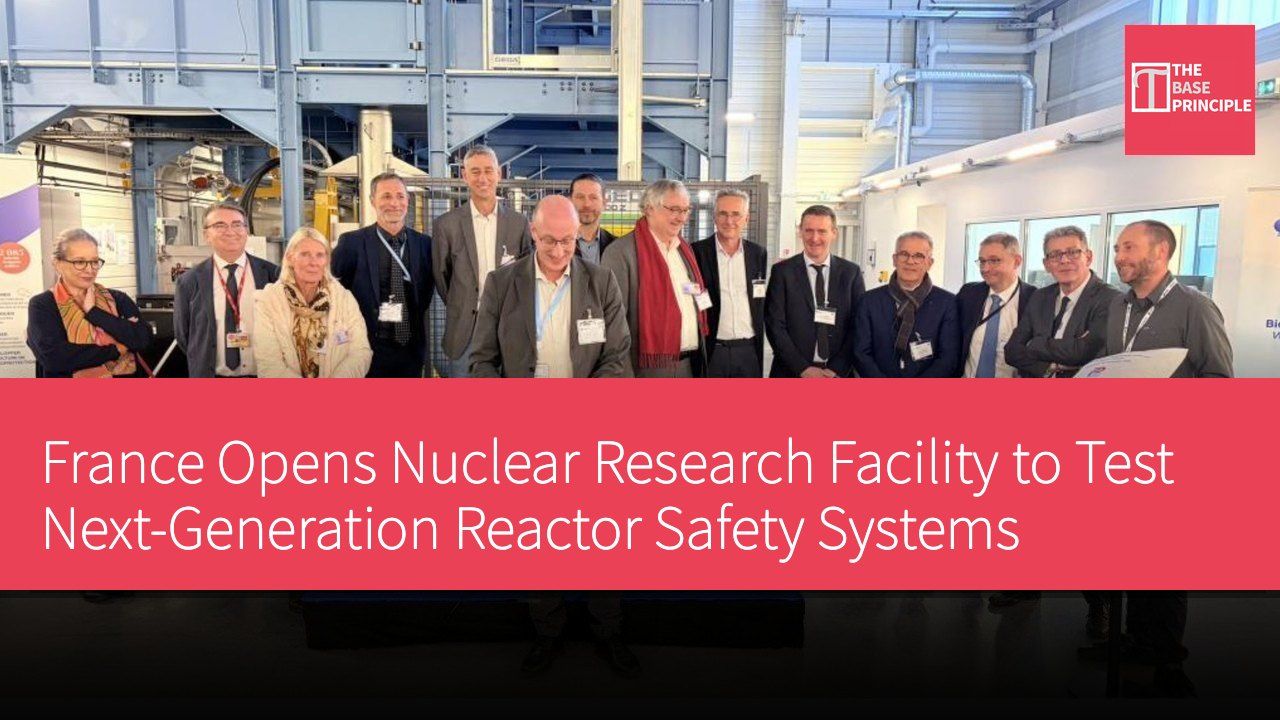
- France's new nuclear research facility will test the passive safety systems of advanced reactors.
- The PASTIS project will study the thermal removal performance of light water reactors during accidents.
- Experimental results will improve France's nuclear simulation tools, particularly CATHARE and ASTEC.
- ASNR plans to share PASTIS research findings with domestic and international organizations to promote collaboration.
France has opened a new nuclear research facility in Cadarache to test the passive safety systems of advanced reactors, including small modular reactors (SMRs). The center will evaluate their performance under normal and abnormal operating conditions, as well as during nuclear accidents. The Nuclear Safety and Radiation Protection Authority (Autorité de Sûreté Nucléaire et de Radioprotection, ASNR) announced the facility's opening on November 9, 2026. The research project, named PASTIS, focuses on the removal of residual heat in light water reactors during accidental operating conditions and accidents.
Background of the PASTIS Research Project
The systems under study rely on natural processes, such as convection and condensation, and require minimal external intervention. The French government has allocated approximately $10 million (around €9 million) through its France 2030 plan to support the project. This funding will assist researchers in generating experimental data to evaluate passive safety systems and improve nuclear safety assessments.
The PASTIS project builds on research conducted in 2016 by the former Institute for Radiological Protection and Nuclear Safety (IRSN), which examined the reliability of passive safety mechanisms and indicated the need for additional experiments under different operating conditions. The Cadarache facility features two modular experimental platforms to study thermal hydraulic processes. ALCINA is a thermal hydraulic loop designed to measure pressure losses in pipes of varying sizes under different operating conditions. It will use forced convection and natural circulation to examine single-phase and two-phase flows. KoKoMo is a closed vessel equipped with a cold wall condenser to study condensation on internal surfaces.
Researchers will explore how condensation interacts with temperature stratification within the vessel. The platform will also test a closed concept for SMRs, where the reactor building is submerged in a water reservoir during an accident.
Application and Collaboration of Research Findings
Experimental results will support the improvement of France's nuclear simulation tools, including CATHARE for normal and accident operating conditions and ASTEC for severe nuclear accident analysis. ASNR stated, "The knowledge gained will be particularly applied in the digital simulation tools used in France (CATHARE for normal and accident operations, ASTEC for severe accident scenarios), through specific developments." The agency added that new experiments will investigate physical processes that are not yet fully understood. The research will follow a universal scientific method, independent of specific reactor designs or components, as industrial concepts have not yet been fully established.
ASNR plans to share the research findings of PASTIS with domestic and international research institutions. Current collaborations include the EDF research and development team and international partners involved in the EU-funded Euratom program, particularly the EASI-SMR project. ASNR indicated that this research will support knowledge sharing and collaboration with other experts and research institutions, and partnerships have been established both domestically and internationally. PASTIS project manager Sébastien Desmarest emphasized the importance of government funding in establishing the facility. He stated, "National support under the France 2030 plan is crucial for the realization of PASTIS."
This investment now provides us with a unique research platform aimed at generating the scientific knowledge needed for safety expertise in the coming decades."
Impact and Importance of PASTIS on Nuclear Safety
The PASTIS project in France marks a significant investment in nuclear safety systems, particularly in passive safety mechanisms. These systems rely on natural processes and can operate without external intervention, which is crucial for enhancing the safety of nuclear energy. By establishing a new research facility, France can not only generate critical experimental data but also improve existing nuclear simulation tools, further strengthening nuclear safety assessments. Additionally, collaboration with domestic and international organizations will promote knowledge sharing, ensuring the continuous advancement and innovation of nuclear technology.