
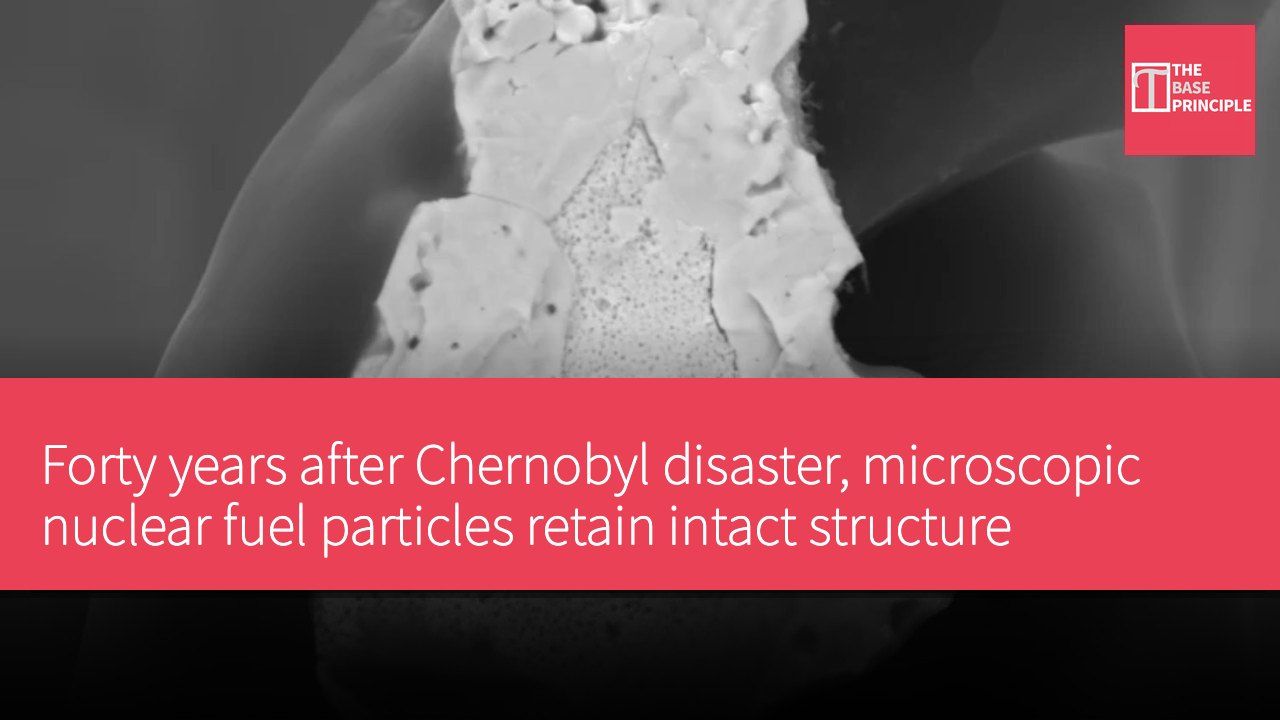
- Forty years after the Chernobyl disaster, radioactive debris still retains the original nuclear fuel's crystal structure.
- Microscopic particles classified into three categories, some similar to uranium dioxide.
- Study shows hot particles' nuclear fuel grains fused with zirconium oxide, high stability.
- Findings cannot justify lifting Chernobyl Exclusion Zone restrictions, more samples needed for assessment.
Forty years have passed since the 1986 Chernobyl nuclear power plant explosion, and the radioactive debris scattered at the time still preserves the original nuclear fuel's crystal structure. A recent study of six microscopic particles from Ukraine has found that these materials exhibit chemical stability beyond researchers' expectations. Scientists from Germany's Leibniz University Hannover and the Helmholtz-Zentrum Dresden-Rossendorf examined these fragments using synchrotron X-ray diffraction at the European Synchrotron Radiation Facility in Grenoble, France. These findings help explain how these residues retain radioactive materials, although the small sample size prevents definitive conclusions about the entire contaminated zone.
Characteristics and classification of microscopic particles
The microscopic disaster residues are known as "hot particles," with diameters of only 8 to 50 micrometers. Despite their minuscule size, these particles remain highly radioactive four decades after the 1986 accident. Researchers classified these particles into three main categories. Some particles are chemically and physically similar to uranium dioxide, the substance that serves as reactor fuel. Others are partially or completely coated with zirconium, or fused with the metal that originally surrounded the fuel. These composite particles formed when the fuel melted at high temperatures and bonded with its protective zirconium cladding. A third category of particles was produced during the burning of the reactor's graphite moderator.
The moderator normally serves to slow neutrons to sustain a chain reaction, but during the disaster its fire burned for ten days. The fuel oxidized into uranium compounds, including triuranium octoxide, a mechanically unstable material that readily forms microscopic particles and can be carried by wind, creating an inhalation hazard.
The study shows that the hot particles produced by the 1986 accident have nuclear fuel grains partially fused with zirconium oxide. To understand why these fragments weather at different rates, researchers examined their internal structure. Hannover researchers isolated particles from Ukrainian soil samples and mounted them on tungsten electrodes. A multi-layer containment structure ensured safe transport of the radioactive samples. At the Rossendorf Beamline, HZDR crystallographer Dr. Christoph Hennig and his colleagues rotated these particles in a focused X-ray beam. "Ultimately, we fully rotated these particles in an X-ray beam focused to 100 micrometers, which is approximately the thickness of a human hair.
Limitations of the findings and future directions
"We measured each particle from 2,000 different angles to seamlessly capture all reflections," Hennig said. The measurements identified distinct oxide phases in the samples. Importantly, the nuclear fuel crystal structure in the examined particles remained largely intact. This stability helps keep fission products locked inside the particles, potentially limiting their release into surrounding soil and water.
The limitations of this study are quite clear: researchers examined only six particles from two locations. "However, each particle's structure is different, and our experiment studied only six particles from two different locations," warned Tobias Wiesenborn, a physicist and doctoral candidate at Leibniz University Hannover. More particles from other locations are needed to establish broader patterns. Even then, average data cannot capture the behavior of every fragment, or establish universal health risks for the entire region. Some more persistent particles can retain radioactive isotopes longer and release them later, complicating the assessment of how contamination changes over time.
Therefore, these results cannot serve as a basis for lifting restrictions on the Chernobyl Exclusion Zone. Wiesenborn and Hennig are already conducting follow-up experiments on highly radioactive transuranic phases in the disaster residues.
Continuing impact after the Chernobyl disaster
The impact of the Chernobyl disaster persists, with microscopic hot particles showing unexpected chemical stability, and their effects on the environment and human health require continued attention. Although the research reveals the structural characteristics of these particles, the limited sample size means the results are not generalizable and cannot fully assess risks across the entire contaminated zone. This underscores the importance of further research to better understand the long-term behavior of these radioactive materials and their potential threats to ecosystems.