
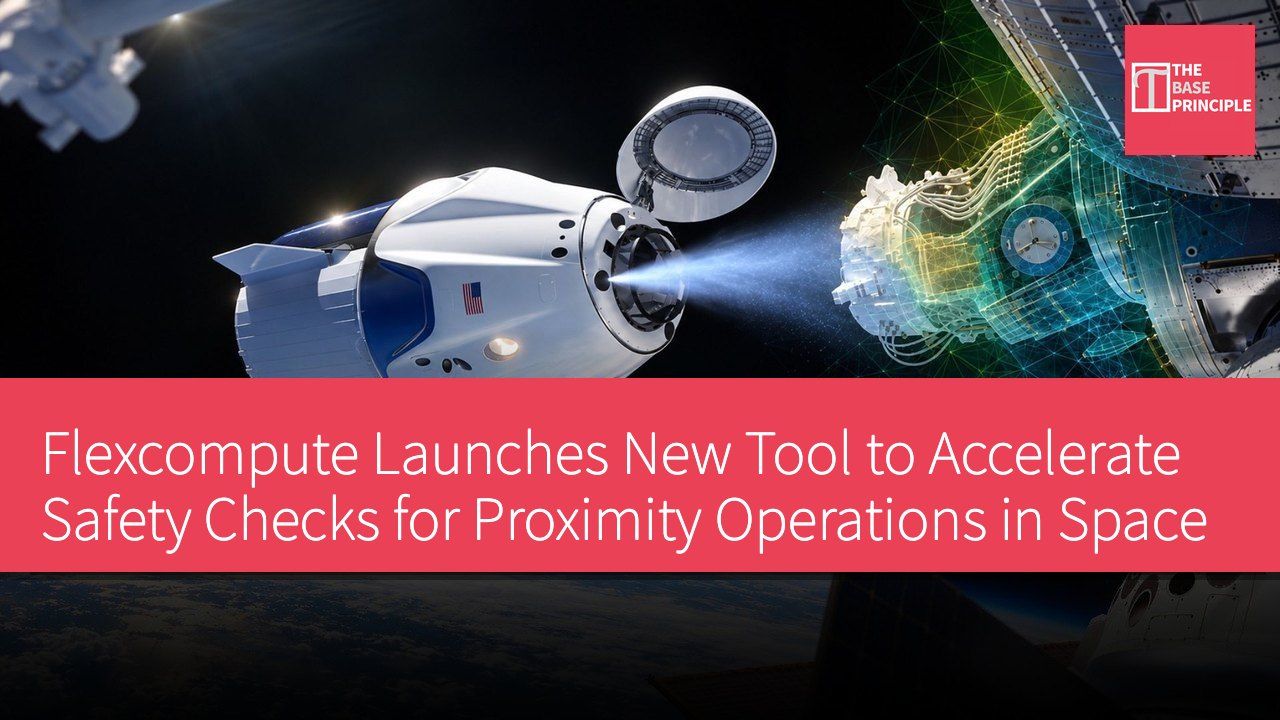
- Flexcompute has launched a new "physical twin" tool to simulate the effects of rocket thruster exhaust.
- The new tool can simulate hundreds of proximity operations in a very short time, significantly increasing analysis speed.
- The tool's computational demands have been greatly reduced, making computational testing routine while maintaining high accuracy.
- Flexcompute plans to expand its technology to other industries, enhancing future digital infrastructure.
Existing simulation methods require days to compute these complex particle interactions, making this new development significant.
Technical Advantages of the New Tool
Safe Space Docking Commercial space operations such as autonomous docking, satellite maintenance, and in-orbit refueling face serious risks from exhaust impacts. Thruster exhaust can destabilize nearby spacecraft, damage external surfaces, or obscure navigation sensors. Previously, Direct Simulation Monte Carlo (DSMC) methods were used to predict these high-speed particle collisions. DSMC requires substantial computational resources, limiting mission teams to testing a finite number of flight paths. Flexcompute offers a new solution to overcome these computational limitations.This tool reduces long computation delays, enabling engineers and autonomous AI flight agents to simulate hundreds of proximity maneuvers in a very short time. The technology, referred to as "tagged physics," combines neural networks with a novel Boltzmann solver within a unified framework to deliver DSMC-level accuracy at breakthrough speeds. Flexcompute's architecture is directly based on physical laws, avoiding the vulnerabilities typical AI surrogate models face when encountering unfamiliar situations. The software can instantly adapt to new spacecraft geometries and launch sequences without the need for retraining.
Future Application Potential
Northrop Grumman's Vice President of AI Integration, Han Parker, stated, "Flexcompute's tagged physics approach has the potential to increase analysis speed by about 200 times compared to Direct Simulation Monte Carlo, allowing us to explore a broader range of exhaust interaction scenarios to support mission needs." He added, "For proximity operations like docking and refueling, Northrop Grumman is leading and conducting unprecedented dynamic space operations, which means we can analyze more approach paths and launch sequences and see how each scenario will affect the relevant spacecraft."
About 200 Times Speed Increase This 200-fold leap makes rare and expensive computational tests routine. The software reduces computational demands, cutting processing time for each case to just 0.4 GPU hours (under three minutes on a single GPU), while a mixed DSMC setup would require 78 CPU hours. This high speed does not compromise accuracy. Compared to established simulation standards, the total force calculation error of the tool is below 3.5%. Specifically, its measurement of the physical thrust (axial force) on spacecraft differs from standard models by no more than 2.84%, while the estimation of temperature effects (thermal flow) remains within 3.35%.According to Vera Yang, President and Co-Founder of Flexcompute, this space exhaust tool is just the beginning. The company is actively deploying its physical twin series across other industries, covering areas from orbital particle dynamics to microscopic deformation in advanced semiconductor packaging. In space missions, confidence is crucial. Flexcompute enables teams to conduct pressure tests for every maneuver before launch, saving computational cycles and establishing a digital foundation for future orbital infrastructure.
How New Technology is Changing the Safety of Space Operations
Flexcompute's new tool not only accelerates simulation speed but also significantly reduces computational demands, which is critical for commercial space operations. As the complexity of space missions increases, the ability to quickly and accurately assess the impact of thruster exhaust on spacecraft will greatly enhance mission safety and efficiency. Furthermore, the successful application of this technology could drive innovation in other industries, demonstrating its broad application potential.