
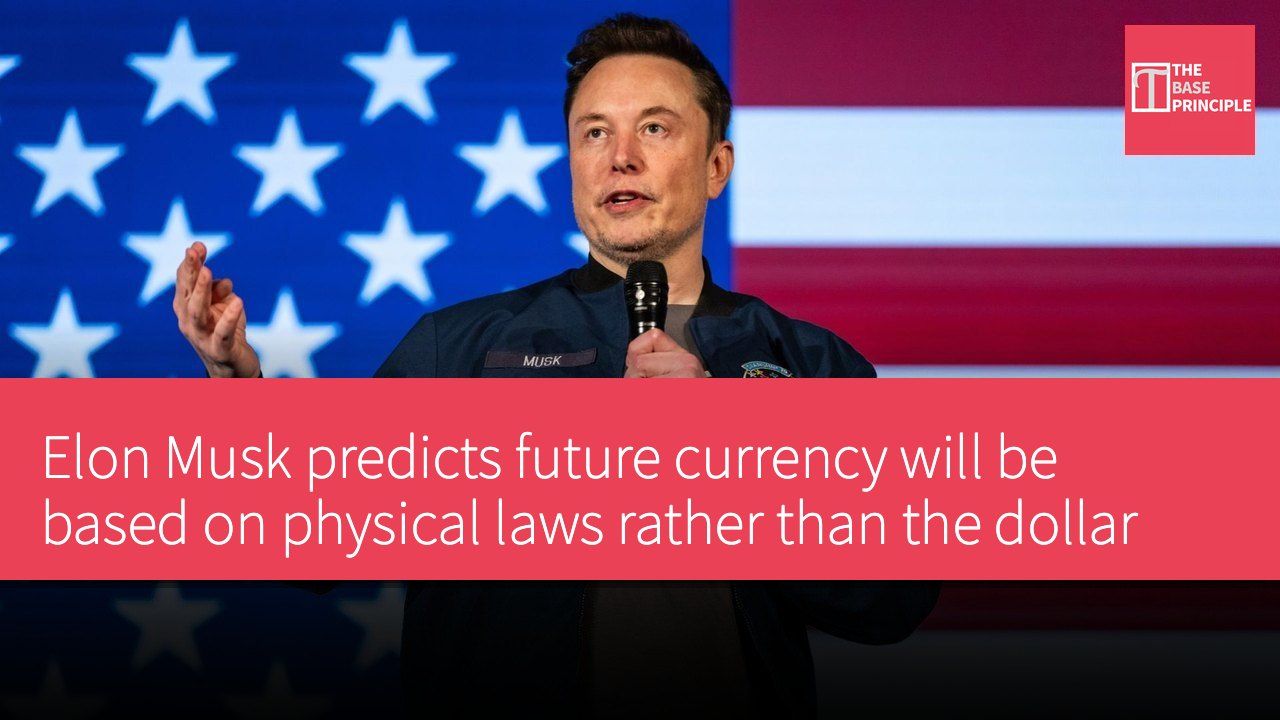
- Musk believes future currency should be based on physical laws rather than the dollar.
- He predicts currency will reflect fundamental physical quantities such as power, mass, and energy.
- Musk points out that robotics may be the only solution to the national debt.
- He expects future wealth to be significantly reduced by taxation, affecting future generations.
Elon Musk believes that future economic systems could measure wealth using physical laws instead of the dollar as a standard. The CEO of Tesla and SpaceX predicts that advancements in robotics and space exploration may ultimately render traditional currency irrelevant. Musk elaborated on this vision during a conversation with biographer Walter Isaacson on The Builders podcast. He suggested that a multi-planet civilization could adopt a new economic value measurement based on physical resources and energy.
The Physical Basis of Future Currency
Musk anticipates that future currency will reflect fundamental physical quantities, including power, mass, and energy. He specifically mentioned watts and metric tons as potential value measurement standards. He told Isaacson, "I think currency will be measured in basic physical metrics," describing a system built around these physical quantities. This shift would challenge the foundations of modern finance. Currently, the U.S. dollar provides a universal standard for pricing goods, paying wages, and trading assets. Musk's vision suggests that technological abundance may eventually diminish the importance of traditional currency.
However, measuring economic value through physical quantities would require a system for comparing different resources. Watts measure power, while mass measures the amount of matter, neither of which can independently capture scarcity, utility, or demand.
The Impact of Technology on the Economy
Musk links his predictions to the future of robotics and space travel. A multi-planet economy may face challenges significantly different from resource constraints on Earth. He also believes that robotics and artificial intelligence may be the only viable solution to the growing national debt in the United States. He reached this conclusion after serving as a special government employee in the Trump administration for 130 days in 2025. He told Isaacson, "The conclusion I came to is that the only way to solve the national debt is to rely on AI and robotics." He considers spending cuts an impractical way to close the gap.
According to reports, the U.S. national debt reached a historic high of $40 trillion in August 2026. Musk believes political resistance will prevent Washington from making sufficiently deep spending cuts. His alternative relies on machines significantly increasing productivity. Automated production can yield more goods and services with fewer workers. However, merely increasing productivity does not guarantee a reduction in federal debt. The government still needs to generate sufficient economic returns through taxes or other revenue.
Musk also predicts that his personal wealth will significantly diminish over the coming generations. He stated that taxes will gradually erode his wealth, leaving his descendants with only a fraction of his current holdings. According to Bloomberg's Billionaires Index, Musk's net worth was approximately $921 billion at the close of trading on Monday. His wealth primarily reflects his stakes in Tesla and SpaceX, allowing him to maintain control of both companies. SpaceX's financial performance has also bolstered its position. The company reported its first quarterly profit as a public company in the third quarter of 2026, with a net income of $4.4 billion.
Compared to $5.6 billion in the same quarter last year, revenue grew by 161% year-over-year, reaching $14.6 billion. SpaceX recorded a net loss of $1.1 billion in the same quarter last year.
Highlights from the third quarter of 2026 include: – Delivery revenue of $14.6 billion, a year-over-year increase of 161% – Successful launch of the first profitable Starship mission, deploying 26 Starlink V3 satellites into its broadband constellation, roughly equivalent to an additional tenfold downstream capacity. Musk hopes his foundation will continue to fund his long-term ambitions after his death. These priorities include making humanity a multi-planet species, extending consciousness beyond Earth, and improving sustainable energy. Musk has also pledged to allocate shares of SpaceX to every American child next year, reportedly valued at over $10 billion at current prices.
His predictions ultimately rest on a broad assumption: that technological advancements may alter the relationship between resources, productivity, and wealth. Whether machines can render traditional currency obsolete remains an open question.
Item Specification U.S. National Debt $40 trillion SpaceX Third Quarter Net Income $4.4 billion SpaceX Third Quarter Revenue Growth 161%
The Future of Economic Systems Based on Physical Laws
Musk's predictions reflect profound thinking about future economic systems, particularly as technological advancements may redefine the role of traditional currency. A currency system based on physical laws, while theoretically appealing, may face numerous challenges in practical implementation, such as how to measure scarcity and demand. As humanity explores space and develops robotics technology, these emerging technologies could fundamentally alter our economic structure and provoke a reevaluation of resource allocation and productivity.