
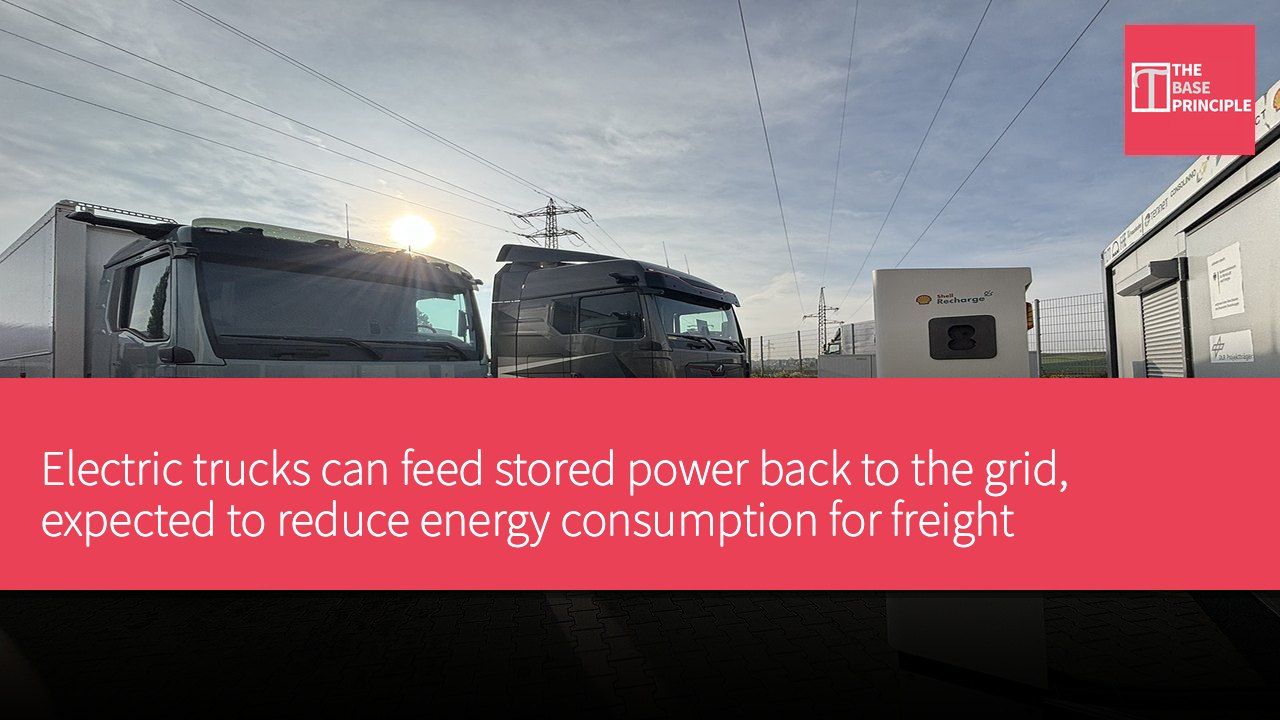
- Electric trucks can store electricity and sell it back to the grid, reducing energy consumption for freight companies by about 10%.
- Bidirectional charging technology allows for two-way power transmission, providing electricity to warehouses and other vehicles.
- The current barriers lie in grid connectivity and economic conditions, rather than the trucks or chargers themselves.
- MAN is working to bring bidirectional charging technology into mass production and is seeking business models.
A research project led by the Technical University of Munich (TUM) has found that electric trucks can supply stored power to warehouses, other vehicles, and the grid. The research alliance states that electric trucks are capable of storing electricity and selling it back to the grid, which is expected to lower energy costs for freight companies by about 10%. The German project, named SPIRIT-E, concluded in October after three years, with partners showcasing results on October 30. According to TUM, during the experiment, a MAN eTGX truck with a usable battery capacity of 480 kilowatt-hours fed power back to the grid through a bidirectional charger, with a capacity of up to 350 kilowatts.
Bidirectional charging means that charging stations can transmit electricity in both directions, allowing power to flow into and out of the truck. Shell's charging unit SBRS provided the charger, while grid operator TenneT is also one of the partners. The project is funded by the German Federal Ministry for Economic Affairs and Energy.
Partners indicate that the larger barriers currently lie in grid connectivity and economic conditions, rather than the trucks or chargers themselves.
Bidirectional Charging Technology for Electric Trucks
The testing took place at Schmid Freight Company near Regensburg. TUM states that the truck charged other vehicles from its battery, helped power the company's facilities, and fed electricity into the public grid. Partners also constructed a reservation system for charging stations and software to schedule truck charging at warehouses. According to TUM, in a simulated electricity market, trucks can buy electricity when prices are low and sell it when prices rise. Researchers indicate that this could provide an additional revenue stream for transport companies. The university notes that using stored electricity from warehouses appears to have the most potential, such as charging during the day with excess solar energy and responding to short-term spikes in demand that could incur high costs.
Another analysis by TUM, based on driving data from six German fleets covering 2.15 million kilometers, found that connecting warehouses to the grid and electricity markets could reduce fleet costs by an average of 1.7 cents per kilometer, while using bidirectional charging could lower costs by 6.1 cents per kilometer.
Challenges Faced at This Stage
However, electricity trading is currently only taking place in a testing environment. MAN states that about 10% of the savings data comes from internal project calculations and adds that under optimal conditions, savings could reach 20%. Neither press release cited peer-reviewed papers. MAN indicates that this approach is suitable for trucks that regularly return to warehouses and travel less than 100,000 kilometers per year. There are still practical barriers. TUM points out that many warehouses lack the grid connectivity required for charging large truck fleets. Additionally, there is no unified standard for selling stored electricity, and many systems used by providers are not interoperable.
How to allocate revenue among transport companies, manufacturers, and electricity marketers has yet to be determined.
Georg Grüneißl, MAN's product strategy leader, stated that the company is working to bring bidirectional charging technology into mass production. Markus Lienkamp, a professor of automotive technology at TUM, noted that the next task is to standardize and scale the trial solutions and transform them into business models.
Item Specification Battery Capacity 480 kilowatt-hours Charging Power 350 kilowatts
Key Challenges in Advancing Electric Truck Technology
Bidirectional charging technology for electric trucks offers new opportunities for the freight industry, enabling effective use of stored electricity to reduce operational costs. However, several challenges remain in the implementation process, particularly regarding grid connectivity and economic conditions. Many warehouses lack the necessary grid infrastructure, preventing the full potential of electric trucks from being realized. Additionally, the lack of unified standards for trading stored electricity also impacts market development. Therefore, future success will depend on the standardization of technology and innovation in business models.