
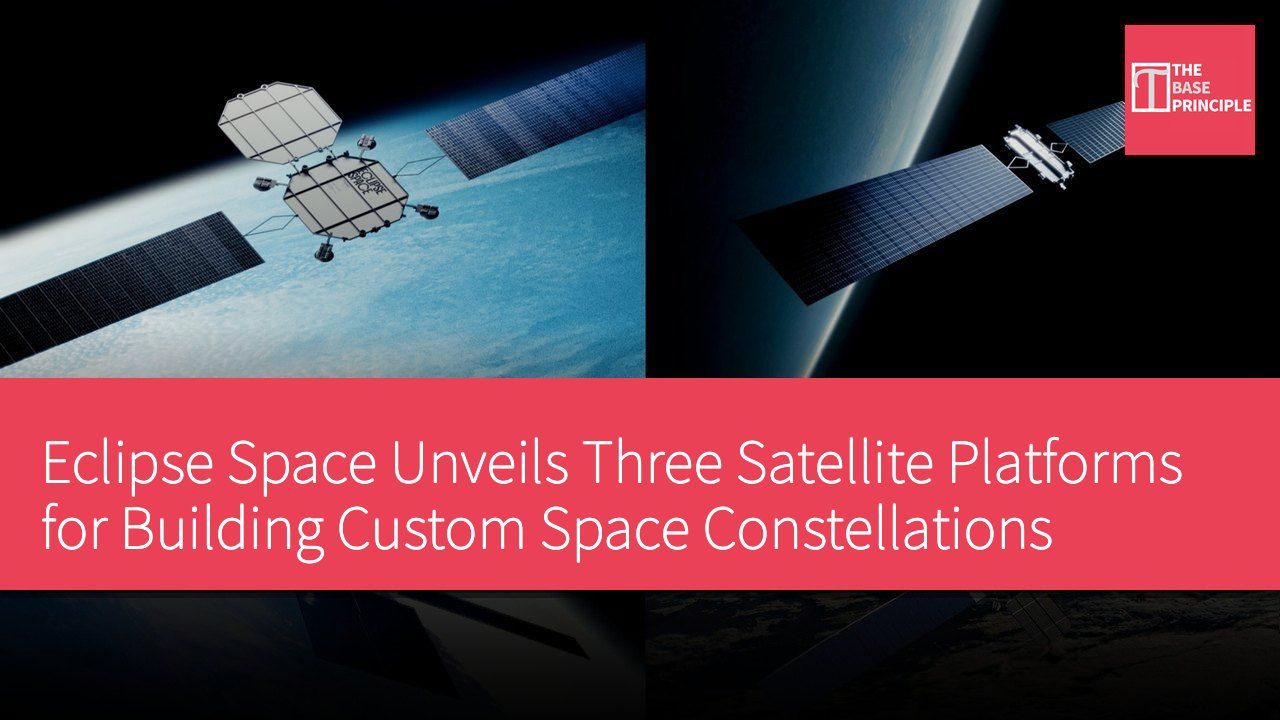
- Eclipse Space has unveiled three satellite platforms for customers to build their own space constellations.
- CitraSat can connect to standard mobile phones and maximize satellite capacity per launch.
- SliceSat offers high-speed connectivity without relying on ground fiber networks.
- SurgeSat is designed for large AI and computing workloads, ensuring data remains under customer control.
Eclipse Space has announced three satellite platforms aimed at enabling nations and businesses to build and operate their own space constellations rather than renting capacity from other networks. The Redmond, Washington-based company, founded by engineers who previously worked on building and scaling SpaceX's Starlink system, announced these platforms and a new power systems partnership with French company Gama ahead of the World Space Business Week in Paris.
Eclipse designs and integrates everything needed for customers to operate independent constellations, including satellites, payloads, ground infrastructure, launches, and ongoing operations. CEO Derek Huerta stated that the company's business model differs from that of typical satellite operators. It provides complete infrastructure for customers to operate themselves, rather than infrastructure that remains under Eclipse's control.
Overview of the Three Satellite Platforms
Of the three platforms, the first architecture, CitraSat, handles direct-to-device communications and can connect to standard mobile phones without the need for specialized antennas or terminals. Its flat-panel design incorporates a 3.5-meter S-band phased array, multi-gigabit E-band backhaul to connect to the ground, and V-band links for inter-satellite communications within the same constellation. The design maximizes the number of satellites that can be launched in a single mission, with each unit having an operational lifespan of over five years.
SliceSat, on the other hand, targets Qualcomm's wideband, providing high-speed connectivity directly from orbit without relying on ground fiber networks. It features four Ku-band phased arrays and has multi-gigabit V/E-band feeder links and the same V-band inter-satellite connectivity as CitraSat. This design aims to establish resilient, low-latency broadband networks, whether regional or global.
SurgeSat extends the platform to an entirely new mission category: performing high-performance computing and data storage directly in orbit. The device is designed for 100-kilowatt-class power output and is built for processing and storing data for large AI and computing workloads. It processes data without going through third-party systems, ensuring that data and its processing infrastructure remain entirely under customer control. SurgeSat shares its core architecture, inter-satellite network, and manufacturing methods with the two communications platforms.
Partnership with Gama
While providing the computing power for SurgeSat's objectives, it also underpins Eclipse's broader plans for high-capacity constellations, leading to the company's new partnership. This partnership is with French company Gama, which focuses on developing large deployable space structures and power systems. The two companies plan to combine Gama's expertise in deployable solar panels with Eclipse's spacecraft power systems, aiming for scalability beyond 100 kilowatts, with the first space demonstration planned for 2028.
Gama CEO Andrew Nutter stated that the shared engineering culture of the two companies is based on large-scale production, as many of the same engineers previously worked together on scaling Starlink hardware. Eclipse described this arrangement as an example of its broader fabless model. The company owns the system architecture, design, and software and relies on specialist partners to provide individual subsystems rather than manufacturing every component in-house.
Eclipse debuted in June 2026. The company was founded by CEO Derek Huerta, who previously served as SpaceX's satellite payload engineering manager and co-founded it with other SpaceX alumni. The company aims to produce at least five satellites per day and plans to launch an integrated demonstration spacecraft in 2027. This week's platform announcement marks the company's first public showcase of the spacecraft hardware underpinning its broader ambitions.
Item Specifications Power Output 100 kilowatts Operational Lifespan Over five years
The Significance of Eclipse Space's Autonomous Constellation Construction
Eclipse Space's new satellite platforms mark a significant advancement in the commercialization of space, enabling nations and businesses to build and operate their own space constellations independently, reducing reliance on traditional operators. This not only enhances operational flexibility and efficiency but also addresses the growing demand for data. The partnership with Gama further extends its technical capabilities, particularly in deployable solar panels and high-performance computing, which will provide stronger support for future space missions.