
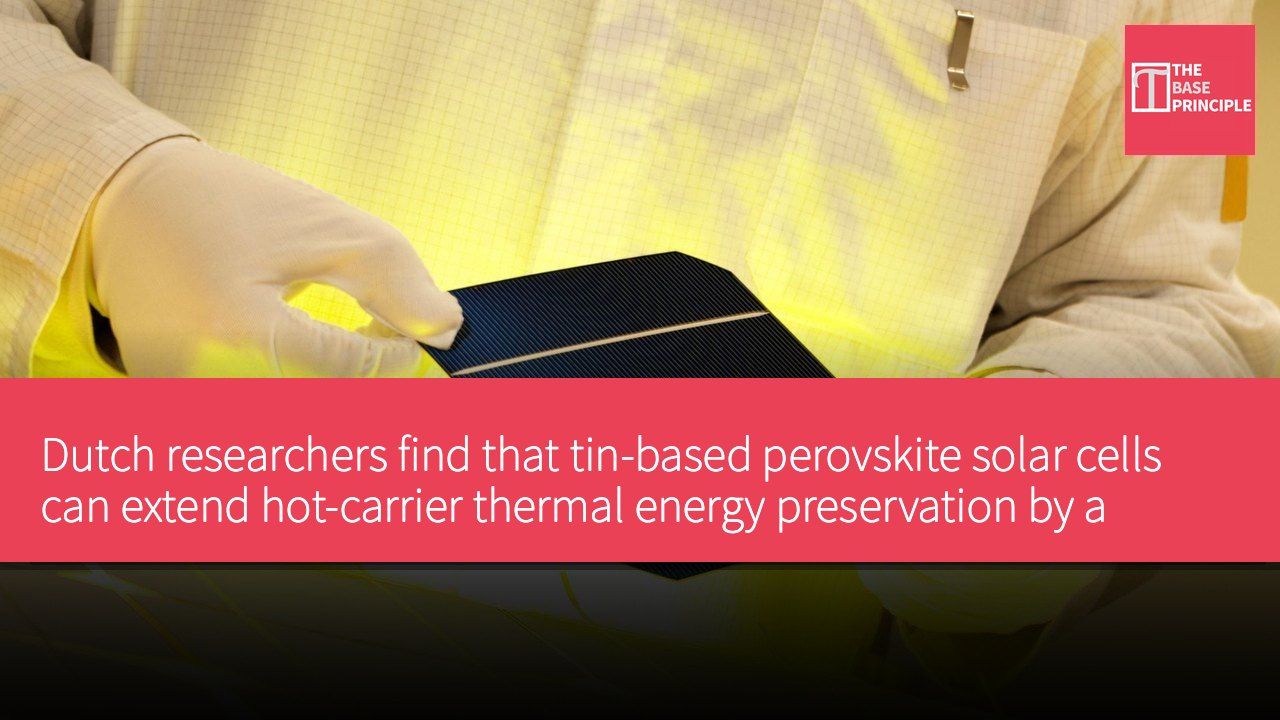
- Dutch researchers found that tin-based perovskite solar cells can slow thermal loss.
- Energy from hot electrons can persist for nanoseconds, raising the efficiency ceiling.
- A hot-phonon bottleneck and the Burstein-Moss effect together delay the cooling process.
- Tin-based materials are non-toxic and environmentally friendly, making them suitable for high-efficiency solar conversion.
Researchers from the University of Groningen in the Netherlands have found that tin-based perovskite solar cells can slow the thermal loss of high-energy "hot electrons," a development that could push cell efficiencies beyond the theoretical 33% limit. When sunlight strikes a solar panel, photons set electrons into motion. The most energetic photons produce overcharged hot electrons. In theory, these high-voltage sources of energy should be capable of generating more electricity. In practice, however, these energetic particles exist only fleetingly, cooling within a trillionth of a second and shedding their surplus energy as waste heat before they can leave the solar cell material.
"That means the energy is lost before the hot electrons can leave the solar cell material," said Jan Anton Koster, professor of physics of new semiconductor materials and devices at the University of Groningen.
A breakthrough in extending hot-electron energy
The research team worked with Maria Antonietta Loi, professor of photophysics and optoelectronics, to build an experimental setup. Using a dedicated solar cell material called a tin-based perovskite, Loi's lab accomplished what many thought was impossible: slowing heat loss by a factor of 1,000. Suddenly, the surplus energy persisted for nanoseconds instead of vanishing within picoseconds. Skeptics voiced doubts immediately, and even the researchers themselves questioned their own data.
"We even started to doubt our own measurements," Koster acknowledged. To resolve the puzzle, Koster and PhD student Tim Faber built digital simulations that drilled down to the quantum level, uncovering a surprising dual mechanism at work.
First, a "hot-phonon bottleneck" creates a heat trap. As electrons shed heat, the surrounding environment warms up so quickly that the electrons end up reabsorbing the very energy they lost. Second, the "Burstein-Moss effect" produces an atomic traffic jam: with the lower-energy states already crowded by excited electrons, the downward pathways are blocked. Together, these two mechanisms delay the cooling process, and the simulations match the nanosecond-scale delays observed in the lab.
Properties of tin-based perovskites
The study, which combined Monte Carlo simulations with time-resolved photoluminescence, shows that band filling together with the hot-phonon bottleneck accounts for the unusually long hot-carrier cooling times in tin-based metal halide perovskites. Through advanced computer simulations and light-based measurements, the researchers found that the tin-based solar material can hold on to surplus energy far longer than usual. These specialized materials could be used to build a new generation of ultra-efficient solar cells. Tin-based metal halide perovskites are non-toxic, environmentally friendly crystalline materials well suited to high-efficiency solar conversion.
These advanced semiconductors have a specialized three-dimensional lattice structure in which tin ions are paired with halides and organic or inorganic components. The material has an unusually low electron mass, allowing charges to move quickly and to retain extra thermal energy for extended periods. This broad light absorption, efficient charge transport and prolonged energy retention make these materials prime candidates for the next generation of solar cells. Commercial solar cells will take time to harvest this sustained thermal energy. "There are still many other questions to answer, but in theory this discovery could make it possible to create solar cells that exceed the theoretical 33% limit," the team said.
The results have been published in the journal ACS Energy Letters.
Potential implications for solar technology
This study's breakthrough carries significant implications for the future of solar technology. By extending the lifetime of hot-electron energy, the researchers may be able to push solar cell efficiencies beyond the existing theoretical limit, a development that would have a positive impact on renewable energy. Tin-based perovskite materials are not only environmentally friendly, but could also deliver higher energy conversion efficiency as they move toward commercialization, supporting broader applications and technological innovation.