
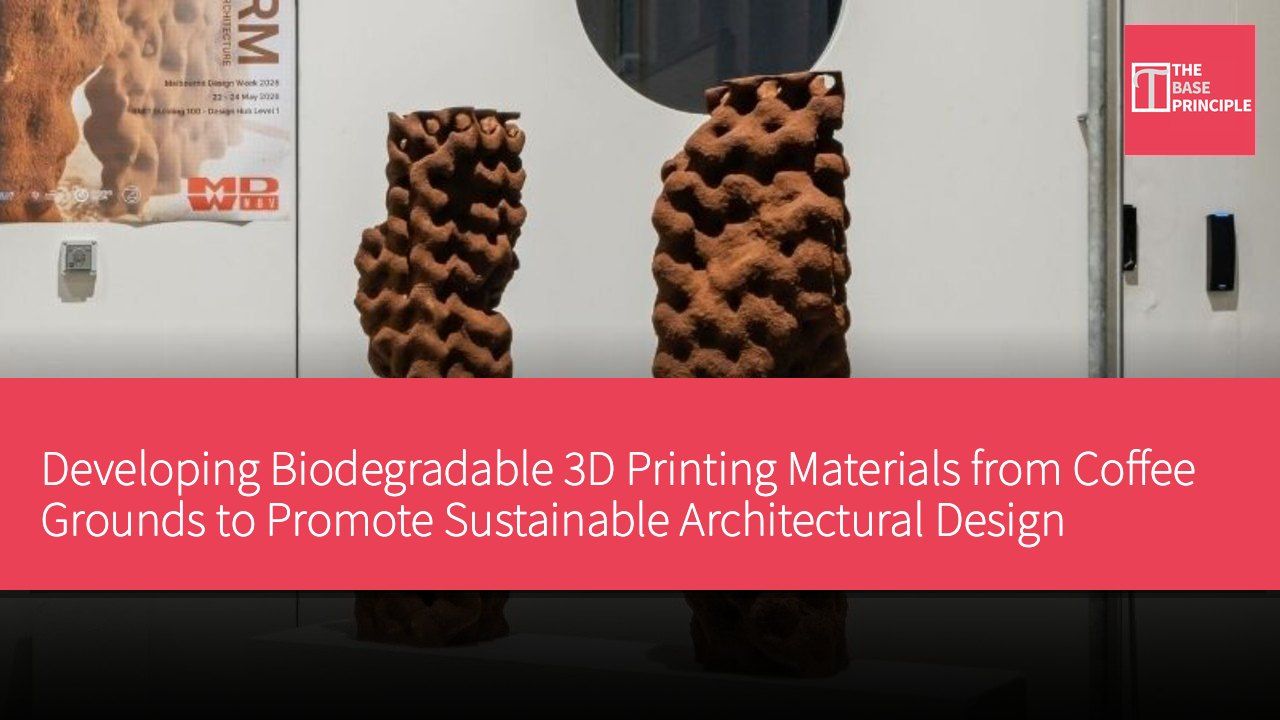
- The RMIT team in Australia has developed 3D printing materials based on coffee grounds.
- The material is biodegradable, promoting sustainable architectural design.
- Coffee grounds can enhance the design and strength of building materials.
- The research demonstrates how a circular economy can transform waste into useful materials.
Discarded coffee grounds may one day become building materials, a concept that sounds like a plot from a children's story. However, a multidisciplinary team from RMIT University in Australia has demonstrated that this is not out of reach. The team showcased architectural designs created from locally sourced discarded coffee grounds during Melbourne Design Week. Led by Professor Jianbo Hu from the School of Science and Dr. Paul Nik from the School of Architecture and Urban Design at RMIT, the team developed a biodegradable 3D printing material based on coffee waste. By transforming coffee waste into 3D printed architectural shapes, the researchers showcased a pathway toward more sustainable and low-carbon building materials.
This work combines the expertise of material scientists and architects to further transform coffee into a reliable source of biodegradable 3D printing building materials. The scientific team assists in developing and understanding the material, while architects propose computational designs, manufacturing additives, and potential large-scale practical building applications. Nik stated, "The scientific team has deep expertise in material development and understanding, while our team explores how to leverage material properties to guide computational design, additive manufacturing, and larger-scale building applications."
The Environmental Potential of Coffee Grounds
In search of more eco-friendly materials, Professor Hu's lab researchers turned to coffee, given the region's abundant coffee resources and environmental friendliness. They noticed that many coffee grounds were being discarded indiscriminately, prompting the team to examine whether these coffee waste materials could be repurposed to enhance the design and strength of building materials. Professor Hu pointed out, "We use a lot of 3D printing in our work, and this process typically uses many plastics made from corn starch or less eco-friendly materials. Given Melbourne's reputation for its coffee culture, we thought this was a material worth investigating."
During the research process, team member Kang Liu noted that the project showed that complex shapes, which architects often avoid due to high costs, could actually enhance the performance and functionality of materials. Liu said, "Using coffee grounds, this material can support sound absorption, insulation, odor, and aesthetics, providing architects with another layer of design." After laboratory research and testing, they advanced the project to a complete spatial demonstration, showcasing a strong case for coffee as a viable raw material for biodegradable 3D printed building materials.
A Practical Example of the Circular Economy
She stated, "This provides a concrete example of how circular economy research can be put into practice, showing how everyday waste can be transformed into useful materials for design, advanced manufacturing, and potential future building applications." Coffee, as an important bio-material, has been integrated with other biological systems to become a bio-based raw material. As a medical biomaterial, researchers are combining coffee with other materials to develop antibacterial films, wound healing dressings, and antioxidant delivery systems. Researchers are also using coffee to create sustainable bioplastics and packaging materials.
How Coffee Grounds Are Changing the Future of Building Materials
This research not only showcases the potential of coffee grounds in building materials but also emphasizes the importance of sustainability. In the current climate of heightened environmental awareness, utilizing everyday waste to develop new materials can effectively reduce resource waste and promote the practice of a circular economy. The applications of coffee grounds are not limited to construction; they can also extend to medical and packaging fields, demonstrating their broad potential for use.