
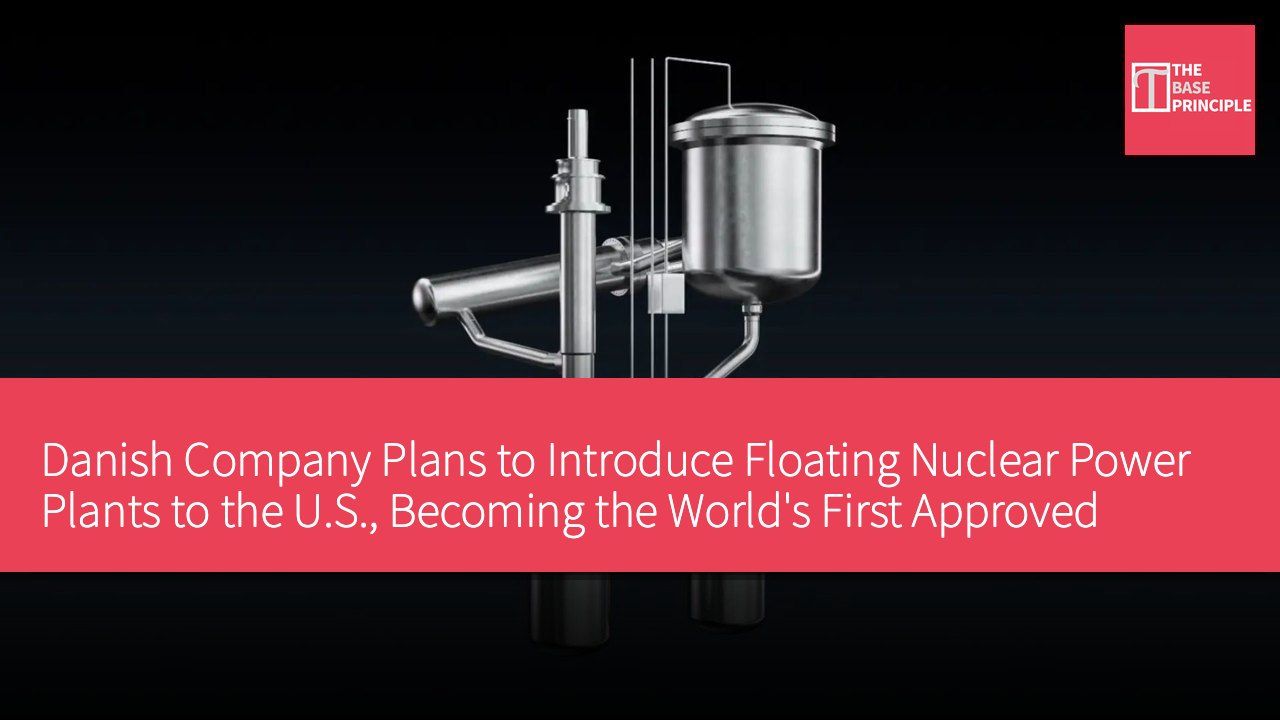
- Saltfoss aims to introduce floating nuclear energy to the U.S. and has sent a letter of intent to the NRC.
- The project will become the world's first approved offshore advanced small modular reactor.
- Saltfoss plans to build the barge in South Korea and assemble the reactor in the U.S.
- The seaMSR-100 technology relies on a loop-type molten salt design, ensuring high safety.
Danish nuclear developer Saltfoss aims to bring floating nuclear energy to the U.S. coast and has submitted a letter of intent to the U.S. Nuclear Regulatory Commission (NRC). The company hopes to initiate early regulatory discussions regarding its offshore power barge and the seaMSR-100 reactor. If approved, the project would mark the world's first licensed offshore advanced small modular reactor (SMR). The timing is particularly interesting, as in March 2026, the NRC introduced 10 CFR Part 53, a modern regulatory framework specifically designed for advanced reactors.
Saltfoss plans to be the first developer to obtain a license under this new framework.
Saltfoss's Construction Plans
Saltfoss does not intend to build a traditional power plant from scratch inland but plans to produce components separately between two collaborating industrial hubs. South Korea's Samsung Heavy Industries will construct standardized steel barges at its high-capacity shipyard. Once the hull is completed, a team in the U.S. will be responsible for the assembly of the reactor, fuel loading, and final integration. The company stated in a press release: "As part of its U.S. expansion, Saltfoss will significantly increase its activities in the U.S., including reactor assembly, fuel loading, and final power plant integration at U.S. facilities."
In terms of international regulatory coordination, the company is also conducting assessments across the Pacific. Saltfoss is collaborating with the Korean Nuclear Safety and Security Commission to review under the country's special SMR law, with South Korea expected to undertake some of the earliest commercial deployments. Meanwhile, a maritime safety assessment is underway. The American Bureau of Shipping is validating the barge design through its formal new technology review. Saltfoss CEO Klaus Nyengaard stated: "We are combining the legacy of U.S. reactor designs proven at Oak Ridge National Laboratory with world-class shipbuilding and nuclear supply chains in South Korea."
How the seaMSR-100 Operates
The technology relies on a loop-type molten salt design that has been refined over six years. Each standardized seaMSR-100 unit can generate 100 megawatts electric (MWe). Multiple modules can be housed on the same barge to provide stable power of up to 600 MWe and high-temperature industrial heat, which can supply energy to remote coastal industries, municipal grids, or high-power super-scale data centers.
Traditional reactors operate under immense steam pressure, while the seaMSR-100 operates at near-atmospheric pressure, with temperatures ranging from 600°C (1,112°F) to 700°C (1,292°F). It uses conventional low-enriched uranium as fuel, avoiding rare or special fuel grades. Safety relies on fundamental physics rather than emergency backup generators. If there is a power interruption or core temperature rises, the system will automatically shut down, and the liquid fuel salt will flow by gravity into a passive discharge tank without operator intervention. Saltfoss stated: "Its fuel salt solidifies at about 500°C, capturing radioactive materials and making large releases physically impossible; the reactor shuts down and discharges solely by gravity, without operator intervention or external power."
Saltfoss completed its conceptual design in 2025 in collaboration with Idaho National Laboratory and Danish researchers. The company plans to submit its formal regulatory engagement plan to Washington in early 2027.
Potential and Challenges of Floating Nuclear Technology
Saltfoss's plans demonstrate the potential applications of floating nuclear energy in the U.S., which can not only meet energy demands but also provide flexible power solutions. The design of the seaMSR-100 emphasizes safety, utilizing fundamental physical principles to ensure stable operation, which is crucial for enhancing public trust in nuclear energy. However, the implementation of this technology still faces regulatory challenges, particularly in the process of obtaining approval under the new framework. If successful, this could potentially change traditional power generation models and drive innovation in nuclear energy development.