
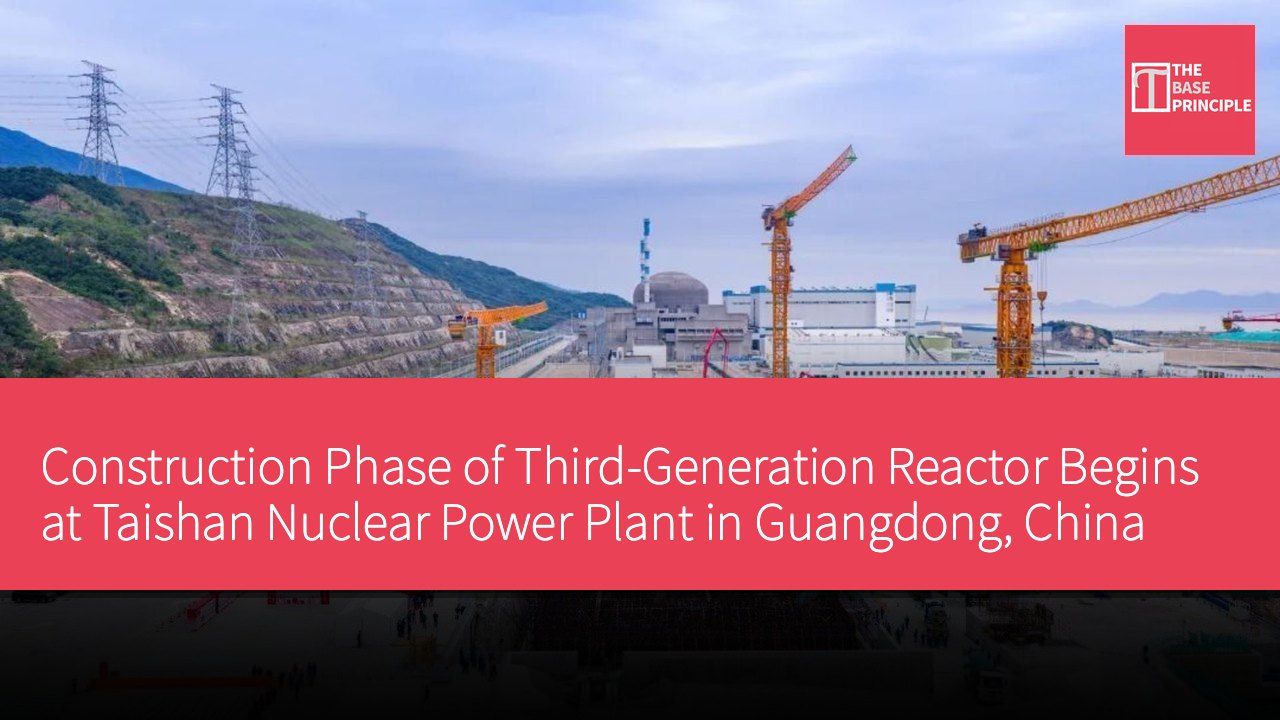
- China General Nuclear Power Group has launched the second phase of construction at the Taishan Nuclear Power Plant, which will build "Hualong One."
- The new reactor will enhance power supply in Guangdong Province and support economic growth.
- The Taishan nuclear project will ultimately include six 1,000 megawatt nuclear power units.
- "Hualong One" features active and passive safety systems, with a design lifespan of 60 years.
China's state-owned clean energy company China General Nuclear Power Group (CGN) has initiated the second phase of construction at the Taishan Nuclear Power Plant site, which will build the third-generation reactor "Hualong One." Construction officially began on November 25, with workers pouring the first concrete for the nuclear island of Unit 3 at the site in Guangdong Province, marking the start of the second phase of development for the plant. According to reports from Chinese state media, the foundational work is expected to involve 55 hours of concrete pouring, requiring approximately 8,823 cubic meters (311,500 cubic feet) of concrete to complete the foundation supporting the reactor's nuclear island.
This milestone was achieved more than a year after Chinese authorities approved the construction of the unit in April 2025. Upon completion, the project is expected to strengthen the power supply in one of China's fastest-growing economic regions.
New Reactor Technology and Safety
The new reactor will utilize "Hualong One," a third-generation pressurized water reactor (PWR) independently developed by China, co-developed by China National Nuclear Corporation (CNNC) and China General Nuclear Power Group (CGN). The nuclear island houses the reactor vessel, steam generators, main cooling systems, and other safety-related equipment, which are the core components of the nuclear power plant. Pouring the first concrete for this structure is widely regarded as the official start of major construction. According to China Central Television, Unit 3 is expected to generate over 9 billion kilowatt-hours (kWh) of electricity annually, enough to meet the power needs of approximately one million people for a year, while also increasing clean energy generation in the Guangdong-Hong Kong-Macau Greater Bay Area, one of China's largest manufacturing and technology hubs.
The Taishan nuclear project is being developed in three phases, ultimately including six 1,000 megawatt nuclear power units, making it one of China's largest nuclear power bases. The first phase of the project included Units 1 and 2, designed using the European Pressurized Reactor (EPR) design, which began commercial operations on September 7, 2019. The newly initiated second phase will introduce "Hualong One," which is China's domestically developed reactor technology and the country's flagship exportable nuclear design. This design features active and passive safety systems, a design lifespan of 60 years, and includes a double-layer containment structure to enhance resistance to external events.
In recent years, China has steadily advanced the deployment of this reactor under its strategy to strengthen energy security while reducing reliance on fossil fuels.
The Future of China's Nuclear Energy Investment
The government has approved multiple "Hualong One" projects nationwide, with additional reactors under construction overseas. The launch of the second phase at Taishan reflects China's ongoing investment in large-scale nuclear energy amid rising electricity demand driven by industrial growth, electrification, and the expansion of artificial intelligence infrastructure. Once all six reactors at the Taishan site are completed, the location is expected to become one of China's primary sources of low-carbon electricity, supporting long-term power needs in southern China while contributing to Beijing's broader decarbonization goals.
When did the second phase of construction at the Taishan Nuclear Power Plant begin?
The second phase of construction at the Taishan Nuclear Power Plant officially began on November 25.
What type of reactor is being built?
The new reactor being built is the third-generation reactor "Hualong One," independently developed by China.
How much electricity is Unit 3 expected to generate once operational?
Unit 3 is expected to generate over 9 billion kilowatt-hours (kWh) of electricity annually, sufficient to meet the power needs of approximately one million people for a year.
How many nuclear power units will the Taishan Nuclear Power Plant ultimately include?
The Taishan Nuclear Power Plant will ultimately include six 1,000 megawatt nuclear power units.
What is the design lifespan of the "Hualong One" reactor?
The design lifespan of the "Hualong One" reactor is 60 years.
The Importance of the Taishan Nuclear Power Plant for Energy Security
The construction of the Taishan Nuclear Power Plant is not only a technological advancement for China in the nuclear energy sector but also a crucial component of its energy security strategy. As electricity demand grows and reliance on fossil fuels decreases, the development of the Taishan Nuclear Power Plant will provide a stable source of low-carbon electricity for the southern China region, supporting sustained economic growth. Additionally, the introduction of "Hualong One" demonstrates China's achievements in the independent research and development of nuclear technology and helps enhance competitiveness in international markets.