
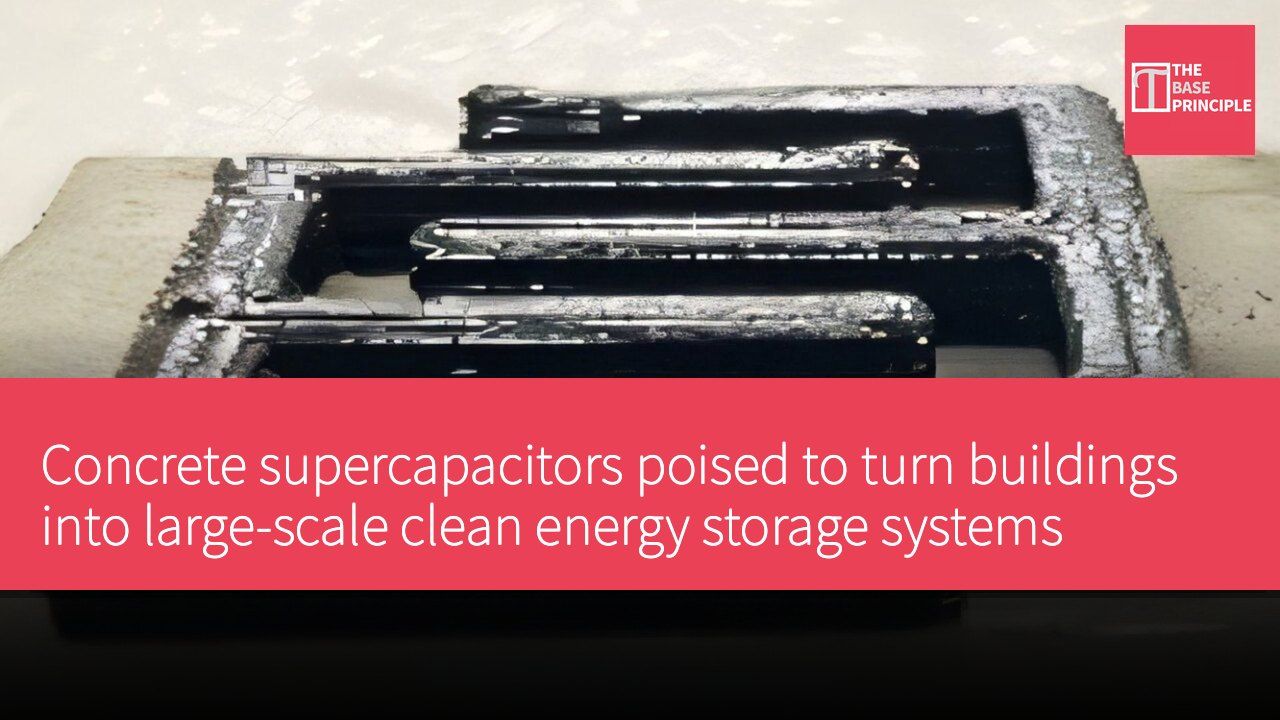
- Concrete structures can be transformed into clean energy storage systems.
- Supercapacitors can rapidly store and release energy, reducing external demand.
- 3D printing technology improves the conductivity and strength of cement-based devices.
- Cold weather limits the performance of concrete supercapacitors.
Turning concrete structures into large-scale clean energy storage systems is no longer merely a futuristic concept. As cities push to eliminate carbon emissions, energy-storing cement could soon become a standard foundation of modern architecture. A team from China's Harbin Institute of Technology has developed a 3D-printable cement-based supercapacitor that can store energy without compromising structural integrity. The technology is said to be powerful and efficient, and if deployed at scale, could redefine urban architecture. "If building materials can not only support structures but also store energy, sense their surroundings, and even interact with people, then buildings will no longer be passive shelters but truly intelligent environments," said Zhong Jing, corresponding author of the study.
Advantages of Supercapacitors
Storing renewable energy in concrete presents a challenge. Solar panels and wind turbines generate large amounts of clean electricity, but storing that energy locally typically requires heavy and expensive battery packs. Supercapacitors can rapidly store and release energy without relying on slow chemical reactions, and can withstand millions of charge cycles. Embedding these devices in foundation slabs or stairwells allows structures to store peak daytime solar power and release it instantly when needed. This approach turns load-bearing concrete into an active energy storage system, reducing the need for external battery installations.
Previous cement-based devices suffered from insufficient interfacial mechanical strength and slow ion transport through the thickness. The team addressed this by mixing carbon nanotubes, carbon black, and cement into a highly conductive printable ink. Using a 3D printer, they deposited the mixture onto concrete slabs in a tight, finger-like interlocking pattern. As the cement hydrated, tiny water-filled pores formed in the matrix, creating high-speed channels for the movement of charged ions, thereby achieving minimal resistance. Innovation is meaningless if the building collapses. Fortunately, rigorous testing proved that the energy-storage panels have compressive strength comparable to commercial concrete used in everyday construction.
Technical Challenges and Potential
To demonstrate its real-world potential, the researchers connected three printed devices on a single slab, immediately lighting up an array of LEDs. In the near term, the technology could power emergency lighting, supply security sensors, or keep structural health monitoring networks operational during outages, all without external wiring.
According to the study, this concrete supercapacitor delivers strong electrical output, with an energy storage density of 22.52 μWh cm –2. It provides an output of 0.49 mW cm-2 within an operating range of 1.0V. At the same time, the technology can withstand 23.00 MPa of compressive force, meeting the strength standards for structural concrete in buildings. These results confirm that building materials can serve as effective power units without sacrificing load-bearing capacity. However, the technology is not without challenges. Although the cement supercapacitor operates smoothly under moderate heating and cooling, its performance degrades when temperatures drop to zero degrees Fahrenheit (–18°C).
Cold weather freezes ion movement in the hydrated pores, limiting power output. Enhancing the material's resistance to extreme cold remains the team's primary challenge before commercial deployment.
Nevertheless, the potential is enormous. Frequent charging from renewable sources enables these concrete supercapacitors to meet a building's specific power needs through continuous energy cycling. Zhong noted that this routine storage and release process provides a viable pathway for structures to supplement their own power demands. The findings have been published in the journal ACS Nano.
Item Specification Energy density 22.52 μWh cm –2 Power output 0.49 mW cm-2 Compressive strength 23.00 MPa
Application Prospects for Concrete Supercapacitors
As renewable energy becomes more widespread, energy storage technology becomes key to solving energy storage challenges. The development of concrete supercapacitors not only enhances building functionality but also reduces reliance on traditional battery systems. Successful application of this technology will help realize smarter building environments and could transform future urban energy management. However, the impact of cold climates on performance must still be overcome, which will be one of the main challenges for commercial deployment.