
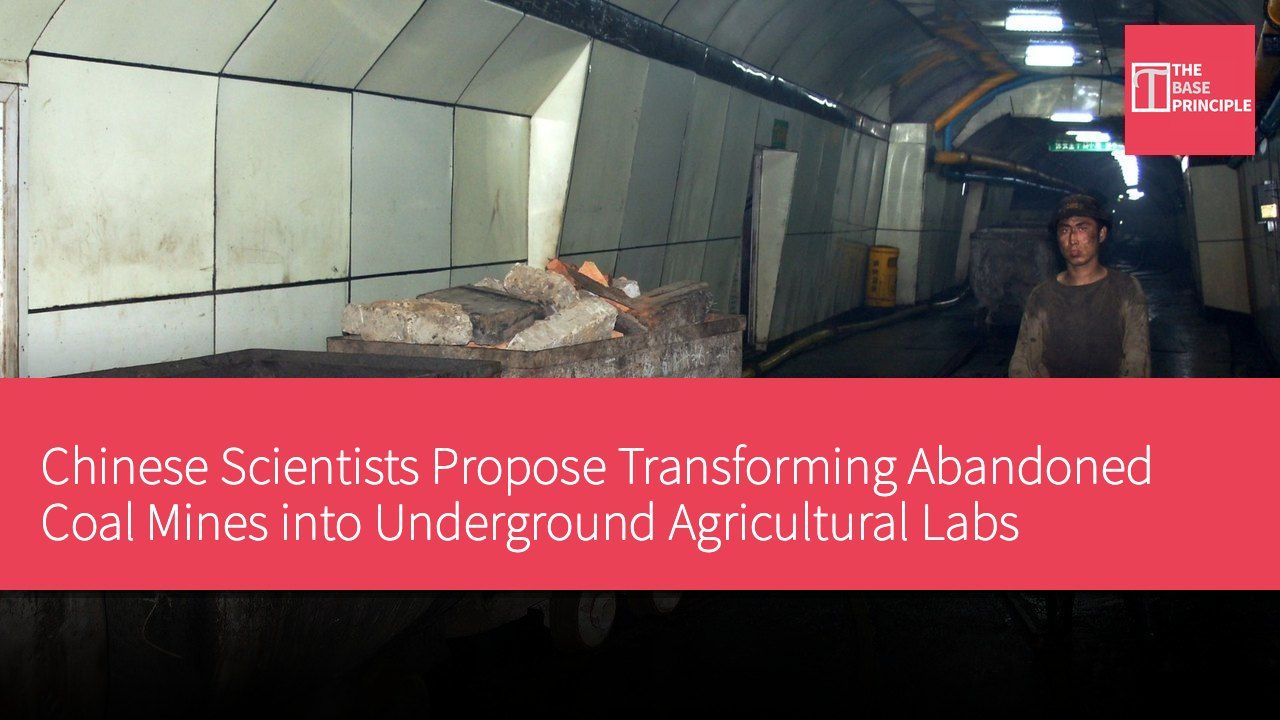
- China plans to transform abandoned coal mines into underground agricultural labs to explore controlled-environment agriculture.
- Underground tunnels can shield against seasonal temperature changes, making them suitable for controlled agricultural experiments.
- Researchers suggest using underground agricultural labs to treat polluted mine water.
- The concept could provide a reliable food production solution for long-term space missions.
China plans to convert thousands of abandoned coal mines into underground agricultural labs, utilizing the country's vast mining spaces and existing infrastructure to explore controlled-environment agriculture. Researchers from the Shanxi Province-based Green and Efficient Development Engineering Center for Coal-Based Resources outlined the proposal in a recent paper published in the journal "China Mining." They believe that abandoned mines could provide a stable environment for studying "closed-environment agriculture" as climate change makes traditional farming increasingly vulnerable.
According to a report by the South China Morning Post, China is expected to have around 15,000 abandoned mines by 2030, creating a large amount of unused underground space. Researchers estimate that the volume of these spaces could reach approximately 720 million cubic meters (254 billion cubic feet). Unlike traditional farmland, underground tunnels are largely insulated from seasonal temperature variations and many weather-related hazards. Researchers believe this makes them suitable for controlled agricultural experiments, where conditions such as temperature, light, water, and air can be precisely managed.
The Potential Challenges and Advantages of Underground Agriculture
Lack of sunlight is clearly a challenge, but researchers point out that the existing electrical infrastructure in abandoned mines can support artificial lighting systems. Underground temperature fluctuations are also much lower than those on the surface, which could reduce the energy required to maintain suitable growing conditions. Geothermal energy might offer another advantage, potentially providing heat for underground cultivation and reducing reliance on fossil fuels.
The researchers are not proposing to immediately transform abandoned mines into massive underground farms. Instead, they envision these mines primarily as agricultural engineering test platforms, where scientists can study how crops respond to controlled underground environments.
The Creation and Application of a Recycling System
The proposal could also provide another use for the infrastructure left behind by mining: the treatment of polluted mine water. Abandoned mines may contain residual contaminants, including lubricants and hydraulic fluids. Polluted water may also migrate through geological faults, cracks, and poorly sealed boreholes, potentially entering surface water. Researchers suggest that underground agricultural labs could provide a practical reason to develop systems to treat and reuse this water. Water containing high concentrations of sulfate or heavy metal ions could be treated through processes such as adsorption and membrane separation, and then used for suitable crops. They mention that acid-tolerant plants, including rapeseed and tea, could be potential candidates.
This would create a recycling system, repurposing the infrastructure, energy, and water resources associated with abandoned mines, rather than simply letting them deteriorate. The researchers also see more unconventional applications for this technology. By creating controlled ecosystems deep underground, scientists can study how plants respond when natural environmental conditions are removed or tightly controlled. The knowledge gained could ultimately aid long-term space missions, where reliable food production is crucial but natural sunlight, soil, and stable environmental conditions cannot be assumed.
China has already begun experimenting with the concept. In Daye City, Hubei Province, researchers have grown butterhead lettuce in an abandoned copper mine about 245 meters (804 feet) underground. The facility uses artificial lighting, intelligent cultivation systems, and low-carbon energy to sustain crop growth. Similar experiments are underway elsewhere. In North Yorkshire, UK, researchers have established agricultural facilities more than 1,000 meters underground to test how crops can be cultivated at such depths.
The concept is not new. British researcher Saffa Riffat proposed using abandoned coal mines for underground agriculture as early as 2018, arguing that these spaces could help address growing food demand while giving former mining infrastructure a new purpose. However, for China, the scale of this opportunity is particularly large. The country closed about 12,000 mines between 2010 and 2019, and thousands more are expected to cease operations in the coming years. Researchers believe these tunnels should not become another legacy of the coal mining industry, but rather laboratories for a different kind of agriculture, aiming to operate independently of increasingly unpredictable environmental conditions.
The Potential Impact of Transforming Abandoned Coal Mines
Transforming abandoned coal mines into underground agricultural labs can effectively utilize existing resources and address the challenges posed by climate change. This not only promotes the development of agricultural technology but also provides new ideas for environmental governance, particularly in the treatment of polluted water. Additionally, this innovative concept could provide important food production technology for future space missions, demonstrating its potential applications in multiple fields.