
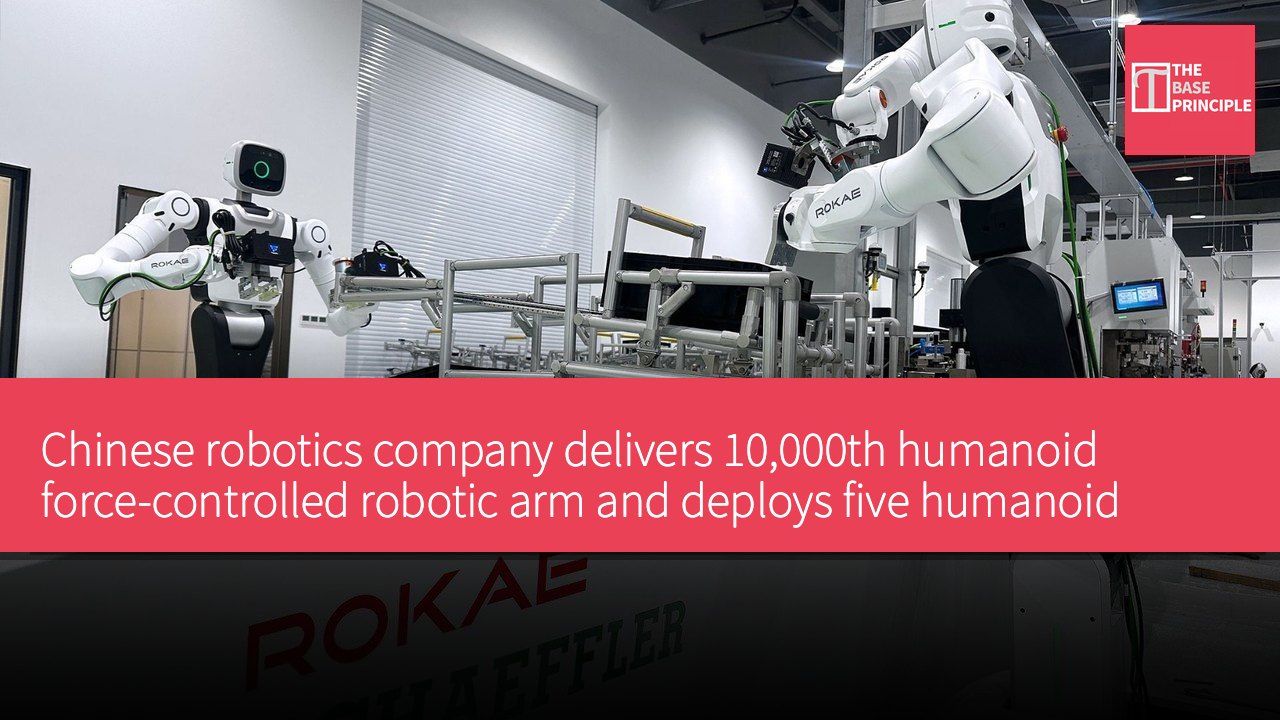
- ROKAE delivers its 10,000th humanoid force-controlled robotic arm, marking a milestone in its industrial robotics business.
- Five Helios wheeled humanoid robots are operational at the Schaeffler factory, performing multiple tasks.
- Force control technology enables the robotic arms to adjust the force applied, suitable for precise tasks.
- ROKAE's product portfolio includes various force control technologies, integrated by over 80 industrial partners.
Chinese robotics company ROKAE has delivered its 10,000th humanoid force-controlled robotic arm, marking a significant milestone in its industrial robotics business. ROKAE stated that this unit came off its production line in September, simultaneously revealing that five Helios wheeled humanoid robots are operating at the Schaeffler factory in Taicang, China. These robots are equipped with ROKAE's AR series robotic arms and have been deployed on assembly lines for components. The announcement highlights the increasingly important role of the robotics supplier in Schaeffler's efforts to implement automation systems in its factories, which focus on producing components for the emerging humanoid robotics industry.
The delivery of ROKAE's force-controlled robotic arms marks a production milestone in its industrial automation technology. The company also reported that five Helios wheeled humanoid robots equipped with AR series robotic arms are operational at the Schaeffler manufacturing facility in Taicang, China, which is an industrial supplier based in Germany. These robots perform tasks including parts handling, assembly, and inspection, specifically targeting production lines for humanoid robot components. The company announced this milestone on October 26, noting that the 10,000th robotic arm came off the production line in September in Shandong Province.
Technical Features of ROKAE's Robotic Arms
This figure specifically refers to its humanoid force-controlled robotic arm product line, rather than the total number of complete humanoid robots produced or delivered.
Force control is a core feature of this technology. Unlike systems that rely on predetermined motions, force-controlled robotic arms can adjust the force applied during physical interactions. This capability is crucial for tasks that require robots to handle components, make contact with objects, and control pressure during assembly operations. According to company data, ROKAE's AR series robotic arms provide force control at each joint, allowing the system to manage physical interactions within the range of motion of the robotic arm. This technology is designed for processing scenarios that require precision and rapid response, including industrial assembly and inspection.
These robotic arms utilize the company's MAC controller, which is compact, measuring 213 × 145.5 × 45 mm. Depending on the configuration, the controller can manage seven joints of a single robotic arm, fourteen joints of a dual-arm system, or over twenty joints of a humanoid robot. This arrangement enables the control system to coordinate multiple joints within the robotic platform.
Application of Humanoid Robots in Factories
ROKAE stated that over 80 industrial partners have integrated its humanoid force-controlled robotic arms into production applications. Its broader product portfolio also includes HSA series integrated force-controlled joints, iNex embodied AI control systems, and Helios wheeled humanoid robots. In Schaeffler's Taicang facility, the Helios robots combine wheeled mobility with the operational capabilities of AR series robotic arms. According to ROKAE, these machines support parts handling, assembly, and inspection on component production lines. Their deployment demonstrates how to combine mobile robotic platforms with force-controlled manipulators for manufacturing tasks.
This installation is part of Schaeffler's larger effort to use humanoid robots in its own manufacturing operations while producing components for the robotics industry.
The company previously described six humanoid robots operating at five workstations in the Taicang facility, producing components including linear and rotary actuators. ROKAE's latest announcement specifically mentions five Helios robots but does not explain the discrepancy between these two reported figures. The companies have not disclosed detailed operational data regarding ROKAE's deployment, including production rates, human intervention requirements, or quantified productivity improvements. These metrics would help determine the effectiveness of robots in ongoing industrial operations.
Item Specifications Robotic Arm Size 213 × 145.5 × 45 mm Number of Joints Seven for single arm, fourteen for dual arms, over twenty for humanoid robot joints
ROKAE's Influence in the Automation Market
The delivery of ROKAE's humanoid force-controlled robotic arms reaching 10,000 units demonstrates its growth potential in the industrial automation sector. As more factories begin to adopt automation technologies, ROKAE's force control technology, which can adjust forces during physical interactions, is crucial for precision assembly and inspection tasks. The utilization of Helios robots showcases the important role of robotic technology in modern manufacturing, particularly in enhancing production efficiency and accuracy. ROKAE's expanding product portfolio indicates its competitive advantage in the future market.