
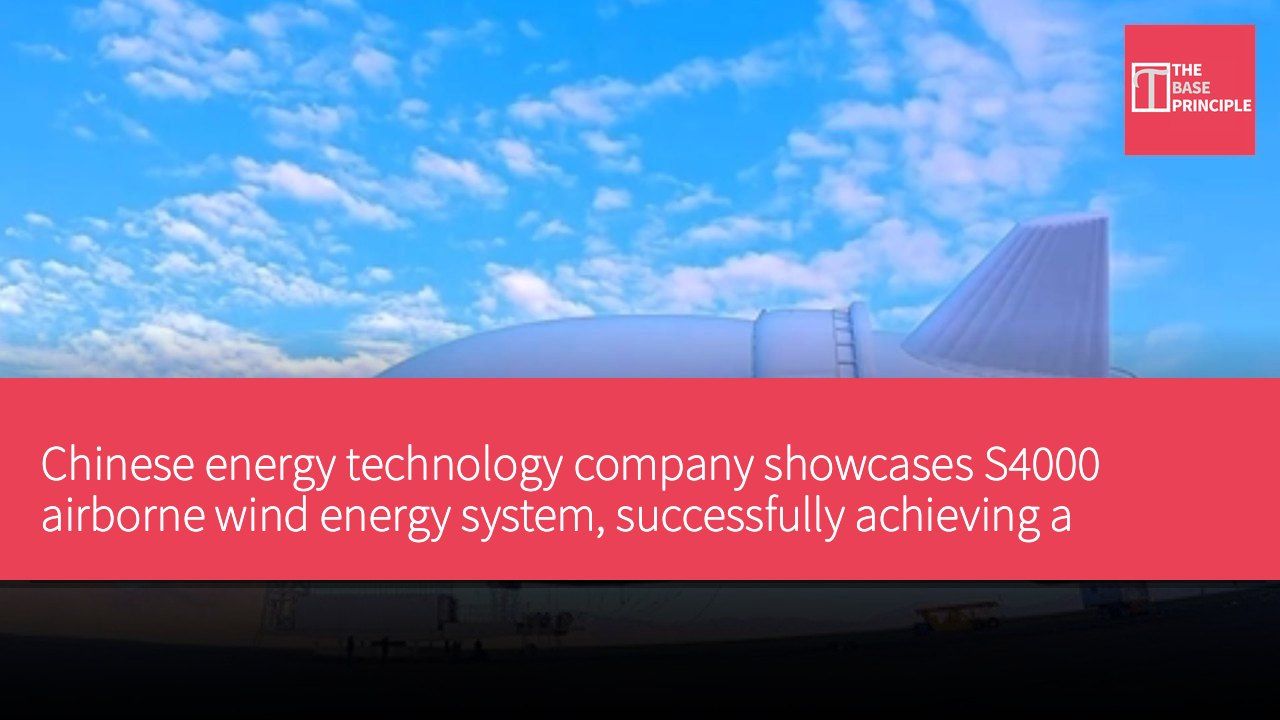
- The S4000 airborne wind energy system can generate power at an altitude of 2.5 miles, exploring new wind energy solutions.
- The system utilizes a helium-filled platform to elevate turbines into stronger winds for power generation.
- The design of the system reduces land requirements and minimizes dependence on terrain.
- High-altitude wind energy is attracting international attention and has the potential to surpass traditional wind energy technologies.
Development Stages of the S4000 System
The launch of the airborne wind energy system follows a series of increasingly ambitious tests, with earlier versions achieving altitudes of 1,640 feet (approximately 500 meters), 3,281 feet (approximately 1,000 meters), 4,921 feet (approximately 1,500 meters), and 6,562 feet (approximately 2,000 meters). The S4000 represents the latest stage of this development, although its commercial performance and ability to provide reliable power supply are yet to be established. The S4000 uses a large helium-filled airborne structure to elevate its power generation equipment into the air.The platform measures 220 feet (approximately 67 meters) in length, 131 feet (approximately 40 meters) in width, and 75 feet (approximately 23 meters) in height, resembling a large airship, and is designed to carry an effective airborne payload of over 2,200 pounds (approximately 1,000 kilograms). Once airborne, wind flows through channels in the structure, driving the turbines to generate power. The tether keeps the platform connected to the ground while also providing a pathway for transmitting electricity to users below. Unlike traditional wind turbines that require tall towers and sturdy foundations, this airborne system is designed to operate without equally scaled permanent structures. Linyi Yunchuan states that this can reduce land requirements and decrease the technology's dependence on local terrain. The company also lists the design's service life as 20 years. However, the durability under long-term high-altitude wind conditions, variable weather, and mechanical stress still needs to be verified through extended operation.
Operational Challenges Near Urban Areas
The latest launch in Yueyang focuses on deploying the system under real operational conditions near urban areas. According to the company, the S4000 successfully completed a full flight verification of 2.5 miles in northwestern China in August, including ascent, hovering, power generation tests, and recovery. Company executives noted that grid connection and proximity to consumers are important considerations for the technology's development. However, this approach also introduces its own engineering and infrastructure requirements: the tether must maintain structural stability while transmitting power, and the airborne platform must withstand changing wind conditions and remain safely recoverable.Its operation in densely populated areas also requires careful assessment of airspace restrictions, weather-related risks, and emergency procedures. The company has not yet provided detailed figures regarding the S4000's power generation capacity, electricity output during the demonstration period, or projected costs per kilowatt-hour. These metrics will be crucial in determining whether the technology can compete with established wind and solar facilities. Airborne wind energy is attracting international attention, as wind speeds at high altitudes are often stronger and more stable than those near the ground, potentially allowing airborne systems to generate more power without the need for large towers and foundations.
Item Specifications Platform Length 220 feet (approximately 67 meters) Platform Width 131 feet (approximately 40 meters) Platform Height 75 feet (approximately 23 meters) Effective Payload Over 2,200 pounds (approximately 1,000 kilograms) Design Service Life 20 years
Future Potential of Airborne Wind Energy Technology
The launch of the S4000 airborne wind energy system marks a significant advancement in energy technology, particularly in high-altitude power generation. The design of this system not only reduces reliance on ground infrastructure but also captures more stable wind energy at high altitudes, which is crucial for improving power generation efficiency. However, the technology's reliability in commercialization and long-term operation still requires further validation, especially in the face of various challenges in urban environments, all of which will impact its future development and market competitiveness.