
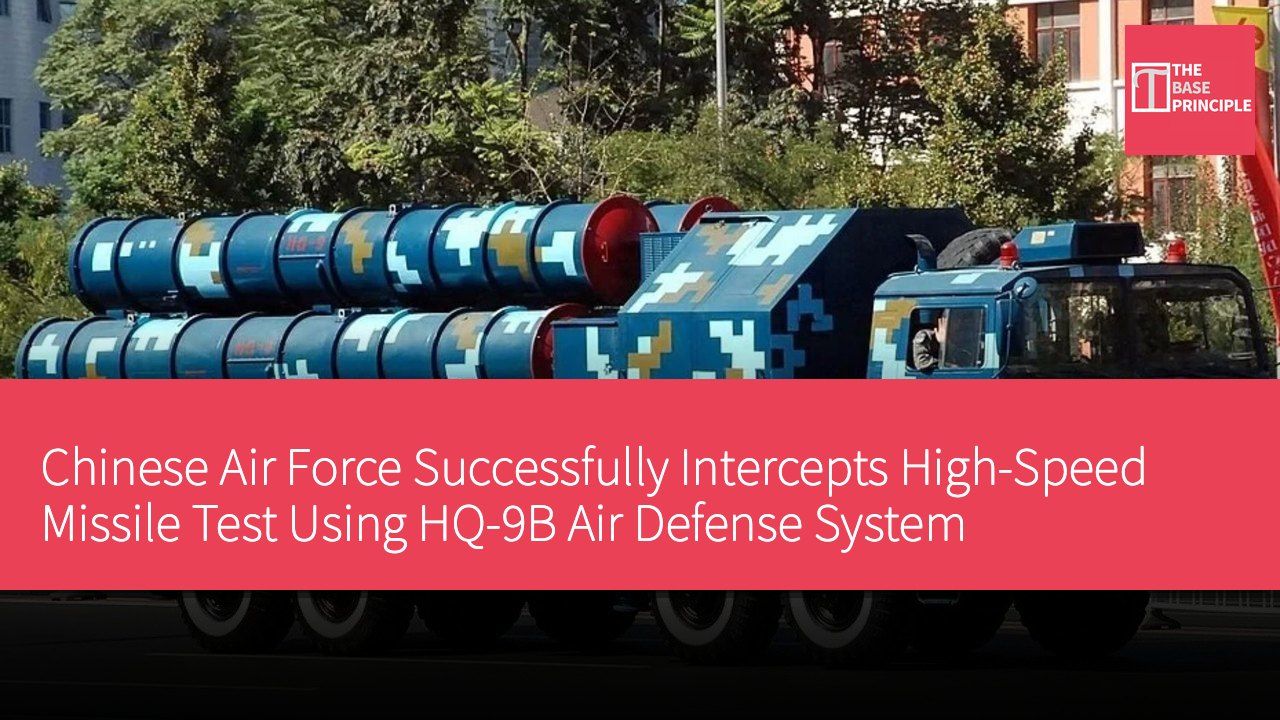
- The Chinese Air Force successfully used the HQ-9B to intercept fast-moving missiles.
- Operators had two seconds to identify and decide whether to launch.
- The HQ-9B can strike targets on nonlinear flight paths, but its effectiveness against hypersonic missiles still needs verification.
- China has established a unified data-sharing framework to enhance air defense coordination.
Beijing authorities announced that the People's Liberation Army Air Force successfully destroyed targets using the HQ-9B surface-to-air missile platform during a training exercise. These targets included missiles capable of rapid movement and complex maneuvers. The evaluation of the HQ-9B, a new piece of equipment for the Chinese military, required intercepting two different types of missiles. One specific target suddenly changed direction in mid-air and then plummeted to the ground at extremely high speed. According to a report by China Central Television (CCTV), the exercise was conducted by the Central Theater Command's Shenzhou Missile Battalion of the People's Liberation Army Air Force.
Performance of the HQ-9B Against Evasive Targets The participants from the Shenzhou Missile Battalion were not informed of the specific threats they would face; they were only told that the mission involved intercepting agile, high-speed objects. One participant noted that operators had only two seconds of reaction time. In this brief window, they needed to identify the mysterious object and decide whether to launch. Military expert Song Zhongping pointed out in a report for the Global Times that despite precise radar monitoring, the defense system must possess the capability to adjust its trajectory mid-course to successfully track targets exhibiting irregular flight patterns.
Intercept Performance and Challenges of the HQ-9B
During combat, the HQ-9B uses an active radar homing (ARH) mechanism combined with an inertial navigation system (INS) for guidance and tracking. In addition to its advanced control and engine technology, the HQ-9B can strike targets on nonlinear flight paths. However, the effectiveness of missile interception depends on multiple variables, such as communication reliability, target speed, response time, and radar accuracy. This exercise also demonstrated the ability of the People's Liberation Army to integrate different missiles, command, and radar components into a unified air defense network.
Expert Song Zhongping clarified that China has established a unified data-sharing framework that allows different air defense sectors to share intelligence regarding imminent threats and coordinate actions. Threats are allocated among different units based on proximity and operational readiness. China's integrated defense network enhances multi-layered protection. Another member of the battalion, Hu Yang, mentioned that it takes only two minutes from receiving a high-level alert to actual interception. While this exercise proved that the HQ-9B can intercept maneuverable missiles, its capability against hypersonic cruise missiles or glide vehicles needs to be validated through real combat simulations.
System Practicality Requires Further Verification
While the HQ-9B may intercept targets approaching directly, intercepting hypersonic cruise missiles or glide vehicles poses a significant challenge for any surface-to-air hardware. Testing the HQ-9B's capability against maneuverable aerial targets does not confirm its effectiveness against operational hypersonic technologies. Assessing the system's practicality against such weapons requires various tests in real combat environments. As early as September 2025, China showcased multiple air defense assets, including the HQ-29, HQ-19, HQ-9C, and HQ-9B.
These platforms demonstrate China's growing capability to defend against various types of missiles and fixed-wing aircraft.
The latest HQ-9B exercise highlights the continuous technological advancements of the Chinese armed forces. However, the system's ability to counter complex missile threats still awaits independent testing to confirm its effectiveness in real combat scenarios.
Technical Significance and Challenges of the HQ-9B Exercise
The HQ-9B exercise showcased China's advancements in air defense technology, particularly its capability to intercept agile, high-speed missiles. However, intercepting hypersonic cruise missiles or glide vehicles remains a significant challenge that requires further real-world testing to validate its effectiveness. Additionally, the unified data-sharing framework indicates the Chinese military's efforts in coordinating defense actions, which helps enhance overall defense capabilities.