
- The research team from the Chinese Academy of Sciences successfully overcame the performance bottleneck of sodium-sulfur batteries.
- A new single-atom aluminum catalyst significantly enhances the stability of sodium-sulfur batteries.
- The study shows that altering atomic structures can effectively suppress the transfer of polysulfides.
- This technology offers new possibilities for the design of main group metal catalysts.
While lithium batteries receive significant attention, the cheap and abundant sodium has long been key for large-scale energy storage. The only issue has been the rapid degradation of sodium-sulfur batteries. Researchers from the Chinese Academy of Sciences have recently overcome a major obstacle that has plagued this technology for years, successfully modifying a metal found in ordinary soda cans. Led by Professors Wang Hui and Zheng Fangcai from the Hefei National Laboratory for Physical Sciences at the Microscale, the team successfully redesigned single-atom aluminum, allowing its performance to surpass that of more expensive rare earth elements. The researchers developed an efficient single-atom aluminum catalyst to overcome the performance limitations of main group metal catalysts in sodium-sulfur batteries.
The team stated in a press release: "This creates an asymmetric structure with three oxygen atoms and one nitrogen atom surrounding each aluminum atom." They also added, "These batteries maintain stable performance over thousands of charge-discharge cycles, demonstrating the great potential of sodium-sulfur batteries."
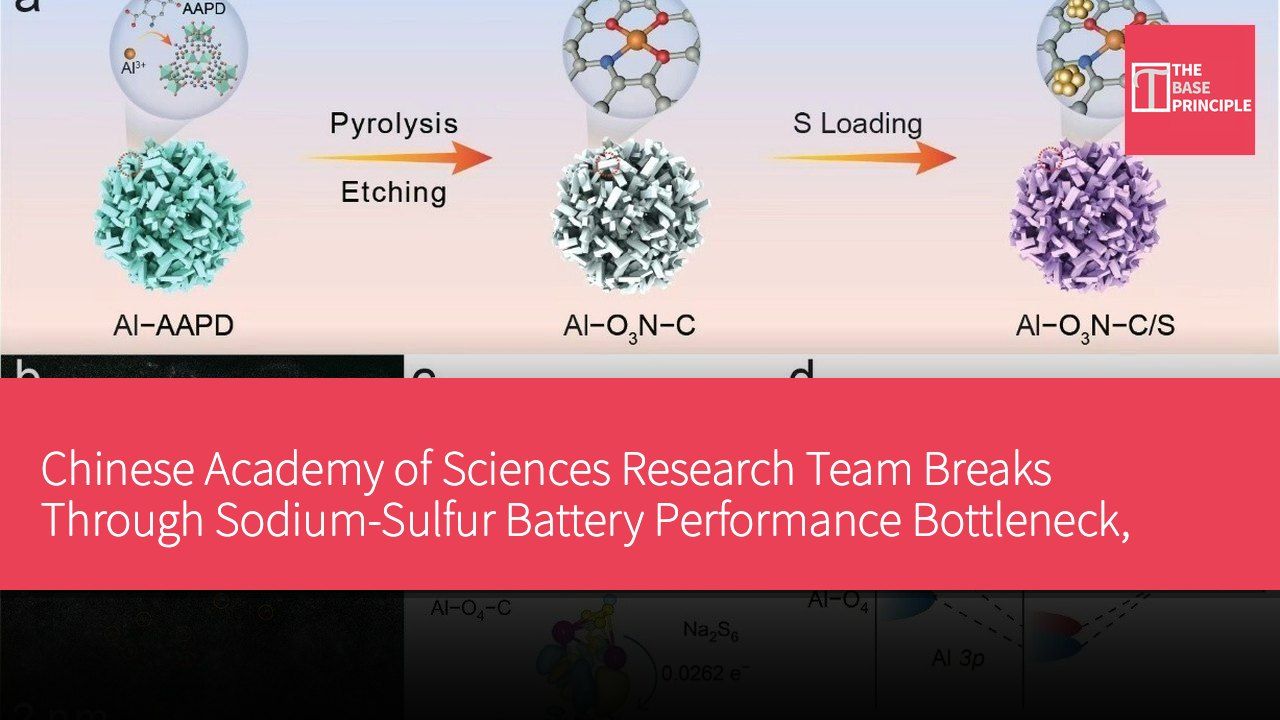
This research describes synthetic schematics, structural characterization, electron transfer during the Na2S6 adsorption process, and the p-p orbital hybridization interaction between aluminum single atoms and sodium polysulfides. (Photo provided by Zheng Fangcai)
Breakthrough in Altering Atomic Structures
For a long time, the search for durable batteries has primarily focused on precious heavy metals such as platinum, cobalt, or nickel. In contrast, main group metals like aluminum are cheap and non-toxic, yet their effectiveness as catalysts is relatively low, and they struggle to manage sodium polysulfides effectively. These volatile intermediate compounds transfer and dissolve between cathodes, leading to shortened battery life. The team discovered that breaking atomic symmetry is the solution. Typically, isolated aluminum single atoms are comfortably surrounded by four oxygen atoms (Al–O4). The Hefei team replaced one oxygen atom with a nitrogen atom. This single change created an asymmetric Al–O3N coordination structure.
The substitution of a single nitrogen altered the local electronic distribution around the central aluminum atom, forming a strong local charge. This charge facilitated strong p-p orbital hybridization between the aluminum sites and sulfur species within the battery. As a result, the transfer of polysulfides was effectively suppressed, improving reaction rates and overall electrochemical stability.
Outstanding Performance of the New Anode
In anode performance tests, the lost polysulfides were effectively captured, preventing material loss while accelerating internal chemical reactions. In laboratory tests, the new aluminum-based anode demonstrated outstanding energy output and long-term durability. After 100 cycles, its storage capacity reached 1,196 mAh g-1. Even after 2,500 continuous charge-discharge cycles, its performance declined by only a minimal 0.017% per cycle. This exceptional stability allows the inexpensive aluminum material to easily surpass the more expensive transition metal catalysts.
The researchers noted: "These findings highlight the importance of the local atomic environment in determining the catalytic activity of single-atom catalysts and provide new possibilities for designing efficient catalysts based on main group metals."
As grid operators seek safer and cheaper lithium alternatives for renewable energy storage, adjusting the atomic structure of abundant elements like aluminum offers a clear and scalable path forward. This research was published in the journal *Applied Chemistry*.
Item Specification Storage Capacity 1,196 mAh g-1 Cycle Count 2,500 cycles
Future Potential of Sodium-Sulfur Battery Technology
The development of sodium-sulfur batteries is crucial for renewable energy storage, as the sodium resources used are abundant and low-cost. The breakthroughs achieved by the research team not only enhance the stability of the batteries but also demonstrate the potential of utilizing main group metals, which is significant for future battery technology. As global demand for sustainable energy solutions increases, the promotion of this technology could facilitate broader applications, particularly in grid storage.