
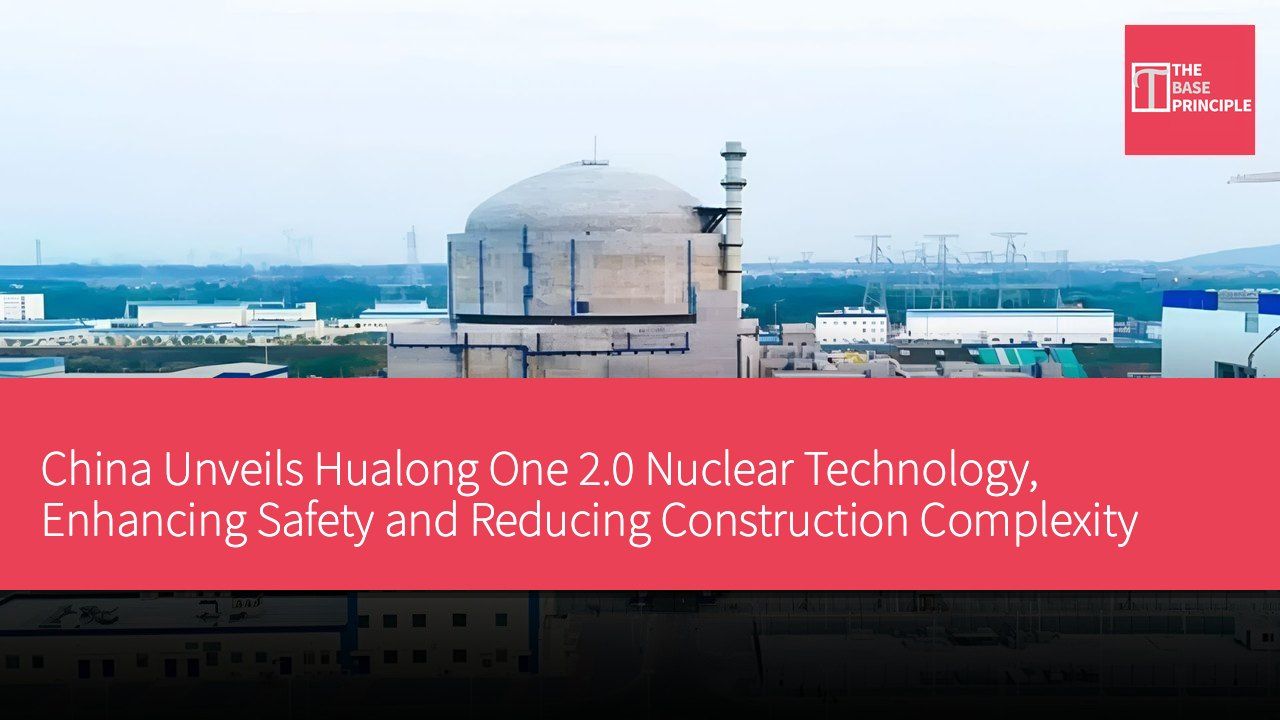
- Hualong One 2.0 enhances nuclear power plant safety and reduces construction complexity.
- The design allows operators to run the plant for 72 hours without intervention after an accident.
- Automation rate increases by 66%, with precise adjustments to system response times.
- Key equipment achieves 100% localization capability, boosting supply chain independence.
China recently unveiled Hualong One 2.0, an upgraded third-generation enhanced nuclear technology designed to boost reactor safety while reducing construction complexity, equipment needs, and operational workload. The technology was launched on September 7 at the China General Nuclear Power Group (CGN) 2026 Sustainability Conference. It builds upon the existing Hualong One design rather than replacing it with an entirely new reactor architecture. One of the most significant changes is the length of time the power plant can continue to operate without external intervention after an accident.
The Hualong One 2.0 design enables operators to run the plant for 72 hours without intervention after an accident, providing a seven-day accident self-sustaining capability.
Design Improvements and Safety Enhancements
The upgraded design also features improvements in the physical complexity of the nuclear island. The length of piping has been reduced by approximately 31%, while the number of process valves has decreased by about 25%. The nuclear island building volume has been reduced by 21%, and the installation volume has decreased by approximately 33%. In terms of safety, the architecture retains the deep defense strategy employed by Hualong One while optimizing 14 safety functions and improving nine key safety indicators. These changes aim to make the reactor easier to build and operate while enhancing its ability to respond to abnormal situations.
Automation is another key aspect of this upgrade. The unit automation operation rate has increased by 66%, allowing the system to make more precise adjustments and potentially shorten response times. "This is not a technology developed from scratch but a systematic quality and efficiency upgrade based on a mature design, encompassing five dimensions: safety, construction progress, capital costs, operation and maintenance, and environmental protection," said Niu Wenhua, chief expert of Hualong One 2.0, at the launch event.
The technology's development also focused on supply chain independence, with CGN stating that key equipment achieves 100% localization capability. This upgrade is based on years of operating experience with Hualong One. Currently, ten Hualong One reactors are in commercial operation in China and overseas, with another 37 approved and under construction. CGN stated that the Hualong One development program has incorporated extensive construction and operational experience, with the research and development team working with industry partners to complete nearly 100 design optimizations before launching the 2.0 version.
Enhancements in Construction Efficiency
The changes also aim to improve the construction efficiency of nuclear power plants. Reducing the number of pipes, valves, and installation volume can simplify the nuclear island and potentially lower the workload required for construction. The development of this technology is based on decades of China's nuclear program. The Daya Bay Nuclear Power Base in Shenzhen currently has six reactor units, distributed between the Daya Bay and Ling Ao nuclear power plants, with a cumulative on-grid power generation exceeding 1,000 TWh. One of the Ling Ao reactors has operated for over 7,200 days, setting a world record for the longest reported safe operation cycle for a reactor of its type.
Hualong One 2.0 is now moving towards its first demonstration project. The State Council Executive Meeting on July 31 approved eight nuclear power units, with CGN's Guangdong Taipingling Nuclear Power Plant Phase III designated as the demonstration project for the upgraded technology. This move provides China with a pathway to test the design's promises in terms of safety, construction, automation, and cost, and to see if the engineering optimizations can translate into large-scale nuclear energy deployment.
The Impact of Hualong One 2.0 on Nuclear Energy Development
The launch of Hualong One 2.0 reflects China's continuous innovation and progress in nuclear technology. This technology not only emphasizes safety but also optimizes construction complexity, demonstrating China's maturity and confidence in the nuclear energy sector. The increase in automation will help improve operational efficiency and reduce the risk of human error. Additionally, the localized design of the supply chain can foster independent research and development capabilities, which are crucial for the future development of nuclear energy projects. Overall, Hualong One 2.0 represents China's significant position in the global nuclear energy market and provides a solid foundation for future nuclear energy development.