
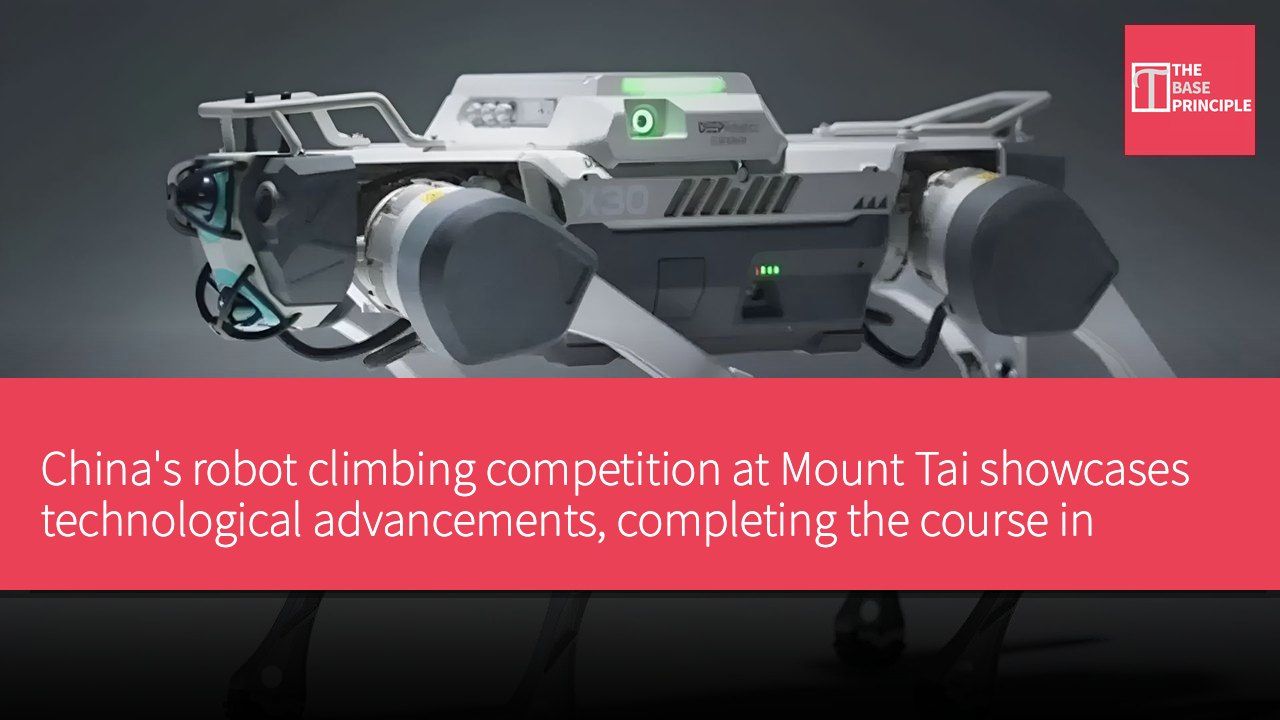
- China's robotics technology showcased advancements in the Mount Tai climbing competition.
- Participating robots had to overcome steep stone steps with over 3,100 stairs.
- A quadruped robot won, completing the course in 43 minutes and 41 seconds.
- The competition tested not only speed but also the robots' mobility capabilities.
China's robotics technology is rapidly advancing. A notable example of this progress is the robot climbing competition held in Shandong Province in eastern China, at the famous Mount Tai. The participating robots demonstrated their ability to navigate challenging mountain paths, showcasing speed, balance, and technical precision. The competition took place on Monday, with approximately 90 teams participating, representing major companies, universities, and research institutions. The main route of the competition was about 3.9 kilometers long, from the Hongmen Gate to the Zhongtian Gate of Mount Tai.
Along the way, the robots had to climb over 3,100 steep stone steps and overcome an elevation difference of about 600 meters. The goal of the competition was not only to test speed but also to evaluate the robots' mobility on difficult and uneven terrain. The participating robots included humanoid robots and quadruped robots. Some robots moved cautiously, taking careful steps, while others appeared capable of climbing stairs at a faster pace. Generally, it takes a person about one and a half to two hours to complete this route, but the participating robots finished in under an hour.
Quadruped Robot Wins
According to China Central Television, the quadruped robot developed by Beijing Lingxi Technology won first place in the competition, completing the course in 43 minutes and 41 seconds. Throughout the process, the robot navigated rugged terrain and narrow mountain paths, demonstrating its agility and stability. The smallest quadruped robot in the competition was the Cyvet from UNIUBI AI. The company told the Global Times that in one test, the robot autonomously completed the entire route from the Hongmen Gate to the Zhongtian Gate in just 35 minutes and 47 seconds.
To tackle these challenges, the company equipped its quadruped robot with LiDAR technology, enabling the robot to scan its surroundings and identify stairs, rocks, and narrow passages. This system can create a 3D point cloud map of the terrain, helping the robot identify suitable paths and move forward. The competition was not limited to speed; it also included tasks such as weight-bearing, humanoid robot races, and inspections in challenging environments. A Shandong company brought three different models of robots: two quadruped robots, Y30 and E15, and one humanoid robot, E1, which secured second place in the competition.
Competition Categories and Challenges
The humanoid robot E1, developed by a Shandong robotics company, performed well, completing the course in 36 minutes and 18 seconds, earning second place in its category. The competition was broadly divided into two categories: speed races and professional technical challenges. Under these two categories, four official events were organized, including humanoid robot races, quadruped robot weight-bearing walks, and climbing competitions with assistive exoskeletons.
China's robotics industry continues to expand. According to the World Robotics 2026 report, China is expected to account for about two-thirds of the global market share by 2025. Data from the Ministry of Industry and Information Technology shows that there are over 400 models of humanoid robots domestically, with more than 40,000 units produced in the first half of 2026. The robotics industry in China is also rapidly growing, with ongoing development of industrial robots and humanoid machines. Xiang Ligang, president of the Beijing Intelligent Robotics Industry Association, told the Global Times that robot competitions can serve as indicators of technological advancement, much like early airplane and automobile exhibitions that attracted public attention.
Xiang stated that such competitions allow robotics companies to identify weaknesses in their technology and make improvements, making it easier to compare performances when robots from different companies operate in the same environment.
Item Specification Main route length 3.9 kilometers Winning time for quadruped robot 43 minutes 41 seconds Maximum elevation difference 600 meters Test time for quadruped robot 35 minutes 47 seconds Humanoid robot E1 time 36 minutes 18 seconds
Impact of Robot Competitions on Technological Advancement
Robot competitions not only showcase the technical capabilities of participants but also promote the development of the entire industry. Through competitions, participating companies can identify technical shortcomings and make improvements, which is crucial for enhancing robot performance in complex environments. Additionally, such events can attract public attention, similar to early airplane and automobile exhibitions, further promoting the popularization and application of robotics technology.