
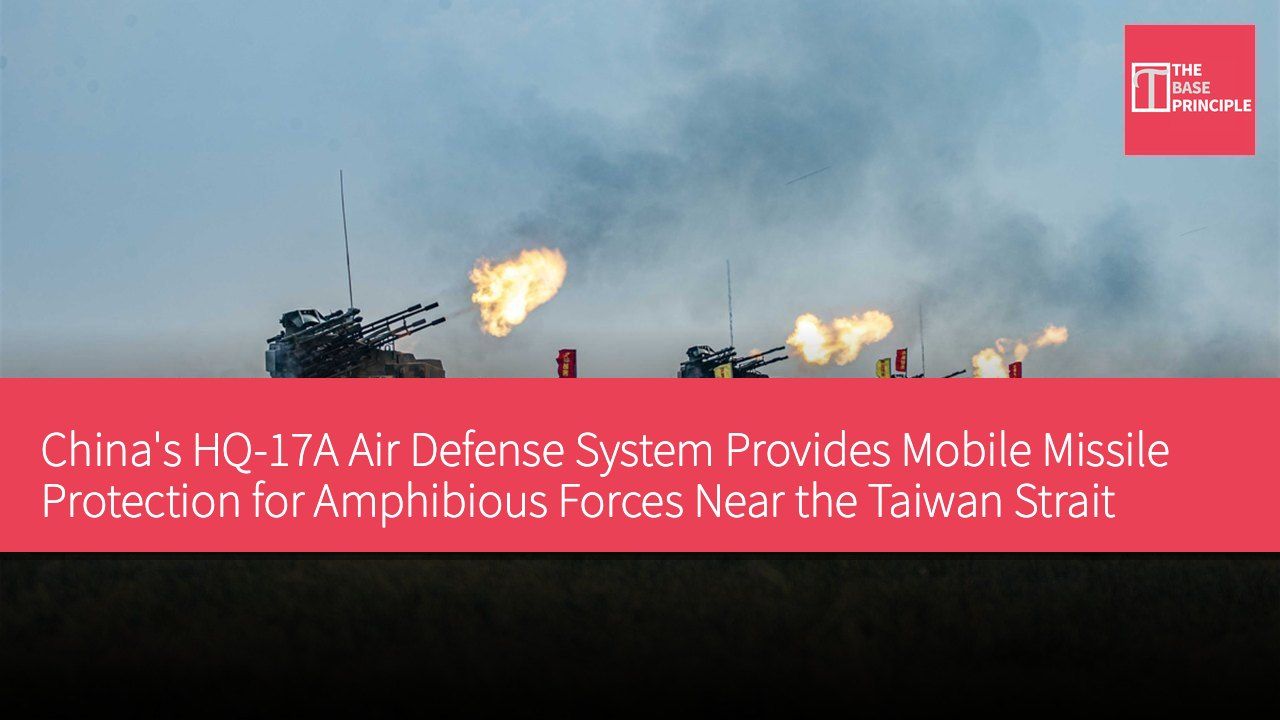
- The HQ-17A system provides crucial air protection for China's amphibious forces.
- This system can independently detect and intercept aerial targets, enhancing operational capabilities.
- The HQ-17A has operational limitations when facing large numbers of drones.
- Taiwan is also expanding its unmanned systems capabilities to counter potential threats.
China's HQ-17A air defense system may play a significant role in protecting amphibious forces and military equipment during cross-strait operations, especially in the lead-up to potential conflict with Taiwan. In a recent exercise, the system's wheeled launcher successfully intercepted a drone simulating an incoming cruise missile, while amphibious armored vehicles advanced into open waters, highlighting how the People's Liberation Army (PLA) provides short-range air cover for troops preparing to cross the Taiwan Strait. The system is designed to operate alongside ground formations to counter aircraft, cruise missiles, and precision-guided munitions, and its wheeled configuration allows for missile launches while in motion, enabling it to protect armored units without needing to stop.
Operational Capabilities of the HQ-17A System
The HQ-17A provides mobile air cover for amphibious formations. In a June exercise last year, amphibious armored vehicles entered open waters while a six-wheeled HQ-17A launcher deployed along the coastline fired at a drone simulating an incoming cruise missile. The participating units are believed to belong to the PLA's 125th Independent Amphibious Combined Brigade. According to the South China Morning Post, U.S. Army analysis suggests that this formation is one of six amphibious brigades targeting potential landing operations against Taiwan. Each launcher can carry eight vertically launched missiles and is equipped with a vehicle-mounted radar, enabling it to independently detect and intercept aerial targets.
The operational range of these missiles is approximately 0.9 to 9.3 miles, capable of intercepting targets at altitudes ranging from about 33 feet to 32,808 feet. A typical launch battery consists of four launchers along with command and ammunition transport vehicles.
Limitations and Challenges of the System
While the HQ-17A possesses mobility, its limitations may become pronounced in prolonged conflicts involving large numbers of drones and precision-guided munitions. Each launcher carries only eight ready-to-fire missiles, which is half the capacity of the newer Russian Tor-M2 launchers that carry 16. Reloading the HQ-17 or HQ-17A takes approximately 18 minutes, which could result in vulnerable periods that diminish operational capability. Its radar-guided nature may also provide adversaries with opportunities to detect and target the system. Operating the HQ-17A close to the coastline against Taiwan's drones, rockets, and missiles will require operators to maintain situational awareness and coordinate with other air defense units.
Additionally, Taiwan is also expanding its own unmanned systems capabilities. In August of this year, Taiwan's Legislative Yuan passed a six-year funding framework of approximately $7.3 billion, covering unmanned systems, including coastal attack and reconnaissance drones.
The People's Liberation Army is also exploring ways to protect amphibious forces departing from the coastline. In the June exercise, soldiers stationed in amphibious vehicles fired shoulder-launched missiles at drones. However, even a coordinated network cannot guarantee complete protection, as its effectiveness will depend on overlapping radar coverage, communication between units, availability of munitions, and the ability to detect threats early.
Impact of the HQ-17A on Cross-Strait Military Balance
The introduction of the HQ-17A air defense system demonstrates China's military preparedness amid cross-strait tensions. This system not only provides the capability to counter aerial threats but also underscores the mobility of the People's Liberation Army in amphibious operations. However, the limitations in missile capacity and reload times of the HQ-17A may affect its operational effectiveness in prolonged conflicts. As Taiwan strengthens its unmanned systems capabilities, the complexity of military standoffs across the strait will further intensify, and competition in air defense and offensive capabilities will become a critical consideration in future military strategies.