
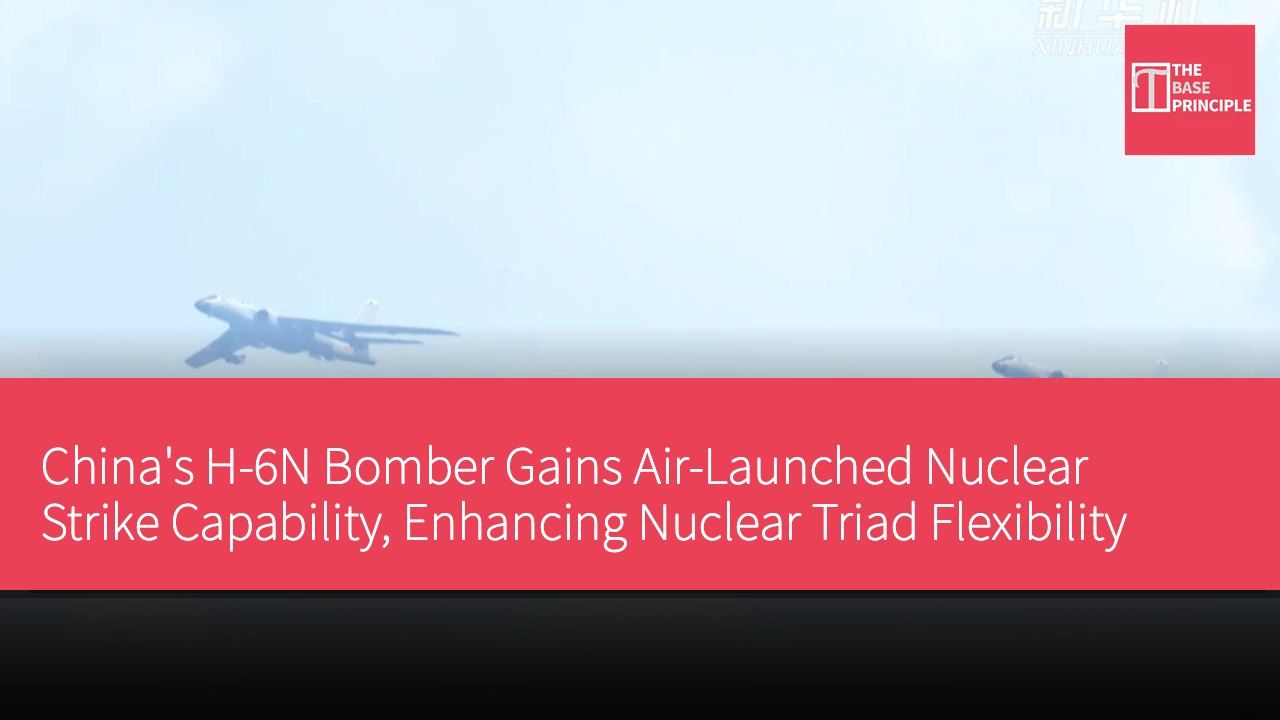
- The H-6N strategic bomber has gained air-launched nuclear strike capability, carrying the JL-1 missile.
- The H-6N offers Beijing flexibility in nuclear retaliation scenarios, extending its strike range beyond the Western Pacific.
- The H-6N is designed to carry large nuclear missiles, restoring the airborne component of China's nuclear triad.
- As China's nuclear arsenal expands, the strategic importance of the H-6N has significantly increased.
China is elevating the role of its H-6N strategic bomber within its nuclear forces, with recent imagery showing the aircraft carrying the nuclear-capable JL-1 (Jielong-1) air-launched ballistic missile. This combination provides China with an air-based nuclear strike option, complementing its land-based intercontinental ballistic missiles and submarine-launched ballistic missiles. The H-6N is a heavily modified version of the H-6, which is derived from the Soviet Tu-16 and has been China's mainstay strategic bomber for decades. Unlike traditional H-6 variants, the H-6N is designed to carry oversized external weapons, including the JL-1 missile.
With aerial refueling and a reported combat radius exceeding 2,175 miles, the aircraft provides Beijing with additional flexibility in nuclear retaliation scenarios and has the potential to extend its strike range beyond the Western Pacific.
The aircraft is an evolution of the H-6, which has been China's primary strategic bomber for over six decades. Its original design was based on the Soviet Tu-16, with China beginning licensed production after an agreement with Moscow in 1957. The first Chinese-assembled Tu-16 flew in 1959. However, following the Sino-Soviet split, China had to continue developing and producing the aircraft without Soviet assistance. The first fully domestically produced H-6 eventually flew in December 1968. It is reported that over 230 H-6 aircraft have been produced over the decades, with various versions developed to fulfill different missions.
H-6N Design and Capabilities
Today's H-6K and naval H-6J are primarily conventional strike platforms, while the H-6N is designed around the new requirement of carrying large, nuclear-capable air-launched ballistic missiles. This capability effectively restores the airborne component of China's nuclear triad, supplementing its land-based intercontinental ballistic missiles and ballistic missile submarines.
The H-6N differs from earlier H-6 variants in several important ways, most notably that its traditional internal bomb bay has been removed or significantly modified, with a recessed area under the fuselage to accommodate oversized external weapons. This configuration allows the bomber to carry the JL-1 missile, which is far larger than the conventional cruise missiles carried by other H-6 variants. The H-6N is also equipped with a nose-mounted aerial refueling probe, enabling it to refuel from China's YY-20A tankers, thus extending its operational range and mitigating a major limitation of the relatively aging airframe.
The aircraft reportedly has a combat radius exceeding 2,175 miles, although the actual range available for specific missions will depend on factors such as payload, flight profile, and refueling support.
Strategic Significance of the H-6N
The JL-1 missile adds another layer to this capability, reportedly derived in part from China's DF-21 medium-range ballistic missile series, and designed to be launched from high altitude by a bomber rather than from fixed or mobile ground launchers. Reports estimate the JL-1's maximum range at up to 5,000 miles, although public information about the missile remains limited. Combined with the bomber's own range and aerial refueling capability, the system has the potential to provide China with an intercontinental strike option. While China's land-based intercontinental ballistic missiles and ballistic missile submarines remain the core of its nuclear retaliation capability, the H-6N offers a different option.
As China's nuclear arsenal expands, the strategic importance of this aircraft grows. The Stockholm International Peace Research Institute estimates that by 2026, China will have about 20 H-6Ns in service, with as many as 20 nuclear warheads assigned to the force.
Impact of the H-6N on China's Nuclear Strategy
The introduction of the H-6N marks a significant advancement in China's nuclear forces, particularly in terms of air strike capability. The bomber not only extends China's nuclear strike range but also enhances the flexibility of its nuclear triad. As the global security environment continues to evolve, China's nuclear strategy is coming under increasing scrutiny, and the deployment of the H-6N could affect the regional military balance and prompt other nations to reassess their defense strategies. This development highlights China's efforts in modern military technology and may draw attention and reaction from the international community.