
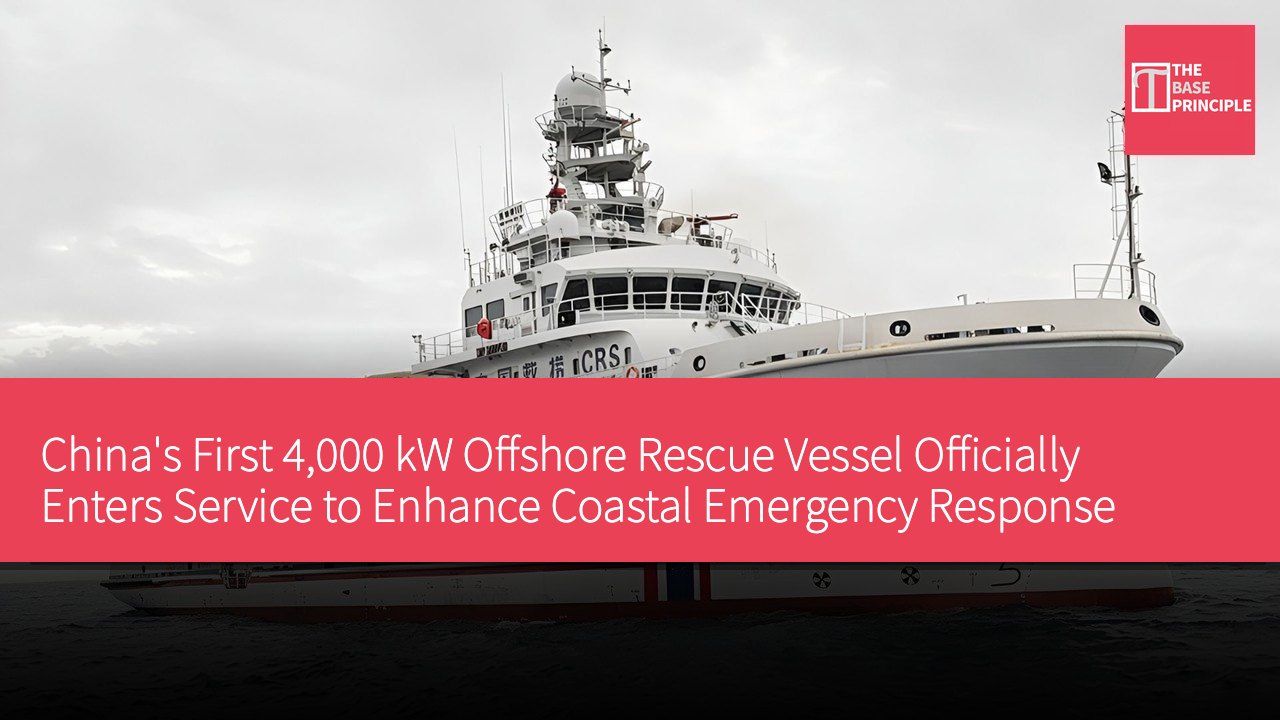
- China's first 4,000 kW offshore rescue vessel, Donghai Jiu 152, is officially in service.
- The vessel is equipped with propulsion and positioning systems to handle challenging marine conditions.
- The new fleet enhances China's emergency response capabilities along its coast.
- The dynamic positioning system improves the vessel's maneuverability in narrow waters.
China has completed the construction of its first batch of five domestically produced medium-sized offshore rescue vessels, enhancing its ability to respond to coastal emergencies. The final vessel, Donghai Jiu 152, officially joined the Ministry of Transport's Donghai Rescue Bureau on November 13, 2026. This 4,000 kW vessel brings multiple specialized capabilities to China's eastern coastal waters, with its propulsion and positioning systems enabling crew operations under challenging marine conditions. Additionally, the vessel is capable of supporting rescue missions involving a large number of survivors. This delivery marks the conclusion of a procurement plan that has lasted nearly seven years.
China delivered its first vessel, Donghai Jiu 151, in December 2019.
Design and Capabilities of the New Vessel
Donghai Jiu 152 is 69.5 meters (228 feet) long and 14.6 meters (48 feet) wide, specifically designed for rescue operations in China's eastern waters. Its hull and onboard systems can withstand harsh conditions in exposed coastal areas. The vessel is capable of withstanding strong winds and is equipped with an external firefighting system, as well as sufficient capacity to accommodate up to 100 rescued individuals. This capacity provides additional flexibility for rescue teams during large-scale maritime emergencies. Its equipment also supports operations that extend beyond traditional search and rescue missions.
An advanced azimuth power propulsion system provides precise maneuverability, assisting the vessel in navigating and maintaining control in narrow waters. The secondary dynamic positioning system (DP-2) further expands its operational capabilities, helping the vessel maintain a designated position without relying entirely on traditional anchoring. This technology is particularly useful for crew operations near islands, reefs, or other challenging coastal terrains.
Dynamic positioning plays a crucial role in modern maritime and marine operations. The DP-2 system uses computer-controlled coordination of propulsion to maintain the vessel's position, capable of counteracting external forces such as wind, waves, and currents. According to CCTV news reports, Donghai Jiu 152 is also equipped with a three-point anchoring device. Captain He Feng stated that this system helps the vessel maintain stability in shallow waters and can hold its position under sea conditions of level 3, supporting diving operations that require a relatively stable working platform. Maintaining position in shallow waters can become challenging under the influence of currents and changing weather conditions, and the additional anchoring device provides the crew with another means to manage these conditions.
China began receiving this series of vessels in December 2019, with the Donghai Rescue Bureau delivering Donghai Jiu 151 on December 25 of that year, establishing a foundation for the subsequent four vessels. In December 2022, China Shipbuilding Industry Corporation (CSSC) signed contracts for four additional vessels, with the shipbuilder developing a new design based on Donghai Jiu 151. The subsequent vessels also upgraded digital systems and network connectivity, aimed at supporting better coordination in offshore rescue operations.
Enhancing China's Rescue Capabilities
The completion of these five vessels provides China's rescue agencies with broader coverage of nearshore waters.
A more extensive emergency response network integrates vessels of various sizes with maritime, land, and aerial resources, assisting authorities in coordinating across different distances and rescue scenarios. This new fleet also addresses gaps in China's nearshore emergency response capabilities, with medium-sized vessels able to handle tasks beyond the capacity of smaller rescue boats. Their specialized equipment also enables crews to operate in challenging coastal environments.
Item Specifications Length 69.5 meters Width 14.6 meters Power 4,000 kW Capacity Up to 100 individuals
Impact of the New Rescue Vessel on Emergency Response
The newly deployed offshore rescue vessel Donghai Jiu 152 marks a significant advancement in China's emergency response capabilities. Designed to handle challenging marine conditions and capable of accommodating up to 100 rescued individuals, it demonstrates its potential in large-scale rescue missions. With the addition of these new vessels, China's rescue agencies can more effectively cover nearshore waters and coordinate with other maritime, land, and aerial resources, enhancing overall emergency response efficiency. The construction of this series of vessels not only strengthens China's maritime rescue capabilities but also lays the groundwork for future maritime safety efforts.