
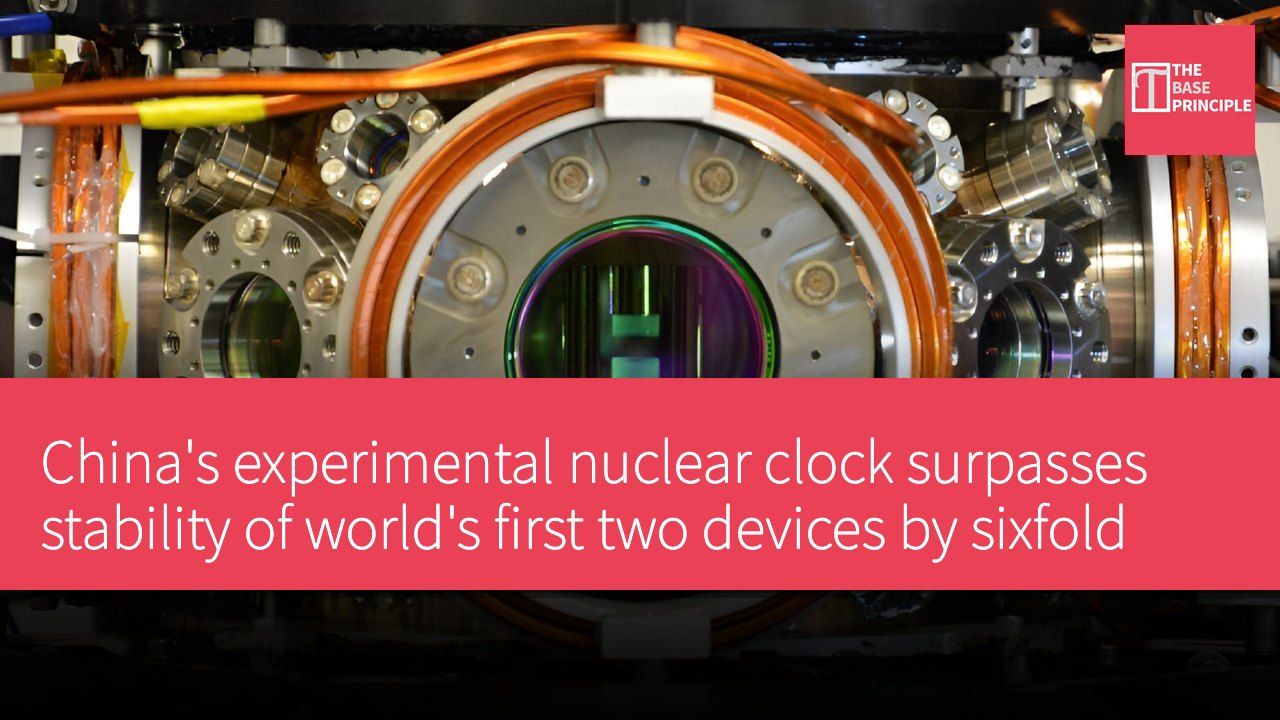
- China's nuclear clock surpasses stability of world's first two devices by sixfold.
- Tsinghua team's measurements show signal does not depend on special crystal.
- Nuclear clock's advantage lies in reducing external interference, improving accuracy.
- Researchers face material and engineering challenges, need to improve nuclear clock performance.
China's experimental nuclear clock has become the more stable option among the world's first two operational devices. Researchers at Tsinghua University found their clock's operational stability is roughly six times that of the rival system in Vienna. Both teams' clocks are based on thorium-229 nuclei trapped in crystals, a method that shifts the timekeeping mechanism from electrons to the nucleus. This result marks another step forward in a new category of precision timekeeping. Nuclear clocks could also provide physicists with a new way to test the fundamental laws of nature.
The Tsinghua team found that separately fabricated crystals produced nearly identical clock signals. Their measurements agreed to about three parts in 10 trillion. The finding indicates the signal does not rely on any one special crystal. The result also aligns with earlier measurements by researchers at JILA in Colorado. Ding Shiqian, who led the Tsinghua research, said the result strengthens the case for reproducible nuclear clocks. Researchers may eventually be able to turn the technology into a practical time standard.
Nuclear Clock Stability and Signal Characteristics
However, the clock has yet to reach the stability achieved by the best atomic clocks. Atomic clocks have defined precise timekeeping standards for the past 70 years. Atomic clocks track changes in electron energy states, while nuclear clocks monitor transitions within the nucleus. This difference may prove especially significant because electrons occupy a region far larger than the nucleus, which is far smaller and more tightly bound.
Thorium-229 offers a rare advantage for nuclear timekeeping. Its nucleus can respond to ultraviolet light, and its energy can be reached with current lasers. Most nuclei require higher energy to achieve similar transitions. Scientists successfully drove thorium-229 with a laser in 2024. The Tsinghua system generates ultraviolet light by heating germanium vapor to 1,112 degrees Fahrenheit. Researchers directed the beam at a small thorium-doped crystal, smaller than a grain of rice yet containing roughly 1 quadrillion thorium nuclei.
The Vienna nuclear clock apparatus, by contrast, used a crystal containing roughly 200 times as many thorium nuclei. Researchers compared its signal to an atomic clock via 6 miles of optical fiber. Vienna researchers found the clock's signal varied slightly depending on where the laser passed through the crystal. This fluctuation caused the device to keep a slightly different time each day. Improving the crystal could help researchers reduce this problem.
Potential Applications and Challenges of Nuclear Clocks
Nuclear clocks can probe physical phenomena because the nucleus's smaller scale may reduce interference from external electric and magnetic fields. Lower interference could ultimately help nuclear clocks achieve extremely high accuracy. Nuclear clocks could also help researchers investigate dark matter. Physicists can compare nuclear and atomic clocks to detect tiny variations in fundamental physical constants. Vienna researchers have already used their clock in a dark matter search that yielded no evidence of dark matter.
Researchers still face significant material and engineering challenges. Thorium-229 is extremely scarce, limiting experiments with new crystal designs. Better crystals could distribute thorium more uniformly and reduce internal defects. More powerful lasers could also improve clock performance. Currently, systems backed by atomic clocks rely on exceedingly precise timekeeping, including satellite navigation. Nuclear clocks would need to significantly improve performance to challenge these established systems. Researchers ultimately hope to move nuclear clocks beyond specialized laboratories, where compact designs could make ultra-precise timekeeping available for a wider range of applications.
The research was published in the journal Nature.
Future Development and Challenges of Nuclear Clock Technology
China's nuclear clock technology has demonstrated remarkable stability, which not only advances precision timekeeping but could also change how physics research is conducted. Because nuclear clocks can reduce external interference, they have future potential to play an important role in dark matter research and tests of fundamental physical constants. However, the scarcity of thorium-229 and material and engineering challenges remain major obstacles. If these challenges can be overcome, nuclear clocks could replace traditional atomic clocks in a wider range of applications, bringing new technological breakthroughs.