
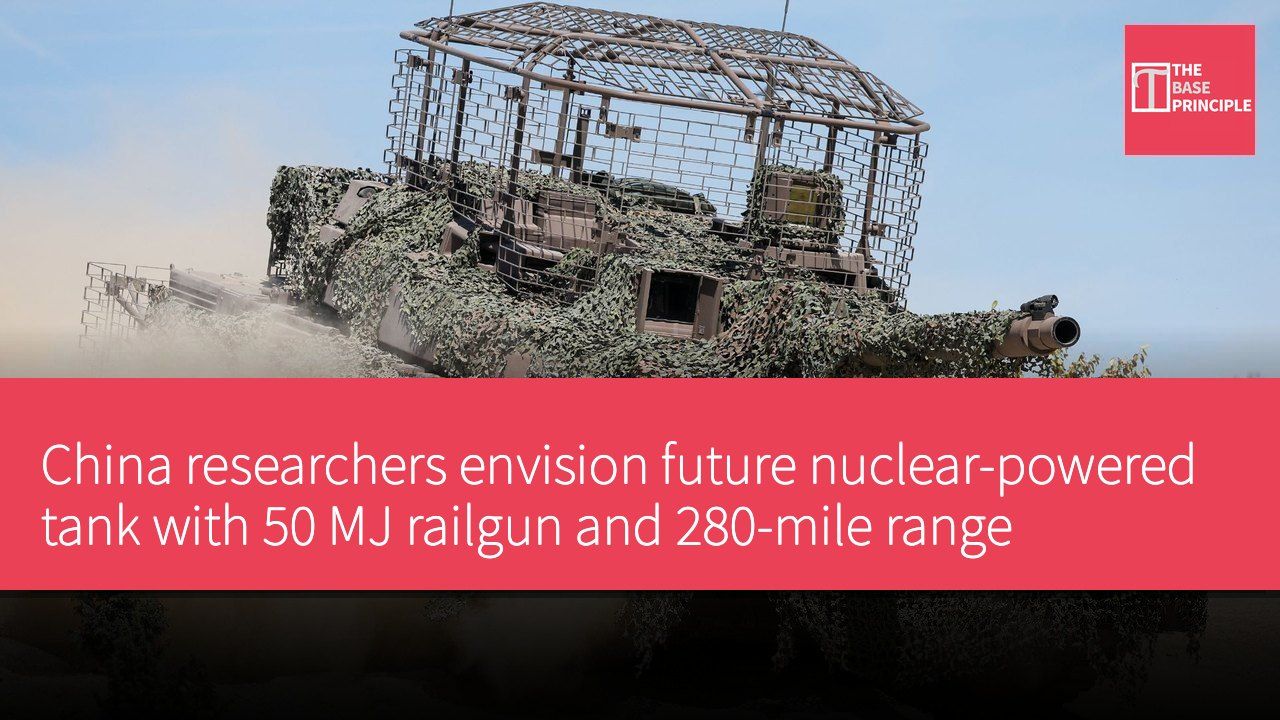
- China has proposed a design concept for a future nuclear-powered tank capable of generating its own electricity.
- The tank would mount a 50-megajoule railgun with a range of up to 280 miles.
- The final nuclear-propulsion stage is expected to be realized after 2045, using a compact reactor.
- Experts have questioned the practicality of a nuclear tank and suggested unmanned alternatives.
Chinese researchers have proposed a design concept for a future tank that could generate its own power and strike targets hundreds of miles away. The concept pairs a compact nuclear reactor with a 50-megajoule electromagnetic railgun. The proposed vehicle is expected to weigh about 60 tons and would be powered by a 10-megawatt-class small modular reactor. The researchers estimate that the railgun could accelerate projectiles to roughly 3.5 kilometers per second, giving it a theoretical range of about 280 miles.
Three steps to nuclear power
The three-stage nuclear roadmap begins with a conventional propulsion system: the initial tank variant would carry a 1,500-horsepower diesel generator. Its 10-megajoule railgun would have a range of roughly 93 miles, with supercapacitors and flywheels supplying extra energy for high-demand systems. The preliminary design would also feature 2-megajoule electromagnetic armor. The second-stage vehicle would raise weapon energy to 20 megajoules, with a projected range rising to about 186 miles. This version would carry 10-megajoule electromagnetic armor and roughly five tons of advanced energy storage. The researchers also envision using solid-state batteries and superconducting energy storage, with an onboard microgrid coordinating the vehicle's electrical systems.
The final stage would introduce nuclear propulsion after 2045, replacing the diesel generator with a compact reactor. The proposed reactor would use a lead-bismuth cooling system and produce 10 megawatts of thermal energy. The researchers hope to package the reactor into a volume of just two cubic meters, with radiation shielding weighing no more than three tons and a fuel-replacement interval of at least five years. These demands create a packaging challenge, as engineers must fit the reactor, shielding and power-conversion equipment inside a combat vehicle.
Reactor challenges
Thermal management is another challenge, since the reactor produces large amounts of heat that engineers must exhaust from the vehicle. The system must also operate in harsh off-road conditions, and the researchers say it should be able to withstand shocks of nearly 30g. The railgun's power demands are even more stringent: a 50-megajoule weapon must release enormous energy in an extremely short pulse. While a reactor can supply steady power, it cannot deliver an entire firing pulse instantaneously. Energy-storage systems must accumulate energy between shots, making the vehicle's capacitors, batteries and power electronics critical components.
Expert views on the nuclear tank
A nuclear reactor could provide continuous power for energy-hungry weapons and sensors, but it would also consume space and weight that would otherwise go to armor, ammunition and crew protection. A military equipment expert told the South China Morning Post that installing a fission reactor inside a battle tank remains impractical, citing the need for shielding and heat dissipation. The expert questioned the real-world value of unlimited electrical supply, since a tank would still require ammunition and maintenance. Survivability is another issue: if a manned vehicle carrying a reactor is destroyed, the risks extend beyond the loss of the platform. The expert recommended an unmanned alternative, where such a vehicle could draw on abundant electricity to drive lasers, microwave weapons, radar and electronic warfare systems, shifting the concept from a conventional tank to an autonomous, high-power battlefield platform.
The nuclear tank remains a long-term research concept, and its core challenge may be how to deliver enormous electrical pulses from within a mobile combat vehicle. The related research has been published in the peer-reviewed Chinese journal Acta Armamentarii.
Item Specification Weight Approximately 60 tons Power output 10 megawatts Railgun energy 50 megajoules Range Approximately 280 miles
Practicality and challenges of the nuclear-powered tank
The concept of a nuclear-powered tank represents a frontier exploration in military technology, yet its practicality remains in doubt. Experts note that installing a nuclear reactor inside a battle tank poses challenges such as shielding and heat dissipation. Moreover, although a nuclear reactor can deliver a stable power supply, a tank still depends on ammunition and maintenance, which calls into question the value of unlimited electricity. Possible future unmanned alternatives could help transform the concept into a more flexible, autonomous battlefield platform, pointing to a wider range of directions for technological development.