
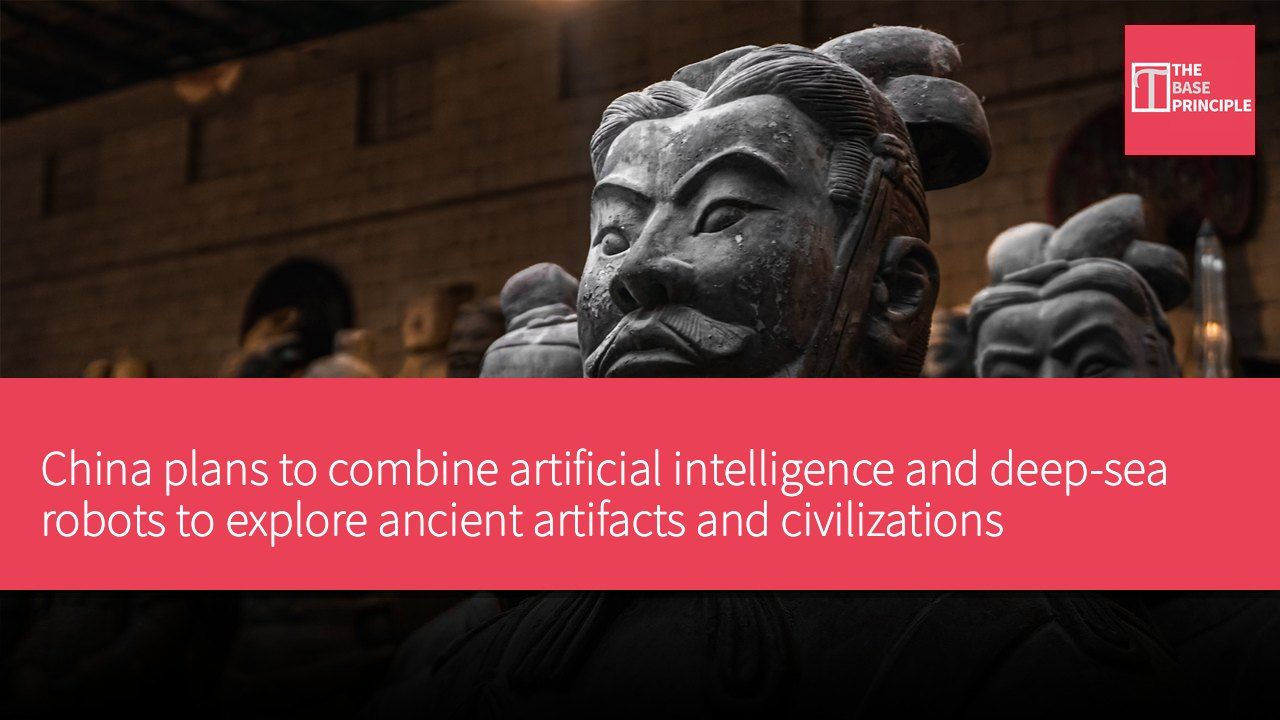
- China plans to combine artificial intelligence and deep-sea robots for archaeological exploration.
- The new initiative will utilize big data to accelerate the artifact reconstruction process.
- Archaeological research will cover ancient human migrations and the development of civilizations.
- International collaboration will extend to archaeological research in the Mediterranean and Middle East regions.
China plans to integrate artificial intelligence, ancient DNA analysis, and deep-sea robots to advance an ambitious archaeological blueprint aimed at uncovering lost artifacts, tracking ancient human migrations, and exploring prosperous civilizations from thousands of years ago. This five-year archaeological plan, covering 2026 to 2030, combines advanced technological initiatives with significant cultural goals, aiming to enhance China's influence in global historical understanding. This move is expected to transform how researchers investigate ancient societies, especially when historical evidence is sparse, submerged underwater, or scattered across vast geographical areas.
A major challenge in archaeology is how to interpret incomplete evidence. Excavations often uncover thousands of pottery shards, metal objects, and other artifacts, sometimes scattered over large areas. Identifying which fragments belong to the same item and reconstructing its original form can take years of painstaking work, from broken pottery to AI-based reconstructions. China's new plan proposes using big data and specialized AI models to accelerate this process. Researchers will develop systems capable of identifying individual fragments, matching physically compatible parts, and generating virtual reconstructions of damaged artifacts.
Using Technology to Accelerate Archaeological Research
These models can help identify connections that might be overlooked, without relying entirely on archaeologists to manually examine and compare each fragment. Virtual restoration also allows researchers to study the original appearance of items without altering the existing parts. The push for this technology extends to other areas of archaeology, with remote sensing helping to locate archaeological sites, while ancient DNA analysis can reveal relationships between different groups thousands of years ago.
Some of the most valuable archaeological discoveries are not underground but beneath the ocean. Ancient shipwrecks can preserve cargo, tools, and everyday items, providing exceptionally detailed snapshots of trade and life during specific historical periods. For example, China's Nanhai No. 1 shipwreck, a 12th-century merchant vessel that sank during the Song Dynasty, revealed extensive evidence of maritime trade. Researchers found that despite strict government restrictions on metal goods, smuggling occurred, suggesting authorities may have deliberately turned a blind eye to such activities.
International Collaboration to Explore Ancient Civilizations
Based on such discoveries, the 2026–2030 plan calls for the use of underwater robots, deep-diving equipment, and specialized tools to carefully excavate fragile remains on the seafloor. These technologies will assist archaeologists in investigating the trade routes of the ancient Maritime Silk Road and accessing underwater sites that are difficult or dangerous for human divers. China is also developing infrastructure to support this work, with plans to establish national-level archaeological laboratories and build a national marine archaeology museum in Qingdao.
Beyond artifacts and shipwrecks, this blueprint emphasizes the importance of understanding how ancient human groups emerged, migrated, and adapted to different environments. Researchers plan to investigate million-year-old archaeological sites in northern China to study how ancestral groups survived in the extreme conditions of the Tibetan Plateau and trace migrations across Eurasia. They will also examine the transition from the Paleolithic to the Neolithic, when human communities increasingly adopted agriculture and settled lifestyles.
The investigation will cover regions along the Yellow River, Yangtze River, and southern Lingnan, helping researchers understand the development and adaptation of different ancestral groups. Other focuses include studying the emergence of early states, imperial capitals, and major Bronze Age civilizations. The plan encompasses investigations into the Xia and Shang civilizations from 2000 BC to 1000 BC, as well as ongoing excavations at significant sites such as the Samsung mound in Sichuan, Erlitou in the Central Plain, and the late Shang capital of Yin Xu. Researchers will also examine major historical routes and infrastructure, including the Straight Road of the Qin Dynasty, the Great Wall, and the Grand Canal, along with archaeological sites in Xinjiang, Tibet, and the Tibetan Plateau.
This plan is not limited to China's borders. Researchers intend to expand international field studies in Austronesian-speaking regions, the Himalayas, and the historical Silk Road network. Joint projects with institutions in Egypt, Greece, Saudi Arabia, and Tunisia will focus on ancient civilizations, underwater survey equipment, deep-sea exploration, and cultural heritage preservation in the Mediterranean and Middle East. Comparative studies will also examine how Chinese civilization developed alongside other major world civilizations.
Ultimately, the blueprint from the National Cultural Heritage Administration aims to position Chinese archaeology as a more powerful international research force while advancing the country's cultural influence. The primary goal is to "enhance the influence of Chinese culture and establish China's discourse power and narrative system," the report states. However, AI reconstructions still rely on the quality and completeness of archaeological evidence, and underwater robots cannot eliminate the difficulties of excavating fragile sites. Ancient DNA analysis also requires sufficiently preserved biological materials. Whether these technologies can yield meaningful breakthroughs will depend on what researchers actually find and how reliably they interpret these discoveries.
Therefore, the next five years will test not only China's technological capabilities but also reveal how much new history can emerge when archaeology combines traditional excavation with artificial intelligence, genetics, and robotics.
Item Specifications Archaeological Plan Period 2026–2030 Key Technologies Artificial Intelligence, Ancient DNA Analysis, Underwater Robots Main Research Areas Ancient Artifacts, Maritime Silk Road, Ancient Human Migrations
The Global Impact and Challenges of China's Archaeological Plan
This plan not only showcases China's ambitions in the field of archaeology but also reflects the potential of technology in studying ancient civilizations. The combination of artificial intelligence and deep-sea robots could transform traditional archaeological methods, especially in the face of incomplete evidence. However, the effectiveness of these technologies still depends on the quality of archaeological evidence, and the next five years will be a significant test of China's archaeological technological capabilities. If successful, it could enhance China's position in global cultural heritage research.