
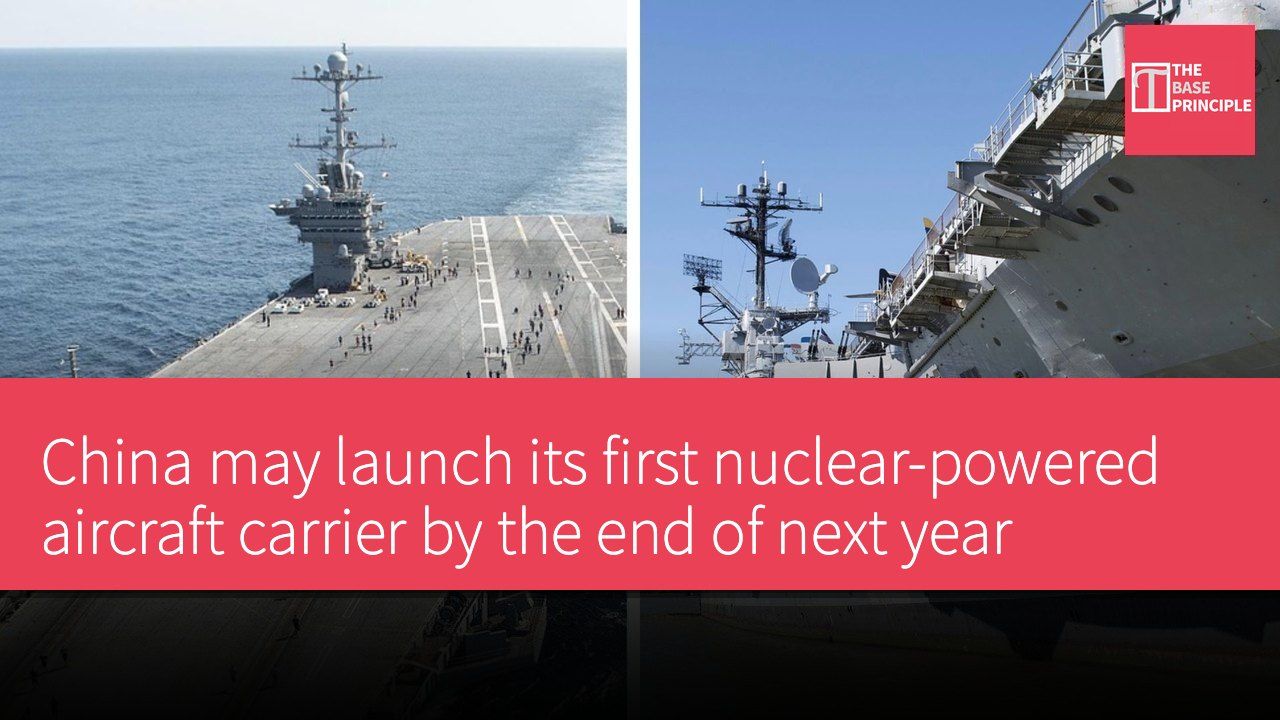
- China may launch its first nuclear-powered aircraft carrier by the end of next year.
- The construction progress of the Type 004 vessel demonstrates the speed and scale of China's maritime industry.
- The ship may be equipped with four fighter jet launch catapults, enhancing its strike capabilities.
- Nuclear propulsion will significantly enhance the capabilities of the Chinese Navy, reducing logistical constraints.
According to reports, China may unveil its new aircraft carrier by the end of next year. This vessel could be China's first aircraft carrier to utilize a nuclear power system. A report released by the Center for Strategic and International Studies (CSIS) reveals that recent satellite images show the ship is being rapidly constructed at the Dalian shipyard in northern China.
This vessel may be referred to as Type 004, and its construction progress is notably swift. CSIS points out that within less than two years, prefabricated hull components that first appeared at Dalian's dry dock have been assembled into a distinctly recognizable hull, showcasing the speed and scale of China's maritime industrial base. The report indicates that the hull length of the vessel is approximately 1,056 feet (322 meters) and its width is about 150 feet (46 meters), significantly larger than other surface combatants in the Chinese Navy.
Construction Progress of Type 004 Vessel
CSIS also stated that the hull configuration of the vessel clearly indicates it is not a civilian merchant ship and does not conform to the configurations of other vessels, such as very large container ships, cargo ships, or tankers. Furthermore, the hull shape and configuration of the vessel are similar to the characteristics of other Chinese aircraft carriers at comparable stages of construction.
The report also claims that the vessel may be equipped with four fighter jet launch catapults, which would enhance its strike capabilities in naval warfare. A larger flight deck and hangar will allow the vessel to accommodate more aircraft and improve the flexibility of flight operations, thereby enhancing China's ability to conduct sustained naval air operations over a wider area.
Significance of Nuclear Propulsion
However, the significance of Type 004 extends beyond its physical dimensions; its propulsion system may be its most important technical feature. The adoption of nuclear propulsion would represent a significant advancement in the capabilities of the Chinese Navy. Unlike conventionally powered aircraft carriers, nuclear-powered vessels do not require regular refueling, can maintain high speeds for extended periods, and reduce some logistical constraints associated with long-range deployments.
Nuclear propulsion provides substantial energy production capacity for advanced onboard systems, including electromagnetic aircraft launch technology. If nuclear propulsion is confirmed, Type 004 would mark a particularly important milestone, potentially enabling China to operate a more capable and sustainable aircraft carrier fleet. China recently launched the Fujian aircraft carrier, equipped with three electromagnetic catapults, a rapidly developed vessel weighing 80,000 tons. The introduction of the Fujian poses a significant threat to Western powers regarding the construction of new aircraft carriers. China's growing naval capabilities could alter the military calculus in the region, especially in areas already marked by maritime disputes and competing territorial claims.
Transformation and Challenges of the Chinese Navy
The construction of the Type 004 aircraft carrier and the adoption of a nuclear propulsion system signify an important transformation for the Chinese Navy in terms of technology and strategy. The long-duration, high-speed operational capability of nuclear-powered vessels will provide China with greater flexibility and sustainability in naval operations, enhancing not only its naval strength but also potentially altering the military balance in the Asia-Pacific region. As the Chinese Navy rapidly develops, Western countries face increasing strategic challenges, particularly in regions with frequent maritime disputes.