
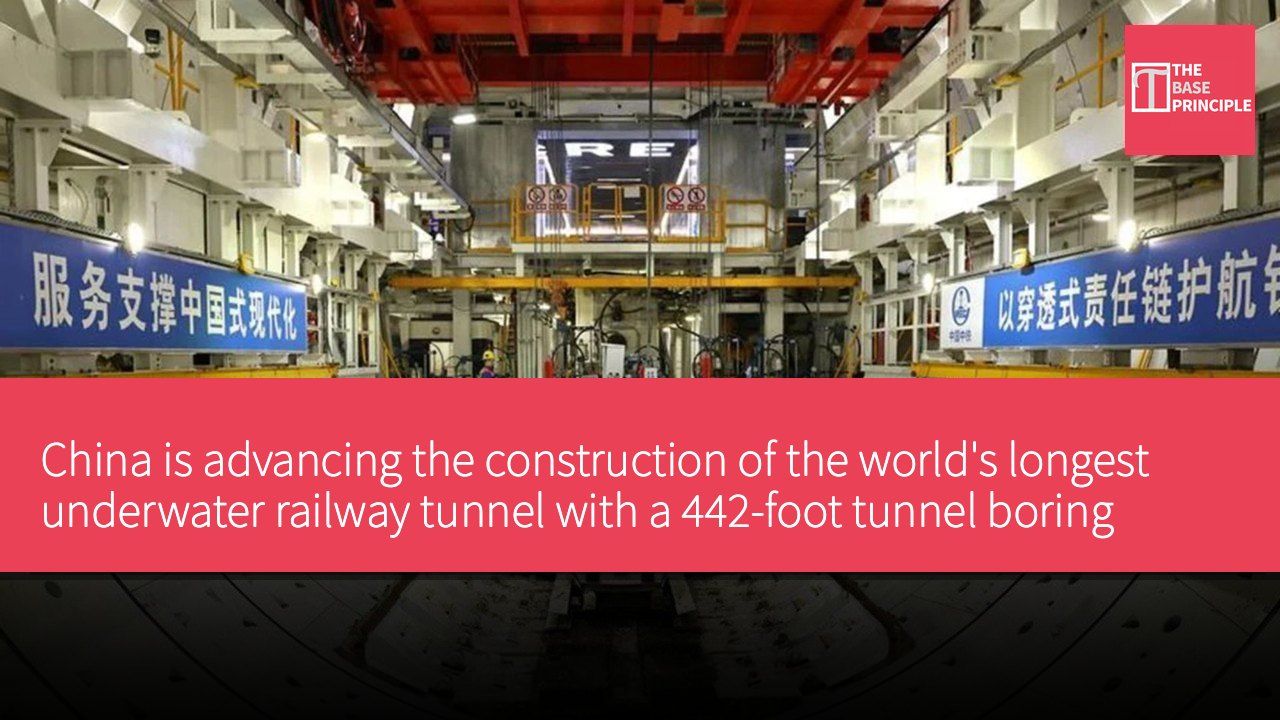
- China is constructing the world's longest underwater railway tunnel, named the Jintang Tunnel.
- The tunnel boring machine "Yongzhou" has completed approximately 83 percent of the excavation work.
- Frequent tool replacements are required due to cutter wear issues in challenging geological conditions.
- The Yongzhou railway is expected to open in 2028, shortening high-speed rail travel times.
Chinese operators are controlling a 442-foot (135-meter) tunnel boring machine from a ground control center about two miles away from the underwater excavation site, using cameras, sensors, and real-time alerts to monitor its progress. The machine, named "Yongzhou," is excavating the Jintang underwater tunnel that connects Ningbo and Zhoushan in Zhejiang Province. It has advanced over 13,123.3 feet (4,000 meters) from the Ningbo side, completing about 83 percent of the planned excavation. As it approaches a section about 305 feet (93 meters) beneath the seabed, the machine is facing increasingly challenging geological conditions.
Remote control allows operators to guide the excavation from the surface while personnel still supervise operations on the machine. The remote driving platform connects the ground control center with the machine's underground operating system. Cameras and sensors monitor the cutter head condition, tool wear, and excavation parameters, helping engineers identify issues as they arise. The monitoring system also sends alerts about abnormal cutter head torque, tunnel segment movement, and changes in hydraulic and sealing pressure directly to engineers' smartphones. "The intelligent system of this tunnel boring machine is more sensitive than humans," said Dong Bing, the chief mechanical engineer for the Yongzhou railway project.
Intelligent Monitoring of the Tunnel Boring Machine
The team is also working towards greater automation. Assistant tunnel boring machine operator Cheng Jie stated that future operators could initiate thrust by activating a command, after which the machine would operate according to preset parameters. This capability remains a development goal.
Challenges in Dealing with Harsh Geological Conditions
To cope with the project's harsh geological conditions, the excavation diameter of "Yongzhou" is 47.8 feet (14.57 meters) and is equipped with 308 cutters. It began operations in May 2024. On the Ningbo side of the route, nearly 70 percent of the geological conditions are poor, including full hard rock, soft soil, and sections where the cutter head encounters both materials simultaneously. Reports indicate that rock strength reaches 240 MPa, more than eight times that of ordinary concrete. These conditions have damaged cutting equipment, and approximately 4,000 cutters have already been replaced.
Previously, a cutter needed to be replaced for every meter of advancement, while in more difficult sections, a cutter might need to be replaced after just a few decimeters. Dong Bing indicated that the machine is expected to reach its deepest point by the end of 2026.
Maintaining the machine beneath the seabed requires workers to enter a high-pressure environment. A saturation pressure intervention system allows technicians to live in a pressurized chamber and work in shifts for up to 28 days to minimize repeated compression and decompression. In its first application, nine saturation divers worked in three teams for 22 days, replacing 46 cutters at a depth of about 75 meters beneath the seabed. Ultimately, "Yongzhou" will meet another boring machine, "Dinghai," advancing from Zhoushan, and the two machines will be dismantled inside the tunnel. The Jintang Tunnel is 10 miles (16.18 kilometers) long, with 6.96 miles (11.21 kilometers) being shield-driven sections.
The Yongzhou railway is expected to open in 2028, providing railway services to Zhoushan and reducing the high-speed rail travel time from Ningbo to Zhoushan to 26 minutes.
Item Specification Excavation Diameter 47.8 feet (14.57 meters) Number of Cutters 308 Rock Strength 240 MPa
Application of Automation Technology in Tunnel Construction
With the development of the "Yongzhou" tunnel boring machine, the application of remote control and automation technology demonstrates its importance in tunnel construction. These technologies not only enhance operational safety but also ensure project progress under challenging geological conditions. Tunnel construction often faces geological challenges, especially in underwater environments, where these challenges become even more complex. Through intelligent system monitoring, engineers can obtain critical data in real-time and respond quickly, which will contribute to the efficiency and safety of future tunnel construction.