
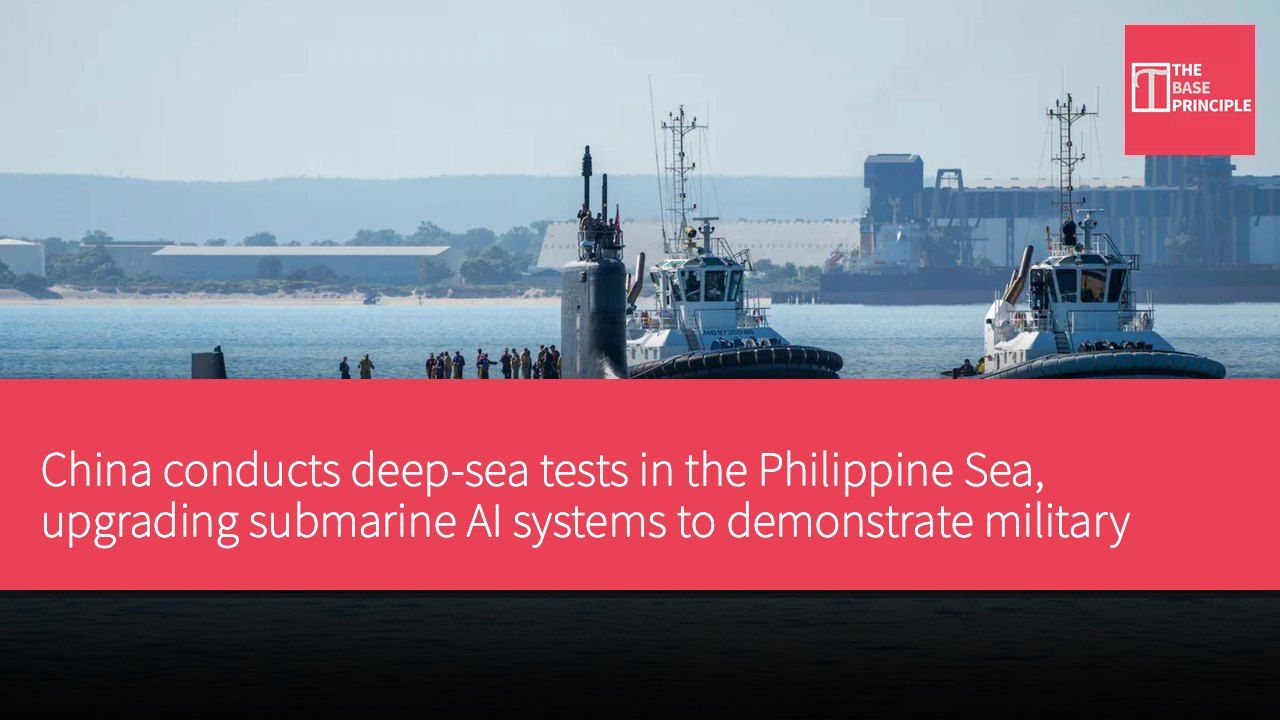
- China conducts deep-sea tests in the Philippine Sea, demonstrating the military potential of submarine AI systems.
- The upgraded AI system includes seabed analysis and fault diagnosis to assist diving operations.
- Artificial intelligence technology can accelerate fault identification, which is crucial for long-duration missions of nuclear submarines.
- The intelligent exploration system can identify marine life and may be applied to underwater military operations.
China has tested an upgraded artificial intelligence system in its manned submersible "Jiaolong," showcasing technology that could support military submarine operations in the future. The tests were conducted in the Philippine Trench in the western Pacific, where the submersible reached a depth of 7,056.9 meters (23,000 feet). The upgrades include an AI-driven seabed analysis system and a fault diagnosis system designed to assist operators during diving operations. This technology also aids in improving decision-making and emergency response capabilities for nuclear-powered submarines.
Upgrades to Submarine AI Systems
According to Chinese media reports, these tests were conducted following significant upgrades that introduced AI-driven seabed analysis and independent fault diagnosis systems to assist operators in underwater operations. The latest developments highlight the potential of artificial intelligence in supporting complex underwater missions, where autonomous analysis and rapid decision-making are particularly important due to limited communication with the outside world. One upgrade to "Jiaolong" is the fault diagnosis and decision support system, aimed at helping operators identify equipment issues and respond to faults during dives.
When a fault occurs, the system provides troubleshooting procedures, records of past faults, and relevant technical documentation. It covers critical equipment, including propulsion and control systems, helping operators identify potential issues and determine appropriate responses. This technology is designed to accelerate fault identification, assisting crew members in addressing equipment problems before they escalate into more serious issues. Such capabilities are particularly vital for nuclear-powered submarines executing long-duration underwater missions, where equipment failures require immediate attention, especially when crew members have limited access to external technical support.
AI-based predictive maintenance can also help identify abnormal operating conditions and potential component failures, allowing for the detection of issues before equipment malfunctions. Submarines face additional challenges as they cannot rely on continuous satellite communication while submerged. AI-assisted systems can help crew members process information, assess equipment status, and make decisions in situations with limited external support.
"Jiaolong" is also equipped with an intelligent exploration system developed using multimodal large AI models. This technology analyzes images captured by the submersible's cameras to identify marine life and seabed materials. Researchers trained the system using over 800,000 images of deep-sea organisms and underwater materials. It can interpret camera footage in real-time, automatically recording identified objects along with their geographic coordinates, observation times, and dive depths. The system also supports manual corrections when it misidentifies objects, allowing researchers to feed these corrections back into the model to enhance its recognition capabilities.
Applications of the Intelligent Exploration System
Users can interact with the software through dialogue to obtain information about underwater observations. The system can also reconstruct the submersible's dive trajectory, conduct three-dimensional analyses of marine species abundance, and generate reports on seabed ecosystems. Although the system was primarily developed for scientific exploration, similar AI technologies may also be applicable to underwater military operations. For instance, specialized models could be trained to analyze acoustic data collected by submarine sonar systems. These systems receive signals from vessels, marine life, and the surrounding underwater environment, making accurate classification crucial for identifying potential threats.
Experts indicate that artificial intelligence can help distinguish between different sources of underwater noise and flag abnormal acoustic patterns for operators. However, "Jiaolong's" current exploration system focuses on visual analysis rather than target identification based on military sonar. The specific depths at which its AI system was tested have not been disclosed. The latest tests also validated the reliability of "Jiaolong's" upgraded equipment, including the replacement of key components with domestically produced alternatives.
Impact of Submarine Technology Upgrades on Military Operations
China's upgrades in submarine technology, particularly the introduction of artificial intelligence systems, demonstrate their potential for military applications. These technologies not only enhance the operational efficiency of submarines but also provide rapid responses in the event of faults, ensuring mission success. As the importance of submarines in maritime operations continues to grow, these upgrades will contribute to enhancing the strategic capabilities of the Chinese Navy and gaining an advantage in future maritime conflicts.