
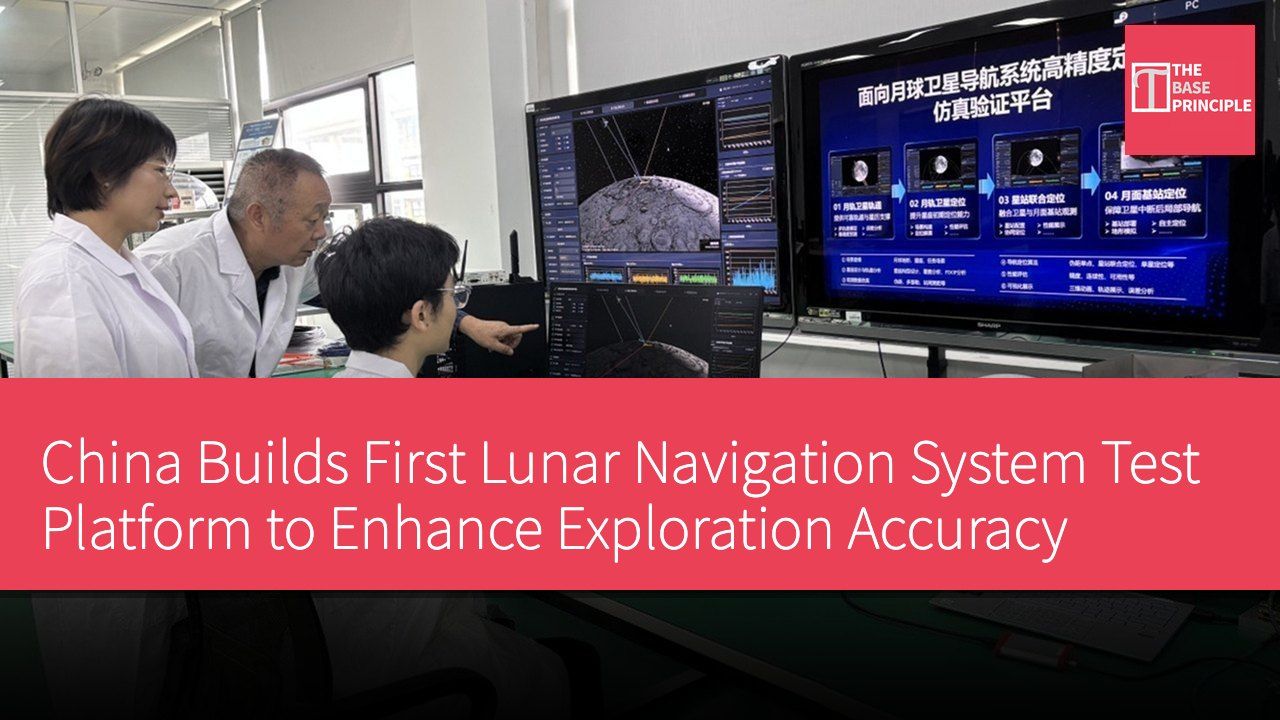
- China launches the world's first lunar navigation system test platform, filling a gap in precise positioning research.
- The platform simulates various system designs, enabling researchers to test lunar positioning accuracy.
- Untested navigation systems face significantly higher risks after deployment on the Moon.
- The platform supports verification of future navigation technologies and evaluation of engineering solutions.
China recently unveiled the world's first publicly accessible test platform for lunar navigation systems, allowing for verification before devices physically leave Earth. Led by Professor Xie Shengli from Guangdong University of Technology, this system fills a gap in precise lunar positioning research. Professor Li Zhenni from the School of Automation at Guangdong University of Technology stated that the platform serves as a virtual testing ground for lunar satellite navigation, simulating the operation of satellites, lunar ground stations, and probes to allow researchers to test whether different system designs can accurately determine positions on the Moon.
The Importance of Lunar Navigation Systems
Positioning, navigation, and timing services are crucial for any large-scale lunar mission. However, researchers lack a real lunar environment to verify new technologies, preventing them from conducting tests as they would on Earth. According to the research team, this gap urgently requires an integrated simulation platform. Untested navigation systems face significantly higher risks after actual deployment on the Moon. Guangdong University of Technology noted that this platform is the first in China and internationally to fill this gap, enabling full-system verification.
The platform provides end-to-end testing, covering scenario modeling, observation generation, algorithm verification, and performance evaluation, all integrated within a connected pipeline. The platform combines various technologies, including lunar orbit satellite trajectory simulation, satellite positioning, joint positioning of satellites and ground stations, and ground-based navigation signal positioning. Researchers can visualize results through 3D dynamic scene displays, monitor operations in real-time, and generate statistical analyses of positioning errors during testing.
Foundation for Future Lunar Exploration
This tool will support future research on navigation constellation design, verification of key lunar navigation technologies, and evaluation of engineering solutions still in development. Professor Xie stated that the platform was developed under the guidance of Chinese Academy of Engineering academician Wu Weiren, with the team working closely with the Deep Space Exploration Laboratory and relevant institutions within the China Aerospace Science and Technology Corporation.
China plans to complete the basic configuration of its International Lunar Research Station by 2035, with future operations expanding over hundreds of kilometers on the lunar surface. Activities of this scale will include surface exploration, multi-robot coordination, and simultaneous manned missions across vast lunar regions. Researchers stated that the platform's release comes as China and other nations accelerate the construction of sustained lunar exploration infrastructure, with navigation, positioning, and timing services being viewed as fundamental capabilities. Future lunar probes, robots, and manned missions will rely on these capabilities, as operational ranges expand beyond the currently explored limited areas.
Strategic Significance of the Lunar Navigation System Test Platform
As China plans to expand its lunar exploration activities in the future, establishing a reliable navigation system is crucial. The test platform not only fills a gap in existing technology but also reduces risks in future missions. Through simulation and verification, researchers can better design and implement lunar missions, which is particularly critical for the long-term construction of lunar bases and multi-robot coordinated operations. As international interest in lunar exploration continues to rise, the establishment of this platform will provide China with an advantage in the global competition for lunar exploration.