
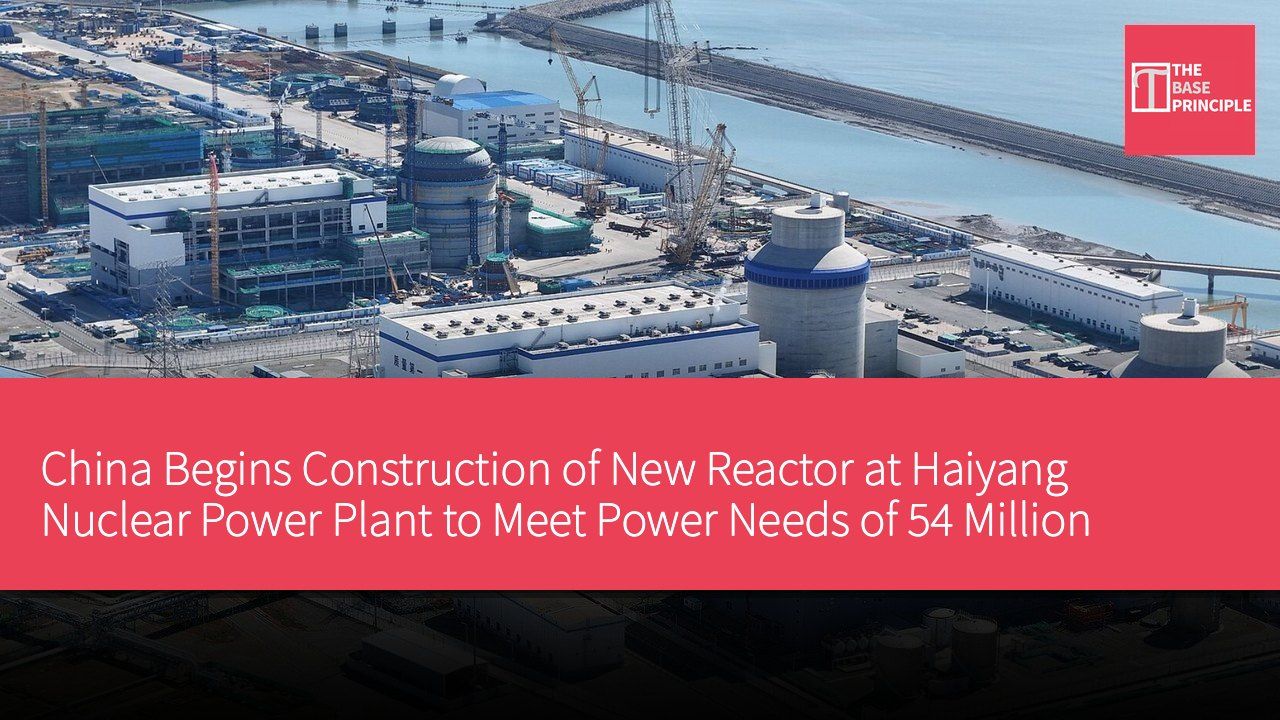
- The new reactor at the Haiyang Nuclear Power Plant has begun concrete pouring, marking the start of the construction phase.
- The construction of the fifth unit will complete the final phase of a regional energy hub, making it the largest nuclear power complex in the world.
- The expanded plant will provide regional heating for five county-level cities and reduce carbon dioxide emissions.
- China dominates nuclear power development, aiming to increase nuclear capacity to 200 million kilowatts by 2040.
Engineers in eastern China have started pouring concrete for a new reactor at the Haiyang Nuclear Power Plant. According to the state-owned developer State Power Investment Corporation (SPIC), the construction of the fifth unit marks the beginning of the third phase of the project in Shandong Province. This significant milestone comes just weeks after the plant overcame another technical hurdle. On August 13, the team for the recently completed third unit finished intensive thermal functional tests. Contractors passed the main cooling loop through 11 temperature stages without using actual uranium fuel. By pushing the system to normal operating heat and pressure, engineers verified the mechanical integrity and thermal stability of the circuit before commercial power generation begins.
Importance of the Fifth Unit Construction
Currently, attention at the site has shifted to the heavy civil engineering required for the fifth unit. Workers are constructing the nuclear island of the power plant, which houses the reactor core and major safety barriers. Workers must place thousands of tons of concrete in a continuous pouring process that lasts for several hours. This single thick raft slab anchors the entire main structure, protecting it from ground movements and potential seismic impacts. The fifth and sixth units form the final phase of an ambitious regional energy hub. Once all six reactors are operational, Haiyang will become the largest operational nuclear power complex in the world, entirely driven by passive pressurized water reactors.
These third-generation systems rely on basic physical properties such as gravity and natural convection to maintain core cooling in emergencies, eliminating the need for external backup power sources. Project director Liu Fei told national media that recent design revisions have increased the power rating of the latest unit to 1.3 million kilowatts per unit. At full capacity, the entire six-unit site will generate nearly 61 billion kilowatt-hours of electricity annually, enough to meet the annual electricity needs of approximately 54 million residents. Liu Fei stated, "Based on modern technology and experience, we have optimized the design to increase the rated power output of each unit to 1.3 million kilowatts, enabling the plant to provide clean heating for five county-level cities."
Environmental Benefits of Nuclear Power Expansion
In addition to providing electricity, this coastal power plant also serves as a major municipal heat source. The expanded plant will provide regional heating for five county-level cities, with a final plan to heat 1.5 million square meters of residential and commercial properties across 25 county-level cities. Utility managers estimate that the complete installation will save approximately 18.5 million tons of standard coal annually, avoiding over 48 million tons of carbon dioxide emissions. This expansion is part of an unprecedented national construction effort. China operates 64 nuclear reactors, second only to the United States. However, with an additional 56 units actively under construction or fully approved, China is poised to dominate global nuclear power development, expected to lead in operational capacity by 2030.
National planners aim to increase nuclear capacity to 200 million kilowatts by 2040, ultimately providing 18% of the national electricity supply by 2060 to support its carbon neutrality commitments.
Strategic Significance of China's Nuclear Power Development
The expansion of the Haiyang Nuclear Power Plant not only enhances China's nuclear energy capacity but also showcases its competitiveness in the global nuclear power sector. With the construction of multiple new units, China is moving towards becoming a leader in global nuclear power operational capacity. This expansion plan also supports the country's carbon neutrality commitments, demonstrating China's determination to address climate change. As nuclear energy becomes a primary source of clean energy, it will have profound implications for future energy structures and environmental protection.