
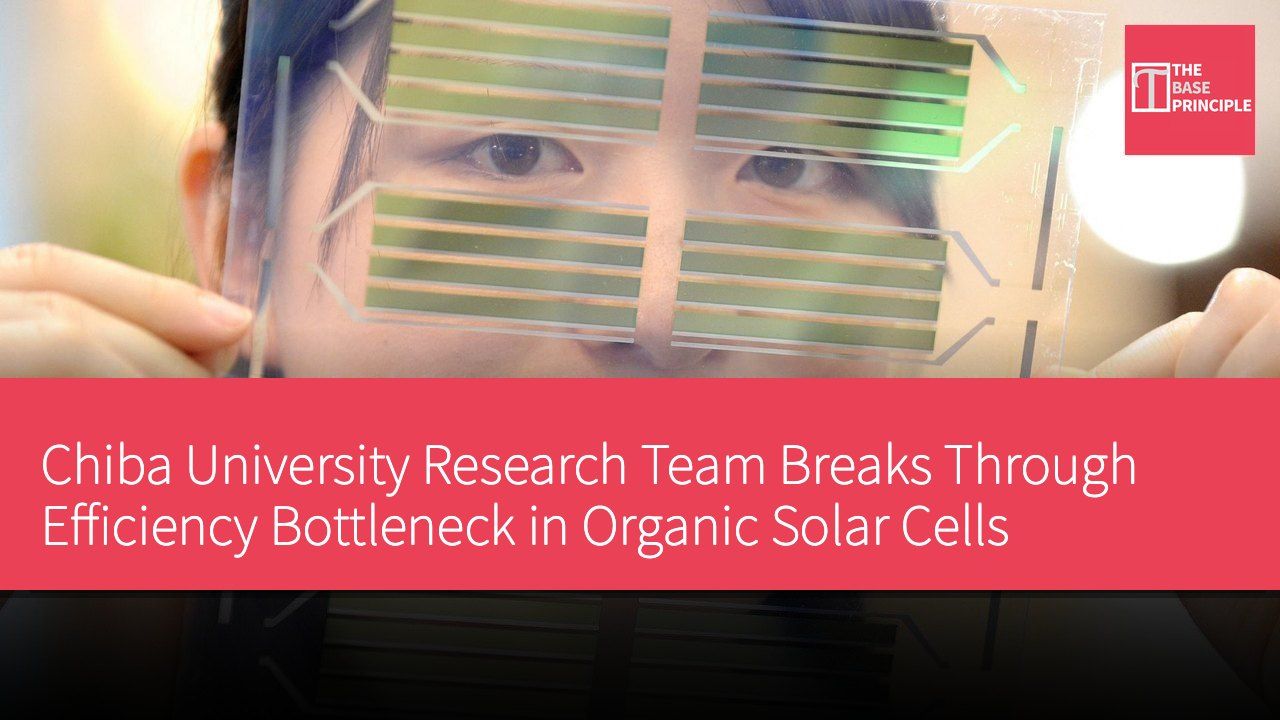
- The research team at Chiba University has broken through the efficiency bottleneck in organic solar cells.
- They discovered that using more rigid donor molecules can reduce radiative voltage losses.
- The new method enhances charge separation efficiency and reduces energy loss.
- The findings provide new guidance for developing more efficient organic solar cells.
For over sixty years, scientists have been working to develop organic solar cells as lightweight and flexible alternatives to traditional silicon panels. These carbon-based devices have the potential to power wearable electronics, curved surfaces, and solar windows. However, they have long struggled to match the efficiency of silicon, losing too much energy in the process of converting sunlight into electricity. Researchers at Chiba University in Japan have now found a way to reduce these losses without sacrificing the current generated by the cells.
The team identified a thermodynamic limit for photocurrent generation and noted that using more rigid donor molecules can lower radiative voltage losses. In multiple devices, these molecules reduced the effective charge transfer (CT) coupling energy to 0.1 electron volts (eV) or lower, bringing the energy of the CT state closer to that of fully separated charges, thereby improving charge separation efficiency. The researchers also found that when the optical gap of the donor is close to the energy of free charge carriers (i.e., the energy required to generate fully separated charges), the photocurrent can be sustained.
New Method Reduces Voltage Loss
In other words, the donor material absorbs enough energy from sunlight to release charges without unnecessarily wasting energy as heat. Solar cells operating near this thermodynamic limit can typically achieve higher energy conversion efficiencies.
Hirohiko Fukukawa, a professor at Chiba University's Frontier Science Center, stated, "In the long run, such devices could make it more practical to harvest solar energy in lightweight, flexible, and space-constrained applications, which are quite challenging for traditional silicon modules."
Experimental Design of the Research Findings
Although organic solar cells in laboratories have now surpassed 20% energy conversion efficiency, researchers continue to seek ways to reduce voltage losses while maintaining stable photocurrent. To reveal this relationship, the researchers constructed simplified organic solar cells with separate donor and acceptor layers. The donor layer absorbs visible light, while the transparent acceptor layer allows sunlight to pass through. They paired five donor materials with varying molecular structures and rigidity with 15 acceptor materials with electron affinities ranging from 2.0 to 3.1 eV.
The research team utilized ultraviolet photoelectron spectroscopy and low-energy inverse photoelectron spectroscopy to measure the ionization energy of the donors and the electron affinity of the acceptors in solid state. These methods allowed them to determine the energy levels of the materials under conditions closer to those of an operating solar cell. The researchers noted that CT coupling energy does not solely determine performance; it is also influenced by factors such as the distance over which charges diffuse between molecules, the stacking arrangement of donor and acceptor molecules, and the electrostatic environment at their interface. They stated that these findings provide a new design guidance for developing more efficient organic solar cells.
These research findings were recently published in the journal Advanced Materials.
Advancements in Organic Solar Cell Technology
The development of organic solar cells is significant for renewable energy applications, particularly in wearable devices and flexible applications. Research from Chiba University shows that by improving the design of donor materials, voltage losses can be effectively reduced and energy conversion efficiency increased, enhancing the competitiveness of organic solar cells in the market. As research progresses, these technological advancements may drive the commercialization of organic solar cells, promoting their widespread use in everyday life.